

We live in a stressful world.
No one argues with this. Ask pretty much anyone if they’re stressed… and I guarantee the answer will be yes.
But most people have almost no conception of just how much stress they’re really under. So much of it is invisible. Or it’s become so common we simply take it for granted. It’s become the new normal.
I teach my patients a simple model.
“Your body is designed to be healthy. It’s meant to work well and feel great. What interferes with that is stress. That stress comes in three forms: Structural, Chemical and Emotional.”
Our levels of all 3 types of stress have exploded in the modern world, accelerating far more rapidly than our bodies and brains can possibly keep up with.
Structurally:
We were designed to walk 8-12 miles per day, barefoot, on natural surfaces. We were designed for almost constant and varied physical activity.
Instead, we sit far more than ever. We stare at screens for hours. And when we do occasionally walk, we wear restrictive shoes and walk on flat, featureless, minimal-stimulation surfaces.
Emotionally:
We were designed to live in small groups with strong, interdependent personal relationships and constant human contact.
Instead, we feel more and more disconnected. We communicate increasingly through screens. We’re bombarded all day long by problems from all around the world, that we have no control over. And we’re constantly pressured to live up to the fantasy lives on our screens that seem so much more perfect than our own.
Chemically:
We were designed for fresh air, fresh water and fresh food… animal and vegetable. That’s it.
This is arguably the category of stress where we have faced the most rapid, massive tsunami of change. Almost every minute of every day we are bombarded by literally thousands of chemicals that never existed in nature… and our bodies have no idea what to do with them.
And the rate is accelerating.
According to the UN Environment Program’s review of worldwide chemical inventories, there are over 350,000 chemicals registered globally… and this number increases by an estimated 1500-2500 every year.
We have pesticides, herbicides, microplastics, xenoestrogens, GMOs, nanoparticles, forever chemicals, pharmaceuticals, preservatives, heavy metals, hydrocarbons, hormone disruptors… the list goes on and on and on.
To share just 1 small (but scary) example I read about recently…
It’s estimated that we consume about a credit card’s worth of PFAS (plastic forever-chemicals) every week through our food, water and the air we breathe. These chemicals have been detected at the summit of Mount Everest, in the depths of the Marianas Trench and in rainwater on every continent, including Antarctica.
In 2024 researchers discovered there are seven grams of plastic trapped inside each of our brains– the equivalent of a plastic spoon.
I could write a whole book on this topic… in fact many have already been written. I’d recommend Slow Death by Rubber Duck and Toxin Toxout by Rick Smith and Bruce Laurie as a great introduction
However, my point is not to depress you with the overwhelming extent of our chemical exposure.
My point is this. You are exposed to these chemicals daily. There’s no avoiding it. And all those chemicals have to go somewhere.
So where do they go?
Ideally, straight out of your body, as quickly and harmlessly as possible.
In order for that to happen, they need to get from wherever they’ve been absorbed or stored, to the liver, where they’re broken down for excretion.
The system that makes that happen is the lymphatic system.
I believe this is one of the most overlooked systems in healthcare.
Yet it’s one of the most critical for survival in the modern world.
When that transport system from our cells to our liver isn’t flowing freely, our cells end up swimming in a sea of toxic waste. I tell my patients it’s like when the garbos go on strike… the rubbish just builds up in the streets.
(For my US friends who may not speak Australian, garbo is our affectionate term for the garbage collectors who pick up the rubbish bins in front of our houses each week.)
I was taught almost nothing about the lymphatic system in my university training. It barely rated a mention. And so I did nothing to specifically address it in my practice for years.
Then I attended a series of courses with Dr. Frank Marcellino. Dr. Frank is a passionate historian of chiropractic who has collected an incredible library of hard-to-find chiropractic texts.
From his extensive reading and research, he has developed a whole system of treatment that was unlike anything else I’d learned in all my training. This included corrections for the lymphatic system, specifically for the cisterna chyli and the thoracic ducts.
When I implemented these into my treatment sessions, amazing things happened. Stubborn, persistent issues began to resolve. My results across the board improved. People got better, faster.
It led me on a journey of discovery to understand the lymphatic system and why it seemed to be having such a profound impact on the health of my patients.
And years later, when I began to uncover the mechanisms behind Better Balance Orthotics, one of the final pieces fell into place…
But before we get to that…
First let’s cover some lymphatic system basics.
This system includes the fluid that’s not in our veins or arteries. It’s the interstitial fluid that constantly surrounds and bathes all of our cells.
As I mentioned before, it’s a transport system- our waste disposal system.
Cells excrete their metabolic waste and toxic byproducts into this fluid. The more toxic we are, the more fluid is required to cope with this load. This is why people often feel bloated and swollen after a big night of drinking.
Unlike our cardiovascular system, the lymphatic system doesn’t have its own dedicated pump. There is no lymphatic “heart.”
Instead, it relies on muscle contraction to do the pumping.
Which means if you don’t move your muscles enough, you don’t adequately pump your lymphatic fluid. And so it just sits there, a stagnant, toxic swamp of chemicals.
That’s our first problem…
We simply don’t move enough.
Studies show that hunter-gatherers typically walked 8-12 miles per day, 7 days per week!
No one I know does that.
Walking is an ideal exercise for the lymphatic system. The main muscular pump that drives the whole system is our calf muscles. Which makes sense- if you want to pump fluid up against gravity, place the main pump at the bottom.
This is why a common sign of lymphatic dysfunction is swollen ankles.
The standard treatment for this is elevation and compression. Which can be helpful, but as is so often the case, it’s addressing the symptom, not the cause.
I find myself applying at least one of the lymphatic pumps that Dr. Frank taught me in almost every single treatment session, every day in clinic.
That’s how common lymphatic congestion is… it’s almost universal.
No one moves enough.
The next key factor is the sheer volume of toxins we are exposed to. We covered this already, so I won’t belabour the point, but it does bear briefly repeating.
The toxic burden we are all dealing with has gone up 1000-fold over the last few decades… and the bulk of that has to pass through our lymphatic system.
Another aspect that contributes to the issue is chronic dehydration. Most of us don’t drink enough water.
One other point worth mentioning here-
The lymphatic system doesn’t just deal with toxins. It’s also vital for our immune system. White blood cells use it to migrate out of our circulatory system to reach sites of infection or damage. It’s how we clean up viral debris, dead cellular debris and inflammation. That’s why you get swollen lymph nodes when you’re sick.
The next major factor that sabotages our lymphatic function is postural. Specifically slumped shoulders.
The entire lymphatic system drains back into the venous system at only two places- our thoracic duct on the left and our right lymphatic duct. These are located behind the pec minor muscles, just in front of each shoulder.
When these are blocked, the whole system comes to a standstill.
It’s like a six- lane highway that narrows down to one single lane due to roadworks or an accident. It’s a disaster.
How commonly does this occur?
Here’s my clinical challenge for you tomorrow… notice how many of the first 10 patients you see have some degree of rounding/slumping/internal rotation of the shoulders.
I’ll bet it’s 10/10.
That’s how common this is.
That’s why I use Dr. Frank’s lymphatic pumping techniques on almost every patient.
Sometimes it’s obvious- the patient is clearly slumped forwards, with a rounded spine and clear forward head posture.
But other times it’s much more subtle. It doesn’t have to be dramatic. Even a slight forward shift of one shoulder begins to interfere with drainage.
Even before you look at their shoulders, you can usually pick which side is the issue based on the patients’ symptoms and presentation.
If the right shoulder is anterior, you will typically see head and neck symptoms.
Chronic sinus issues. Post nasal drip. Blocked ears. Acne and skin breakouts. Headaches. Any right arm symptom.
This is because the right lymphatic duct drains the right side of the head and right arm.
If the left shoulder is sitting even slightly anterior, the symptoms could include pain, inflammation, swelling or nerve compression almost anywhere in the body.
This is because the Thoracic Duct on the left drains the whole rest of the body.

Of course, a patient could also have both (many do.)
And these are just the physical, mechanical issues caused by fluid pressure and poor drainage.
Remember, the bigger picture is the effects on our immune system and ability to detoxify.
A quick Google search returns the following as well-established effects of lymphatic congestion:
- Swelling
- Heaviness, especially in the arms or legs. Also fatigue with prolonged standing.
- Tightness, reduced flexibility, reduced range of motion
- Thickened skin, skin changes or increased susceptibility to skin infections
- Recurrent infections (not just skin)
- Slow wound healing
- Dull aching, pressure sensations, tenderness or general discomfort
- Fatigue, low energy, feeling sluggish, low exercise tolerance
These symptoms are also listed but described as having weaker evidence:
- Brain fog
- Generalised inflammation
- Weight gain
- Headaches
- Poor sleep
- Digestive issues
- Toxin build up
I can tell you from my personal clinical experience working directly with lymphatic issues over the last 10-15 years (since doing Dr. Frank’s course…)
I have seen all of these occur commonly in cases of lymphatic dysfunction, and I have seen all of them improve when the appropriate corrections and interventions were applied.
How many of your patients did I just describe?
To say this is incredibly common would be a vast understatement.
So how can you help these people (short of flying to Australia and taking Dr. Frank’s course?)
Prescribing more movement and more hydration is a great start.
So is reducing toxin exposure, although as we discussed, it is impossible to eliminate completely in the modern world.
Strategies like dry brushing and various rubbing, tapping and movement practices can help. A friend of mine, Dr Caitlin Czezowski blew up on Instagram to over 1.3 million followers by demonstrating daily lymphatic tips… if you want to check her out it’s doc.talks.detox.
To me this is another indication of how many people are struggling with the symptoms listed above and looking for solutions.
I often get asked about lymphatic drainage massage, and while it sounds good in theory…
In practice I have rarely seen it significantly move the needle. What I have observed is that practitioners are often pushing the congestion around from one area to another, but usually not totally clearing it.
Massage is too passive.
Really clearing lymphatic congestion requires pumping.
The techniques I learned from Dr. Frank are active pumping techniques.
The homework I prescribe for patients are active pumping exercises.
Remember, what naturally moves lymph around the body is pumping via muscle contraction.
The good news is, when it comes to that… you already have a secret weapon up your sleeve. And it’s dynamite for improving lymphatic issues.
Better Balance Orthotics are a gamechanger when it comes to improving lymphatic flow.
Here’s why:
They directly and consistently improve two of the major factors we’ve discussed…
1/ Posture- specifically Forward Head Posture and shoulder slumping [FBC#7]
2/ Muscle activation – specifically calf muscle activation [FBC#24]
Let’s take the second one first. We talked last week about the Superficial Back Line and how it transfers ground reaction forces through the plantar fascia, up through the calves and hamstrings. It literally activates the primary muscular pump for the lymphatic system.
People rarely experience discomfort as they wear in their Better Balance Orthotics. For most of my patients I tell them to just chuck them in their shoes and go for it.
But if they do experience any sort of discomfort, it’s almost always in their calf muscles.
I believe many people’s calf muscles are weak and dysfunctional from years of walking on flat surfaces. This isn’t just a mechanical problem for their knees and ankles…
It means that their primary lymphatic pump is barely pumping… leading to stagnation, fatigue and all the symptoms listed above.
So when we stimulate their feet with Better Balance Orthotics, we wake up their calves… which occasionally causes them to complain a little!
I tell them it’s just like starting a new exercise program at the gym…. sometimes the muscles take a few days to adapt.
Last week we covered how forefoot splay is the “ignition switch” for activation of the posterior chain. This week we’ve uncovered how the calf muscles are the pump for the lymphatic system.
Is it starting to sink in just how many important physiological functions begin with foot function?
The next big factor for the lymphatic system is the consistent postural improvements we see when patients start wearing Better Balance Orthotics. We dived into the research in [FBC#7- More than a pain in the neck]
One of the biggest postural adaptations we see to poor foot function is Forward Head Posture (FHP) and internally rotated shoulders. Rather than go over it all again, here’s a few quick visual examples…
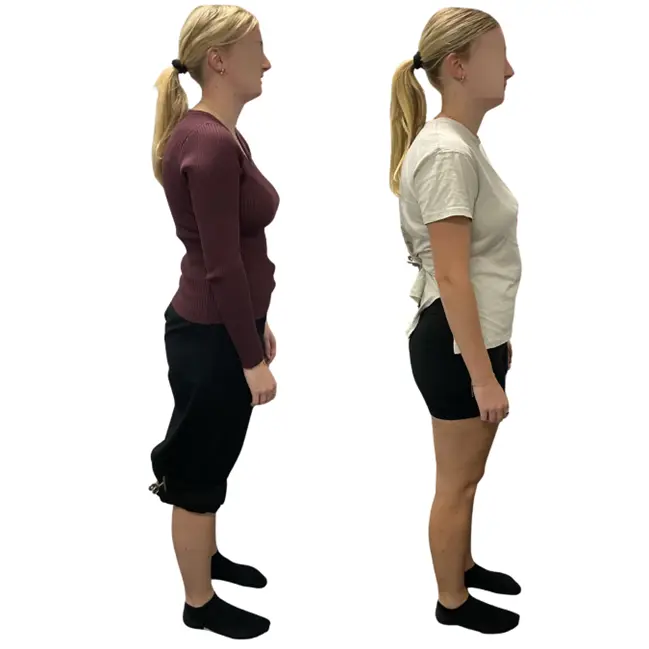
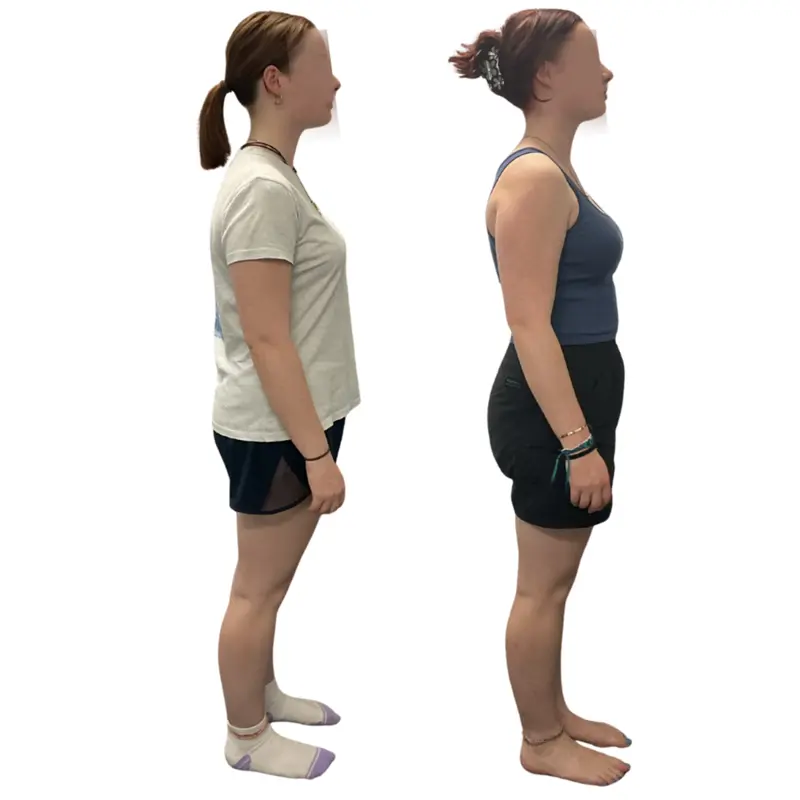
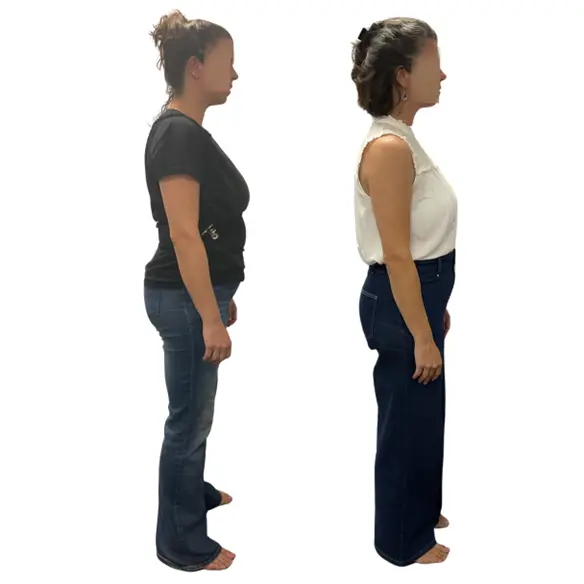
In every one of these, notice how the FHP has reduced and the shoulders have shifted back. The implications of this are far more than just biomechanical. From a lymphatic point of view these changes are massively significant.
I believe this potentially one of the biggest (and most overlooked) benefits of wearing these orthotics. I think it’s also why so many people report having more energy. It’s not just because they’re moving more efficiently… it’s also because they’re draining and detoxifying more efficiently.
(Not to mention the improvements in all the other lymphatic congestion symptoms listed above!)
So to revisit what I teach every patient in my clinic:
“Your body is designed to be healthy. It’s meant to work well and feel great. What interferes with that is stress. That stress comes in three forms: Structural, Chemical and Emotional.”
We’ve seen in almost every issue of The Foot-Brain Connection how BBO impact structure.
In [FBC#22- Posture] we looked at the research on how improving posture has significant emotional benefits.
And today we’ve looked at a powerful mechanism through which wearing BBO helps patients reduce their toxic chemical burden by improving lymphatic drainage.
When I first started Better Balance Orthotics, I saw these orthotics as a niche product for addressing scoliosis. I had no understanding that they were actually one of the single most powerful, easiest interventions available for addressing all three sides of the Triad of Stress.
I no longer believe these are a “nice to have” in your practice.
I actually believe this is about raising the standard of care across our profession.
I realise that’s a pretty bold statement… but I believe it’s 100% true. If your patients are not wearing Better Balance Orthotics…
They’re not as healthy as they could be.
And that’s something I know we’re all committed to improving.
Cheers,
