

I used to hate seeing pictures or video of myself… especially if it happened to catch me from the side. My head was always dropped forward and my shoulders were hunched over.
It didn’t matter how much I tried to correct it, or how many times my Mum yelled at me to stand up straight…
Nothing ever changed it.
If anything, as I got older it just got worse (and more embarrassing.)
How many of your patients display this same posture?
I bet it’s almost every single one.
In fact, I’d bet you’ve had one of those moments where you caught sight of yourself in a mirror or on film and noticed the same thing.
In recent years the trendy name for this phenomenon has become Tech Neck…
There’s no doubt overuse of tech is a problem… just take a look around any bus, train or even loungeroom these days and you’ll see bent heads everywhere.
But I’ve observed this pattern in practice for decades… way before staring at a phone all day was a thing. And growing up as a kid, the only handheld electronic device was a calculator… and that definitely wasn’t to blame for my slouchy posture!
So, if this has been going on forever, and pretty much everyone seems to have it… is it really that much of a problem?
Turns out the answer is yes.
A recent Systematic Review, published in October 2022, looked at the Effect of Forward Head Posture (FHP) on:
· Balance
· Stability
· Postural control
· Gait
· Proprioception
The relationship between forward head posture, postural control and gait: A systematic review
(Big thanks to Dr Jeff Langmaid at theevidencebasedchiropractor.com for bringing this study to my attention… if you haven’t checked out Jeff’s stuff, it’s worth a look.)
What it found was that FHP is important for much more than just neck pain, headaches and looking good in photos!
The review included 19 studies. It showed:
Consistent Evidence that people with FHP had significant alterations in:
· Limits of Stability
· Performance-Based Balance
· Cervical Proprioception.
In other words, these people have worse balance and a greater risk of falls. They are less able to shift their weight safely… like say, bending to reach for something, or even just shifting from foot to foot as they walk.
They perform worse on tests and activities that require balance (in other words, the actual real-world things we do every day.)
They have less idea where their head is in space… which means they have less ability to set up their posture appropriately or deal with gravity.
(This fits with my experience… I never felt like I was sticking my head forward. That’s why it’s often an unpleasant shock to see yourself in photos or the mirror.)
They also have poorer gait and movement efficiency. One of the studies included specifically measured the relationship between children with FHP and Ground Reaction Forces (GRF.) These are the forces generated every time we take a step. For a deep dive on this, check out my previous email The real cause of every acute (and chronic) injury.
Controversial evidence (ie. shown in some of the included studies but not all of them) existed for a relationship of FHP with Static Balance and Postural Stability Control.
This was an interesting nuance for me- the difference between Static Balance and Performance-Based Balance. I shared in The Foot-Brain Connection Issue #2 – This Changed My Treatment Approach Forever how we use a vestibular plate in my clinic to measure different aspects of balance.
However, all the tests we perform are done standing still… in other words they are measuring Static Balance, not Performance-Based Balance.
But which one do you think is more important in day-to-day life?
It made me realise that even with all our testing, we’ve been missing vital information. Someone could perform well on all 4 standing tests we measure…
But still be vulnerable when walking, running, moving or playing sports… in other words, simply living their life!
These are all functional measures, which is something we strive to educate patients about, rather than just focusing on pain. Of course, many people first seek our care to resolve a pain or symptom of some sort… but we understand that’s just the tip of the iceberg.
Getting rid of pain is great…
But when we start seeing functional improvements, we know we’re having a real, lasting impact on that person’s quality and even longevity of life.
By the way, strong research exists linking FHP to pain as well. A research review paper from 2019 looked at 15 studies and found that adults with neck pain show increased FHP when compared to asymptomatic adults and that FHP is significantly correlated with neck pain measures in adults and older adults.
The Relationship Between Forward Head Posture and Neck Pain: a Systematic Review and Meta-Analysis
The paper didn’t find the same link in adolescents… but of course, adolescents with FHP grow into adults with FHP… if they hadn’t already developed pain, I think they were on their way there.
So, if FHP is such a problem, in terms of Pain, Balance, Posture and Function, what can we do to improve it?
As chiropractors we have many tools to achieve this…
Adjustments, soft tissue procedures, rehab exercises, spinal orthotic devices such as the Denneroll…
These are all powerful interventions that can produce great results.
However, I believe there is one window of clinical opportunity, that massively influences FHP outcomes, that is being missed by almost all chiropractors (and other health professionals.)
That window is addressing your patients’ feet.
Even if you’re currently utilising Better Balance Orthotics, and adjusting feet in your practice, I bet there’s still a bunch of patients who could benefit even more from including BBO in their care plan… (I’m not pointing any fingers here… this still happens occasionally even in my own clinic!)
Let me show you a few examples of the difference in FHP we see in patients who wear Better Balance Orthotics.

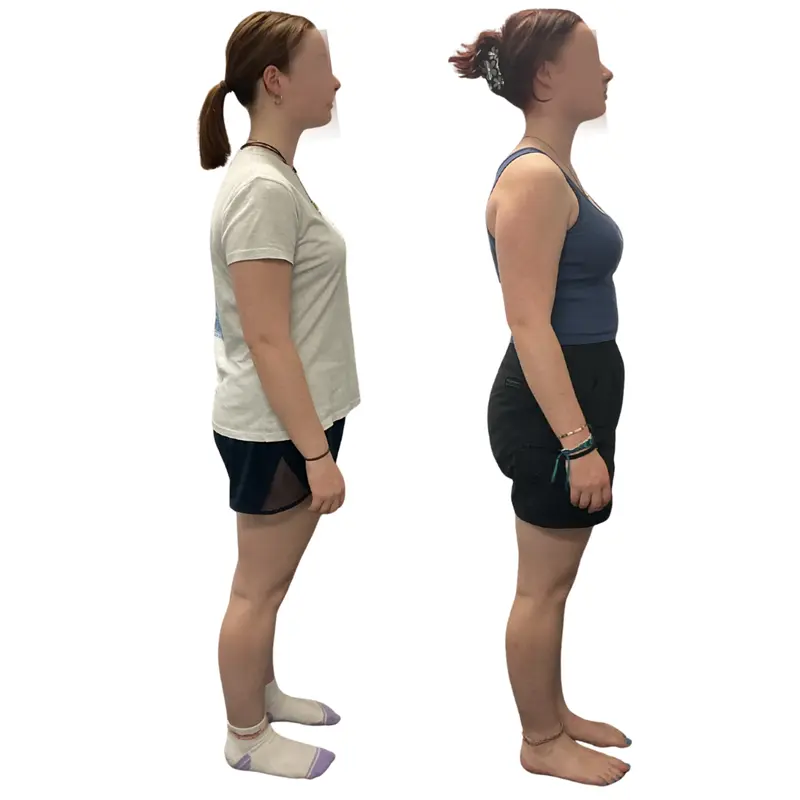

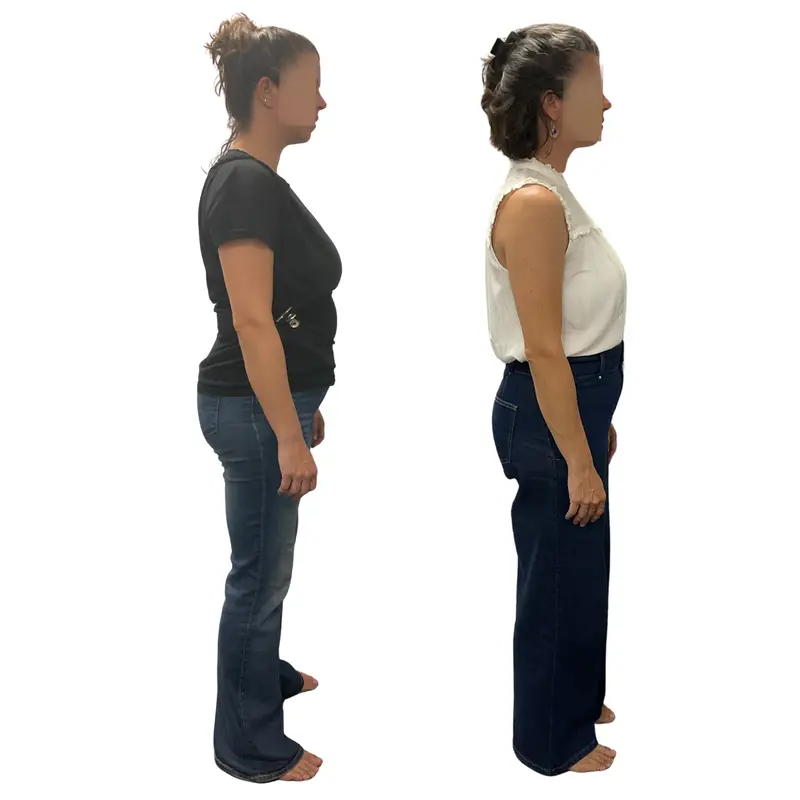
Reduction in Forward Head Posture is one of the most consistent changes we see when people wear Better Balance Orthotics.
It’s a significant change, and it usually happens fast… often within the first 12 weeks (that’s when we first retake these posture photos.) It also continues to improve over time, as you can see from some of these examples.
(By the way, these are just a few examples… we have many more on file in the clinic.)
I was talking to a doc at the UAC meeting last week and he shared something insightful…
He said he used to use the Insight Scanner in his reports, but that was just a generic picture, patients didn’t really see themselves in it. Even with x-rays… they know it’s them… but it’s not what they see in the mirror every day.
But when they see an actual photo of themselves… that’s powerful.
They really connect with it… and it motivates them to stay committed to their health and to their care.
How can we explain these results?
How does placing a device to stimulate the nerves, muscles and fascia of the feet in someone’s shoe produce such dramatic improvements in FHP?
The way I explain it to my patients is…
“Your brain is always setting up your posture based on the information it’s receiving from your feet. Bad information = bad balance, bad posture and bad neurology.
And guess what causes bad information from your feet?
Wearing shoes and walking on flat, boring surfaces.”
The actual mechanism at play is this…
“As the arches in your feet dysfunction, it shifts your centre of gravity back over your heels. In order to stay upright, you have to compensate by swaying your hips forward.”
(I’m physically standing and demonstrating this to them with my own body as I explain.)
“Then, so we don’t topple forwards, we have to slump our shoulders and drop our head forward like this…”

In this picture the anterior pelvic translation is minimal, although you can see her hip is anterior to her ankle. However, it captures the upper body compensation pattern perfectly. Often when I demonstrate it, patients nod and acknowledge… “Yep, I know I do that.”
From a muscular point of view (I don’t go into this level of detail with my patients)what we are seeing is inhibition of our core muscles, pelvic floor, hip flexors and neck flexors.
This is why the Standing Hip Flexor test that we use to assess patients for Better Balance Orthotics is such an effective demonstration of the problem.
It’s also why the Standing Neck Flexor Test works.
As we know, muscles don’t work in isolation- they work as agonist/antagonist pairs. So for every weak muscle, there is a correlated tight muscle.
What that looks like in practice is…
· Tight lower back muscles
· Tight hamstrings and weak glutes
· Tight upper traps and neck extensors (especially in the sub occipital area)
· Tight chest and shoulder flexors
This pattern is almost universal in our patient populations. Some may emphasize more of one element or another… but it’s almost always present!
It’s been described in many ways over the years. When I was a student, we learned about Upper and Lower Cross Syndromes, which are basically the exact postural patterns I just described.
When I look up their causes online, the answers are:
- Prolonged Poor Posture: Frequently looking down at smartphones, laptops, or tablets.
- Occupational Factors: Driving or working at a desk for long periods.
- Chronic Stress: Can cause habitual tightening of the neck and shoulder muscles.
I don’t doubt that all of these are significant contributing factors…
However, my contention is that the primary driving factor behind these postural syndromes is actually people’s feet.
(In particular, the unnatural way we use them in our modern environment.)
For years I couldn’t work it out…
I wasn’t just seeing these postural patterns in desk workers. They were also present in physically active, non-sedentary people.
They were common long before smartphones and heavy device usage were an issue.
And not everyone who displayed them reported feeling particularly stressed.
They were persistent and often quite resistant to stretching and rehab programs- they would improve for a while, but when patients slacked off a little they tended to recur.
Almost as if there was some other hidden factor driving the whole situation.
One that almost everybody was experiencing.
Eventually the penny dropped.
It was my own personal “It’s the economy, stupid” moment.
It’s the ground, stupid.
One day I looked at my son. He was about 8 years old at the time.
He has been adjusted his whole life, right from the minute he was born, in my loungeroom at home.
He has never worn a pair of regular shoes in his whole life… he only wears Vivo Barefoot.
Yet he had the exact postural pattern I’ve been describing.

Notice the anterior pelvic tilt, rounded shoulders and FHP in the first picture. The second one is after about 3 months of wearing Better Balance Orthotics- we didn’t make any other changes to his care, shoes or activities. The improvement in alignment is obvious.
That was the moment that I realised the critical importance of the surfaces we all walk on.
No matter how natural your shoes are…
No matter how often you get adjusted…
If you live in the modern world, you simply can’t escape walking on flat, unnatural surfaces.
Which don’t exist in nature.
Apart from the occasional flat rock, for millions of years our brain’s have had zeroexposure to flat, featureless surfaces. The exact kind of surfaces that almost all of us spend over 90% of our upright time walking and standing on.
Our feet (and brains) evolved with constant, varied stimulation.
Our posture relies on it.
Our balance relies on it.
Our movement efficiency and longevity rely on it.
Suddenly it made sense why virtually every patient I saw, young or old, active or sedentary, device-addicted or not, was displaying aspects of the same postural pattern.
The ground we walk on is the one universal stress that basically everyone in the modern, industrialised world is constantly exposed to.
You are treating the effects of this in your clinic every single day.
And it’s working against you the moment each patient stands up off your treatment table and walks out the door.
There are things that can help.
Walking on the beach for at least an hour daily is beneficial.
As barefoot science continues to expand, I’ve seen a rise in the number of people teaching foot rehab and exercise courses. I personally own and use every one I can find. I’m working on developing some educational materials based on what I’ve found to work best clinically.
However, both these strategies require significant time and daily discipline.
Neither of those things are easy or popular in our fast-paced, immediate-results-focused world.
Fortunately, there is a simpler, easier-to-implement solution.
(Although the above strategies are also worth including where possible.)
Just wear your Better Balance Orthotics.
And get your family and patients to do the same.
It’s easy, requires almost zero effort, and it works (as the pictures above demonstrate.)
Not only will they feel better, but as the research shows, they will also Move Better, Balance Better and have Better Posture.
That’s a whole lot of Better from a single, 1-off intervention… you just throw them in your shoes.
So for today, here’s my challenge for you… think of 3 specific patients, right now, who you know would benefit from this. And have that conversation with them this week. They’ll be grateful you did.
Have a great week.
Cheers,
