

I remember my first day of high school. I went to the most selective, most academic school in Australia, which meant that I didn’t know a single other person there.
It was a grey, blustery day, and there we were, 120 out-of-place nerds milling around the quadrangle. Generally feeling awkward and intimidated…
Except for those few who weren’t.
They were standing straighter, smiling brighter, and already striding around like they owned the place.
There’s generally a few in every crowd (even a crowd of nerds!)
That person who walks into the party and all eyes turn their way.
The beautiful people at the gym who make everything look effortless.
They stand out… our brains are wired to notice them.
So what are we actually noticing?
We could characterise it in many ways…
Their energy.
Their confidence.
Their charisma.
Those may all be true… but they’re all intangibles.
On a simple, physical level, we are noticing 2 things:
Their posture and their movement patterns.
And that tells us all we need to know. Unconsciously, we’ve already sized them up and determined our place in the pecking order relative to them. And it’s remarkably accurate.
Those kids standing tallest on that first day of school? They were the kings of our grade for the next 6 years.
We talked last week about how Posture is Neurology made visible.
But nothing in the body is ever a 1-way conversation. Biology is too efficient for that.
Our neurology may determine our posture… but our posture also influences our neurology. Like so many other systems in the body, it’s a feedback loop. So today let’s take a look at the other side of the story.

I. HOW YOUR POSTURE IMPACTS YOUR PHYSIOLOGY
We’ve all heard the saying … “Fake it till you make it.”
Generally, I’m not a fake-it kind of guy… what you see is pretty much what you get. However, there’s plenty of evidence that this approach does have some grounding in physiology. Changing your posture does change your physiology… and it doesn’t seem to matter what causes the change in posture.
For example, there was a famous study years ago by Fritz Strack where participants were asked to hold a pencil in their mouth. One group held a pencil horizontally between their teeth without letting their lips touch the pencil. This forces the mouth to engage the zygomaticus major (the primary smiling muscle.)
Another group held the pencil just in their lips, activating more of a pouting position.
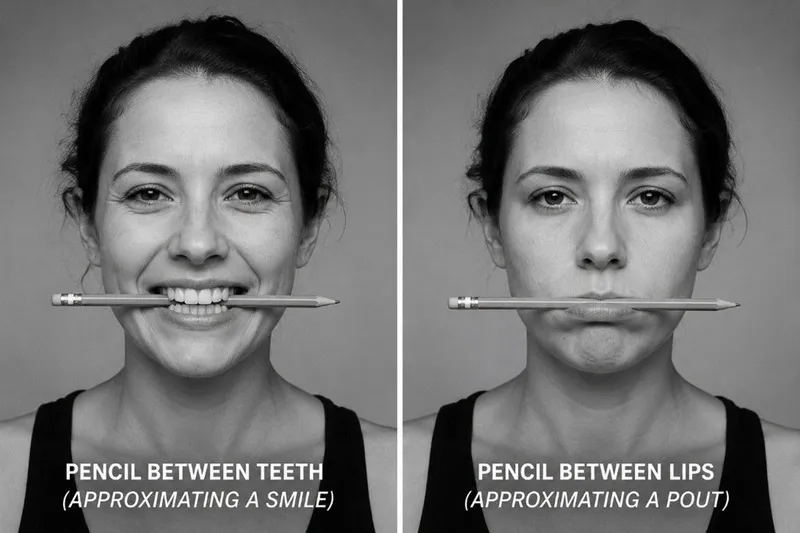
The researchers reported significant changes in mood, confidence and physiology between the two groups. Importantly, neither group was asked to think happy or sad thoughts… the effect was produced simply through mechanical muscle activation.
The brain is always monitoring the body, in the same way it constantly monitors the external environment. And it draws conclusions based on that information. As we discussed last week, the single biggest afferent input to the nervous system is from muscles spindle cells.
So when the muscles associated with feeling positive are firing (such as muscles involved in smiling, or standing upright), the brain concludes “I am happy/safe.”
When muscles associated with negative feelings are active (such as muscles involved in frowning, or slumping), the conclusion is “I am unhappy/unsafe.”
Early research into this phenomenon reported increased testosterone and decreased cortisol based on “power poses.” There has been some dispute about these findings, as they have been inconsistently replicated, however the overall effect of posture on mood and cognition has been established beyond doubt.
For example:
- Correcting stooped posture in people with mild-to-moderate depressive symptoms produced higher arousal positive affect, lower fatigue, more words spoken, fewer first-person singular pronouns. Wilkes et al. (2017, in J Behav Ther & Exp Psychiatry)
- Slumped sitting makes recalling hopeless/defeated memories easier; upright posture makes positive memory recall easier. Peper and Lin (How posture affects memory recall and mood)
- Upright sitting improves test performance (Ergonomics)
- Upright sitting in stress maintains self-esteem and reduces negative mood. (Nair et al.)
- Upright posture during a stressful task lowers cortisol and increases self-reported sense of control. (J Behav Ther & Exp Psychiatry; covered in multiple meta-analyses)
- Slumped posture decreases parasympathetic activity and increases sympathetic activity. Upright posture increases vagal tone and reduces salivary chromogranin A, a stress marker. (Scientific Research Publishing, 2020)
There’s plenty more research out there, but I’m sure you get the point. In fact, I’m sure you’ve felt this in your own body.
But mood is just the tip of the iceberg.
II. HOW YOUR POSTURE IMPACTS YOUR BRAIN
Forward head posture has been shown to significantly increase beta and gamma wave activity in the brain at rest, creating a constant, low-grade state of anxiety, hyper-arousal and stress.
What impact do you think that has on concentration, learning and productivity?
Not to mention the long-term effect on the autonomic nervous system.
This is one of the many things we assess when patients first walk into my clinic. We measure a number of specific markers associated with autonomic balance and burnout. For years I did this only with adults… after all, why would children be burned out?
However, over time I came across a few cases that led me to test children with the same protocol… and the results shocked me.
You’d be horrified to discover how many children are walking around in a state of adrenal exhaustion and burnout…
Something we used to associate primarily with adults who’d been through events like divorce, bankruptcy or loss of a career or loved one.
Our neurology is constantly creating our posture…
But our posture is also constantly feeding back into our nervous system… sometimes with devastating results.
Another area this has a major impact is on our breathing. 83% of subjects with Forward Head Posture (FHP) show altered breathing patterns. Forced vital capacity may be reduced by up to 0.81 litres. That’s a whole lot less air entering the lungs with each breath!
Sternocleidomastoid and anterior scalene over-recruit, deep cervical flexors weaken and ribcage mobility drops. (J Phys Ther Sci, 2019; PMC 4755989; Bulletin of Faculty of Physical Therapy review, 2024)
These alterations reduce cortical oxygenation and impact cognitive performance.
They also feed back into our autonomic system. Shallow, upper chest breathing stimulates the sympathetic “fight-or-flight” system, whereas deep, diaphragmatic breathing has the opposite effect, stimulating the parasympathetic “rest-and-digest” system.
Yet another driver of constant stress and anxiety.
This is a major contributor to a problem that chiropractors deal with every day in practice…
Tight neck and shoulder muscles (as well as loss of the cervical curve.) These accessory breathing muscles were never designed to replace our diaphragm as the primary engine of our respiration.
It gets even worse than that though…
This one really stunned me.
III. HOW POSTURE IMPACTS LONGEVITY
A 2004 prospective, multiply-adjusted study of 1,353 people found thathyperkyphosis reliably predicted 1.4x all-cause mortality. Hyperkyphotic Posture Predicts Mortality (Kado et al., JAGS 2004)
That’s a 40% increase in death rates linked directly to slumped thoracic posture.
There was also a clear link to increased atherosclerosis. A follow-up study showed that this relationship held independently of vertebral osteoporosis.
30-40% of older adults have hyperkyphosis.

That’s a big deal.
The analysis suggested that rather than interpreting this as “kyphosis causes atherosclerosis”, a more accurate understanding is that kyphosis is a visible biomarker for systemic decline — autonomic, respiratory, vagal, proprioceptive.
We are seeing this in our clinics every day.
The bottom line is this…
Posture matters.
It’s not about how you look… it’s about how you function.
It’s a neurological issue. A hormonal issue. A respiratory issue. A cognitive issue. A mood and self-esteem issue. A longevity issue.
And it’s largely going unaddressed.
Or at least under-addressed.
So what can we do about it?
IV. TWO APPROACHES TO IMPROVING POSTURE
There are 2 basic strategies- Active and Passive.
Passive approaches include external supports like traditional orthotics, arch supports and various postural support braces. With the exception of bracing for scoliosis, I haven’t seen any of these approaches work.
Either the brain becomes reliant on the external support, becoming weaker over time, or the nervous system accommodates and simply tunes the external support out.
So that leaves us with active approaches.
Things like:
- Exercises
- Regular chiropractic care (and probably other forms of bodywork… my bias and personal experience are in favour of chiropractic.)
- Environmental modification (improving ergonomics)
All of these can be helpful, but since you’re reading The Foot-Brain Connection… of course we’re going to focus on feet.
In past issues we’ve covered in detail how feet, and particularly feet standing on Better Balance Orthotics, influence posture. So I’m not going to rehash old ground. If you’re a new subscriber and would like to catch up on the science, check out these issues for a good grounding: [FBC#2] [FBC#3] [FBC#4] and [FBC#7]
Today I wanted to touch on a couple of other points. The first is that the evidence is clear. As I was digging through the posture research for this issue, there were plenty of papers showing that foot interventions improve posture, balance, proprioception, movement patterns and reduce falls risk (see references at the end.)
However, what I was unable to find were papers showing long-term results from these short-term interventions.
Most papers involved some kind of exercise or training program… say a 4-6 week rehab program followed by remeasuring various indicators. Usually with good results.
However, my question is…
What happened after the participants stopped doing the exercises?
How were they 6 weeks later?
Or 1 year later?
No one seems to be tracking that… but I suspect I know the answer.
Chances are, the exercise or rehab program needed to be maintained in order to maintain the benefits.
And the problem with patients is… they’re human beings just like you and I.
Sometimes life gets in the way.
The unfortunate truth is…
For the majority of patients… over time they stop doing the exercises or stop getting regularly adjusted.
Now, I know that’s not true for all of them. I have many patients that have seen me regularly for over 2 decades (as I’m sure you do too.) It feels like I have a practice full of them.
But the stats argue otherwise.
Over that time there are countless thousands of other patients who have, for one reason or another, dropped out of chiropractic care.
And as a result, have likely lost some or all of the postural benefits they gained from that care.
That’s one of the challenges with active interventions…
You have to stay active.
The Best of Both Worlds
This is where Better Balance Orthotics shine.
They sit in a unique intersection between Active and Passive interventions.
On the one hand, they’re Passive – all you have do is chuck them in your shoes and walk happily ever after. So patient compliance is massive.
On the other hand, they’re Active.
Unlike a regular orthotic, which is static and quickly tuned-out by the brain, BBO have an inbuilt aspect of instability. It’s their springiness that makes the difference. It means they actively stimulate the nervous system with every step and every minute on your feet.
There are very few other 1-off interventions I can think of that continue to pay dividends for years.
Especially across all the areas we’ve covered above…
- Better posture
- Better balance
- Better movement
- Better breathing and oxygenation
- Better cognitive performance
- Better mood and self-worth
- Reduced anxiety and depression
- Reduced falls risk
- Reduced all-cause mortality
If you haven’t been paying that much attention to posture in your practice, I get it. There are only so many things we can focus on at once, and practice constantly demands so much of us.
But the research backs up the benefits. Anything you can do to improve your patients’ posture delivers highly significant short and long-term benefits.
And getting Better Balance Orthotics on your patients’ feet is potentially the easiest, low-cost, highest-return place to start.
Cheers,

PS. Thanks to everyone who sent an email with subject line PROTOCOL. It’s great to see so many docs interested in improving their patient’s posture. You should have received your Clinical Reference Card, as well as a link to a video of me demonstrating the procedure.
Remember, this isn’t meant to be a complete postural ‘fix’ for the patient… What it is meant to do is create a fast, noticeable result for the patient and open up a conversation about the role of their feet in their posture. Let me know how you go- I’d love to hear your results… or even better, see before and after pics.
If you meant to send an email but didn’t quite get around to it… this is one last chance to send an email with PROTOCOL in the subject line.
References: (I originally included links to all these papers, however I realised that would set off every spam filter on the planet, so I removed them. Just copy and paste into any browser to find the paper)
- [Hyperkyphotic Posture Predicts Mortality (Kado et al., JAGS 2004)
- [Hyperkyphosis predicts mortality independent of vertebral osteoporosis]
- [Effect of forward head posture on thoracic shape and respiratory function (J Phys Ther Sci, 2019)]
- [Effects of forward head posture on forced vital capacity and respiratory muscles activity (PMC)]
- [Forward head posture and dynamic lung volumes — systematic review, 2024]
- [Upright posture improves affect and fatigue in people with depressive symptoms (Wilkes et al.)]
- [How Posture Affects Memory Recall and Mood (Peper et al.)]
- [Body Posture Affects Confidence In Your Own Thoughts (Briñol, Petty, Wagner)]
- [The Influence of a Posture on the Autonomic Nervous System and Stress Hormones in Saliva]
- [Power Posing original (Carney, Cuddy, Yap 2010)]
- [The proprioceptive weighting changes on posture control in chronic low back pain (Frontiers Neurology, 2023)]
- [Importance of plantar sensitivity in postural control (Apunts review)]
- [Effects of an eight-week composite plantar sensory exercise on postural stability in older adults
- [Effects of plantar surface stimulation on neuromuscular responses (systematic review, 2025)]
- [Contributions of Intrinsic and Extrinsic Foot Muscles during Functional Standing Postures]
- [Effect of intrinsic foot muscles training on foot posture (PLOS ONE)]
- [Emily Splichal — The Future of Proprioception Training (OTP)]
- [Percentage of decline in individual proprioceptors in older adults]
- [Forward Head Posture’s Effect on the Cervical Spine]
- [Association of kyphosis index with decreased physical function and cognitive domain]
- Anwar G, Moustafa IM, Khowailed I, et al. Comparison of corticomuscular coherence under different balance paradigms in individuals with and without forward head posture. Scientific Reports. 2025;15:22985.
- Jung JY, Lee YB, Kang CK. Effect of forward head posture on resting state brain function. Healthcare (Basel). 2024;12(12):1162.
- Moustafa IM, Youssef A, Ahbouch A, et al. Is forward head posture relevant to autonomic nervous system function and cervical sensorimotor control? Gait Posture. 2020;77:29–35.
Chiropractic Biophysics (CBP) Research Literature (I didn’t reference these studies in this issue as we’ve covered them previously, but I’ve included them here as a significant body of research on how posture affects physiology and function):
- Ibrahim M. Moustafa, Aliaa A. Diab, Deed E. Harrison. The effect of normalizing the sagittal cervical configuration on dizziness, neck pain , and cervicocephalic kinesthetic sensibility: a 1-year randomized controlled study. European Journal of Physical and Rehabilitation Medicine. 2016 Aug 30
- Demonstration of central conduction time and neuroplastic changes after cervical lordosis rehabilitation in asymptomatic subjects: a randomized, placebo‑controlled trial Ibrahim M. Moustafa1,2, AliaaA. Diab2 , Fatma Hegazy1 & Deed E. Harrison
- Demonstration of Autonomic Nervous Function and Cervical Sensorimotor Control After Cervical Lordosis Rehabilitation: A Randomized Controlled Trial Ibrahim Moustafa, PhD; Ahmed S.A. Youssef, MSci; Amal Ahbouch, MSci; Deed Harrison, DC
- Increase in cerebral blood flow indicated by increased cerebral arterial area and pixel intensity on brain magnetic resonance angiogram following correction of cervical lordosis Evan A Katz, Seana B Katz, Curtis A Fedorchuk1 , Douglas F Lightstone1 , Chris J Banach, Jessica D Podoll
- Does improvement towards a normal cervical sagittal configuration aid in the management of cervical myofascial pain syndrome: a 1- year randomized controlled trial Ibrahim M. Moustafa1,2, Aliaa A. Diab2, Fatma Hegazy1 and Deed E. Harrison
- The effect of normalizing the sagittal cervical configuration on dizziness, neck pain, and cervicocephalic kinesthetic sensibility: a 1-year randomized controlled study Ibrahim M. MOUSTAFA, Aliaa A. DIAB, Deed E. HARRISON
- Is Thoracic Kyphosis Relevant to Pain, Autonomic Nervous System Function, Disability, and Cervical Sensorimotor Control in Patients with Chronic Nonspecific Neck Pain? Ibrahim M. Moustafa, Tamer Shousha, Ashokan Arumugam and Deed E. Harrison
- Does Forward Head Posture Influence Somatosensory Evoked Potentials and Somatosensory Processing in Asymptomatic Young Adults? Ibrahim M. Moustafa, Aliaa Attiah, Mohamed Diab and Deed E. Harrison
- Does Improvement towards a Normal Cervical Sagittal Configuration Aid in the Management of Lumbosacral Radiculopathy: A Randomized Controlled Trial Ibrahim Moustafa Moustafa, Aliaa Attiah, Mohamed Diab and Deed Eric Harrison