

A couple of weeks ago I introduced you to the “Molecule of Adaptability”
BDNF (Brain Derived Neurotrophic Factor.)
We looked at how experiences rewire the brain and the critical role that BDNF plays in that process (if you missed it you can catch up here: [FBC#32] I promised you a practical guide on how to increase your BDNF levels.
This is it.
The good news is, you have far more control over your BDNF levels than you might think. Which matters, because BDNF has been shown to:
- Create greater neuroplasticity
- Improve learning and memory
- Build greater neuronal resilience
- Support neurogenesis
- Contribute to healthier brain aging
When you dive down the BDNF research rabbit hole you discover a plethora of tips, hacks and strategies, all with varying levels of evidence. But there is one intervention that clearly stands head-and-shoulders above the rest.
BDNF LEVER #1: EXERCISE
If you only do one thing… do this.
Across every domain of health that I research, there is one thing that consistently shows bigger benefits for health and longevity than anything else. Move your body.
BDNF research is no exception. Meta-analyses of randomised trials show that both acute exercise and longer-term training increase circulating BDNF (Ya-Hai Wang et al. 2022)
Aerobic exercise appears to have the strongest benefits. Which is great news, because this is available to pretty much all of us. Things like walking, running, swimming and cycling. Anything that gets your heartrate up. Even relatively short bouts are beneficial.
I definitely notice this personally. Whenever I start getting a bit sluggish on longer sedentary tasks (like writing this newsletter) I take a 15-20 minute walk. Then find I can sit right back down and immediately drop into laser-focused flow. It’s like my brain just clears right up.
I always thought of this as the release phase of the flow cycle [FBC#8] but now I understand the molecular mechanism. Research shows that exercise can boost BDNF levels within 15 minutes.
Higher-intensity aerobic exercise has also been shown to produce substantial acute BDNF increases. And you don’t have to slog away for hours. In fact, HIIT (High Intensity Interval Training) has been shown to produce greater BDNF effects than Moderate-Intensity Continuous Training (Rodriguez-Gutierrez E, et al. 2024.)
So the message isn’t simply Move more.
It’s… Regularly give your nervous system a reason to adapt.
For me what that looks like is 15-20 minute walks most days, especially the days I’m not in clinic. And once or twice a week a 20-minute HIIT sprint session on a bike at the gym.
It seems to be working… my Oura Ring consistently measures my “Cardiovascular Age” as being 5.5 – 6 years younger than my biological age. I wish it had a way of measuring BDNF levels!
Speaking of Oura Ring metrics… we moved house over the weekend. According to my ring that process involved taking over 49,500 steps and burned nearly 10,000 calories! Moving sucks, but at least it’s a decent workout!

BDNF LEVER #2: LEARN SOMETHING DIFFICULT
A couple of weeks ago I shared a number of studies showing that learning physically changes the brain… from mapping the streets of London to juggling or learning a new language. There is solid human evidence that cognitive training can increase circulating BDNF levels (Ledreux A, et al. 2019.)
In a randomised control trial of 146 healthy older adults, five weeks of cognitive training increased serum BDNF levels by approximately 10%. Not only that, a subsequent analysis showed that the increased BDNF helped mediate improvement in cognitive performance (Hakansson K, et al. 2022.)
In these studies, they used computerised training – 35 minutes a day, 5 days a week. I’ve played around with this myself… I have a lifetime subscription to the Lumosity brain-training app. The research shows it works… but these days I rarely open it.
There’s so much to learn in this world that actually matters, rather than just mindless computer games (yes you can exercise your brain without engaging your mind!)
Personally, I’d recommend you pick something that’s fascinating, useful and meaningful for you. Master that. Pick an instrument, a new language or a new clinical technique.
Speaking of learning new stuff… a quick reminder for my US BBO docs: I’m opening a few days in September to come and teach my entire clinical system in person in your clinic. Details at the bottom.
Whatever you choose, make it hard. Remember your brain evolved to solve problems, not just consume information. You have to challenge it enough to actually drive adaptation.
BDNF LEVER #3: MANAGE STRESS EFFECTIVELY (DON’T ELIMINATE IT)
This is where the Goldilocks Principle we discussed in [FBC#30 Hormesis]becomes relevant to BDNF. In fact, studies have shown that BDNF levels are effectively a direct molecular representation of this principle.
Acute stress and challenge transiently increase BDNF (which makes sense, after all, it is the Molecule of Adaptability.)
But chronic psychological stress is associated with decreased BDNF (Herhaus B, et al. 2024)
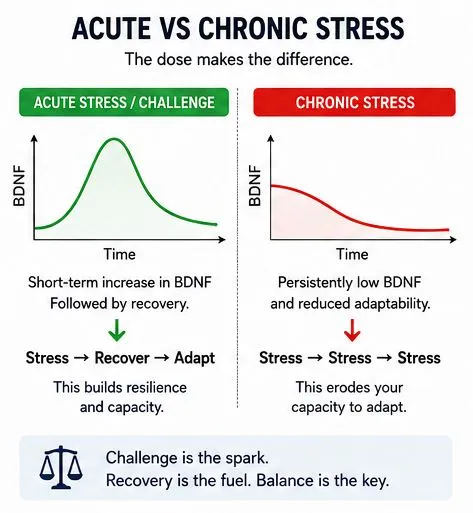
Perception of stress also mattered- higher perceived chronic stress predicted lower basal BDNF levels. And stronger cortisol responses to acute stress were associated with a faster decline in BDNF.
In other words, stress itself is not the enemy. The amount of stress, and what you make it mean, determines how beneficial or detrimental it becomes.
Of course, there’s another key factor here…
Recovery.
BDNF LEVER #4: SLEEP
The evidence here is clear. Even without that, we all know it’s true. We’re sharper when we’ve slept well.
This is something I relentlessly ignored in my 20s and 30s, but have learned to fiercely protect and value in my 40s. Gone are the days where I could pull multiple all-nighters and still sail through the next day like nothing happened. I sometimes imagine younger-me shaking his head in disgust as I climb into bed before 10pm… and I don’t care!
There are a bunch of things that happen at night when we sleep. The Glymphatic System that drains and detoxifies the brain is primarily active at night. Memory consolidation from short-term to long-term memory occurs during deep sleep. Muscles grow and repair after exercise when we’re asleep. Growth hormone levels rise. The brain remodels.
Great sleep isn’t just about resting. It’s about protecting the conditions in which plasticity can occur.
Chronic insomnia has been associated with lower BDNF levels (Ballesio A, et al. 2023)
Challenge and Recovery are really the two halves of the Adaptability Equation… the Yin and the Yang of health and high performance.
During the day:
Exercise. Learn. Challenge yourself and solve complex problems.
And during the night:
Give your nervous system the chance to consolidate it.
BDNF LEVER #5: NUTRITION
The levels of evidence here aren’t as established as with exercise, but there are still clear factors worth mentioning.
One of them I found particularly interesting, as it’s something I’ve been implementing in the clinic lately with impressive results.
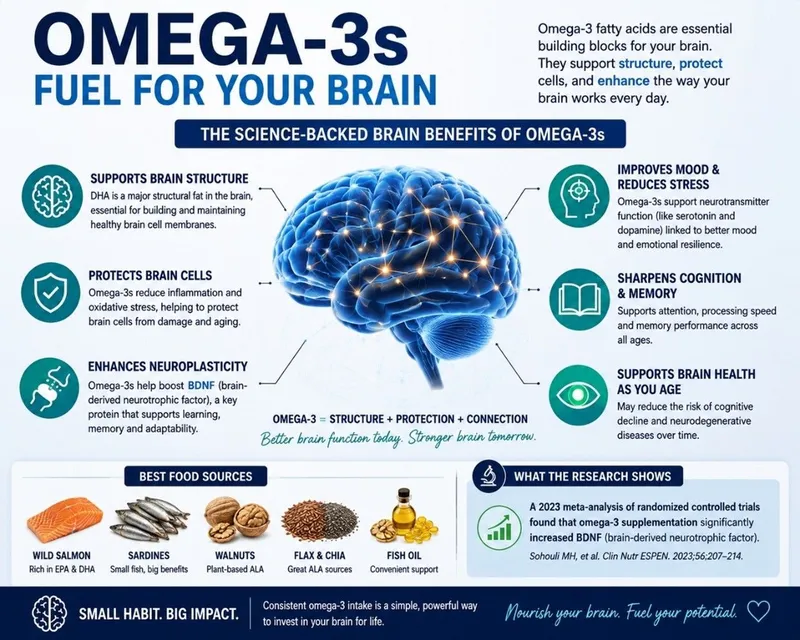
Omega-3
Two recent meta-analyses have found that omega-3 supplementation can significantly increase BDNF levels, especially when consistently supplemented over time (Sohouli MH, et al. 2023)
Both of these looked at circulating BDNF levels in the blood, rather than measuring it directly in the brain, however it makes sense… our brains are made of roughly 70% fat.
Most Western diets provide plenty of omega-6 but relatively little omega-3, producing a dramatically higher omega-6:omega-3 ratio than is thought to have existed throughout much of human evolution.
For about the last year I’ve been taking an innovative omega-3 supplement which combines high-quality fish oil with extra virgin olive oil. The polyphenols in the olive oil act as antioxidants to protect the omega-3s… significantly boosting their positive effects.
The improvements I’ve seen in joint pain and mobility, energy levels, brain fog and even blood sugar regulation both personally and in my clients have been pretty amazing.
The company recommends an independent finger-prick blood test that measures omega-6: omega-3 ratio. A healthy ration is somewhere between 2:1 and 3:1. After more than 1.4 million tests worldwide, the average ratio is more like 17:1 (in the USA it’s 25:1)
That’s a massive imbalance!
And it’s associated with major health consequences.
So I wasn’t surprised to see this show up in the BDNF literature.
We just offered this test to our active patient database. I was expecting maybe 10-20 people to take us up on it. So far we’ve tested over 130 and counting. And the results have been incredibly revealing… and frightening.
If you’re wondering why certain patients or conditions don’t seem to respond as well as you expect, a massive metabolic tilt towards inflammation may be one of the major hidden drivers.
If you’d like to know what we’re doing with this in my clinic, hit me up by replying to this email. It’s pretty cool.
Fasting / Energy Restriction / Ketosis
This is another interesting area of nutritional research. In one randomised crossover trial involving people with metabolic syndrome, carbohydrate restriction alone raised BDNF by 20%, and when combined with HIIT exercise increased BDNF levels by 38% (Gyorkos et al. 2019)
Obviously there are important factors to consider when deciding if these dietary strategies are right for you, but I personally find that my ideal setup for the day includes an early morning workout, fasted, followed by a sauna (whole-body heat exposure also has reasonable evidence for increasing BDNF (Glazachev OS, et al. (2020)
Sadly, with my move over the weekend I’ve gone from a 3-minute walk to the gym and sauna, to a 15-minute drive 😭 We’ll see if my sauna habit survives the transition.
There’s also one other vital component of my morning routine that happens before all that… and it’s our next BDNF factor…
BDNF LEVER #6: MEDITATION
I shared some studies a couple of weeks ago showing that meditation structurally changes the brain. So it’s no surprise that it’s also been shown to raise BDNF levels (Gomutbutra P, et al. 2020)
There’s also loads of evidence that meditation, in all its many forms, lowers both acute and chronic stress. And we know that chronic stress reduces BDNF.
So there’s a double benefit here- 2 opposing mechanisms that both increase BDNF. There are so many established benefits of meditation that if you’re not adding this into your physical, mental and emotional toolkit, you’re simply not performing as highly as you could be.
It doesn’t have to be fancy. Even 10-20 minutes a day of simple mindfulness is enough to move the needle.
BDNF LEVER #7: WATCH THE ALCOHOL
Sorry to be a party-pooper, but higher alcohol use has been associated with lower circulating BDNF levels (Shafiee A, et al. 2023)
It doesn’t mean you can’t enjoy a drink now and then, but just be aware that it’s probably not doing your BDNF levels any favours.
BONUS BDNF LEVER: BLOOD FLOW RESTRICTION (BFR) TRAINING
As I was writing this one, I received an email from one of our docs, Dr. Greg Adams, on how he’s using BFR training to boost BDNF levels. This one’s a fascinating area that I’ll admit I haven’t dived deeply into, but I do use BFR protocols in my own training and I love the results and time-saving benefits it produces. Here’s the study he shared (Landers et al. 2025)
If this is an area you’re interested in, let me know and I’ll put you in touch with Dr. Greg.
What I’ve shared are the BDNF-boosting interventions with the most established evidence base. But there are plenty of other strategies that haven’t established strong evidence yet… but look promising.
These include heat exposure, vagal stimulation, transcranial red-light and near-infrared therapy, probiotics, transcranial magnetic stimulation, hyperbaric oxygen and psychedelics.
These are a pretty wide-ranging group of approaches, but there’s one thing they all have in common…
They are all inputs the nervous system has to respond to. Considering the list has me wondering… what other forms of meaningful afferent input can modify neurotrophic signalling?
I’d speculate that both chiropractic adjustments and Better Balance Orthotics fit the bill.
PUTTING IT ALL TOGETHER: THE BDNF DAY
So what does this look like in practice?
It’s actually pretty simple.
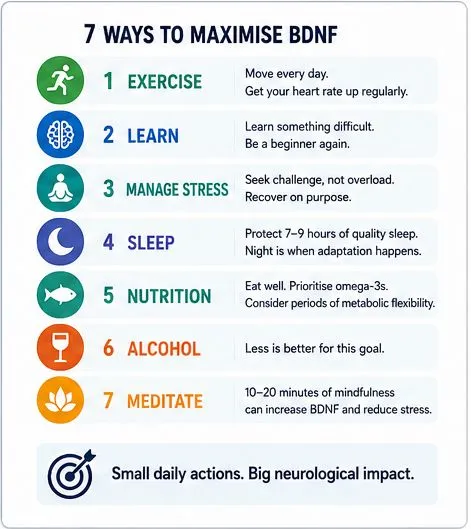
MOVE: Exercise. Get your heart rate up. Occasionally push yourself hard.
LEARN: Do something difficult enough that your brain has to adapt.
CHALLENGE: Don’t automatically choose the easiest option every time. Give your nervous system problems worth solving.
NOURISH: Prioritise omega-3s and good metabolic health.
RESET: Build moments of recovery into your day. Breathe, meditate and down-regulate.
SLEEP: Prioritise the time when your brain gets to consolidate what you’ve asked it to learn.
And if maximising BDNF is the goal, go easy on the alcohol.
That’s it.
Stimulate → Recover → Adapt.
The real question is…
Once you’ve built a brain capable of changing…
WHAT ARE YOU TRAINING IT TO BECOME?
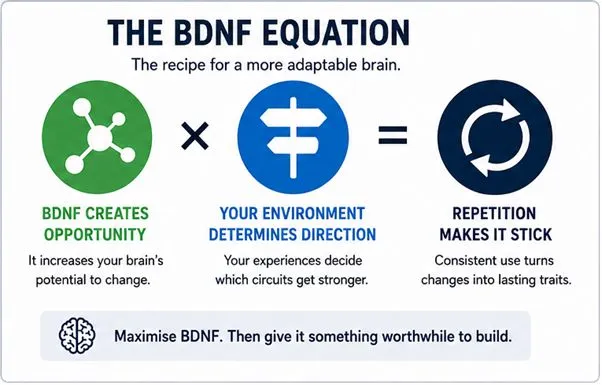
You could be doing everything I just described… whilst spending several hours every night mindlessly scrolling. Remember, BDNF creates the necessary conditions for brain plasticity and adaptation…
But it doesn’t give any instructions on what to adapt towards.
Your behaviour supplies the direction.
So be aware of what you’re rewiring your nervous system to become great at.
Focusing… or being distracted?
Deep learning… or passively consuming infotainment?
Handling uncertainty… or avoiding it?
Moving… or sitting on your butt?
Remember, whatever you repeatedly ask your nervous system to do physically becomes the hardware of your brain.
ADAPTATION = PLASTICITY x DIRECTION
At the end of the day, the goal is not to raise a number on a blood test. It’s about creating a resilient, adaptable brain that will support you living the life you love as far into the future as possible.
My friend and mentor Dr. Stephen Franson says…
“The goal is to build a Remarkable Practice as part of a Remarkable Life.”
When it comes to raising your BDNF levels, I’d say the goal is to build a Remarkable Brain as part of a Remarkable Life.
Cheers,

PS. A quick update on the Foot-Brain Connection Road Trip…
I mentioned last week that while I’m back in the US this September I’m opening up a few days to visit BBO clinics and personally train their teams.
I’ve had a couple of conversations since then and I’m excited to start filling in my schedule. But to answer some questions that have come up… you don’t need to have everything figured out. And you don’t need to convince 5 other chiropractors before you contact me.
If your clinic isn’t directly between Boston and Fort Lauderdale, don’t worry… I’ll figure out the route, even if it potentially means a flying detour. I’m already travelling all the way to the States- I figure what’s a few more miles? I don’t know when, if ever, I’ll have this kind of time and opportunity available again, so I want to make the most of it.
If you’d genuinely love to have me come spend time in your clinic- training your docs, working hands-on with your team and helping you integrate BBO more effectively- just send an email with the subject line ROAD TRIP.
Tell me where you are- I’ll figure out the logistics from there.
I’m only going to have room for a handful of these clinical workshops, and I’d much rather spend my time inside great chiropractic offices than sitting in hotels and airport lounges.
So if having me in your clinic sounds valuable, put your hand up.
Let’s see what we can create.
References:
1. Exercise
Wang YH, Zhou HH, Luo Q, Cui S. The effect of physical exercise on circulating brain-derived neurotrophic factor in healthy subjects: A meta-analysis of randomized controlled trials. Brain Behav. 2022;12(4):e2544. doi:10.1002/brb3.2544.
2. HIIT
Rodríguez-Gutiérrez E, et al. Effectiveness of high-intensity interval training on peripheral brain-derived neurotrophic factor in adults: A systematic review and network meta-analysis. Scand J Med Sci Sports. 2024. doi:10.1111/sms.14496.
3. Cognitive training
Ledreux A, Håkansson K, Carlsson R, et al. Differential effects of physical exercise, cognitive training, and mindfulness practice on serum BDNF levels in healthy older adults: A randomized controlled intervention study. J Alzheimers Dis.2019;71(4):1245–1261. doi:10.3233/JAD-190756. PMID: 31498125.
4. Cognitive performance/BDNF mediation
Håkansson K, et al. BDNF mediates improvement in cognitive performance after computerized cognitive training in healthy older adults. 2022. PMID: 36089933.
5. Acute and chronic stress
Herhaus B, Heni M, Bloch W, Petrowski K. Dynamic interplay of cortisol and BDNF in males under acute and chronic psychosocial stress – A randomized controlled study. Psychoneuroendocrinology. 2024;170:107192. PMID: 39332135.
6. Insomnia
Ballesio A, Zagaria A, Curti DG, Moran R, Goadsby PJ, Rosenzweig I, Lombardo C. Peripheral brain-derived neurotrophic factor (BDNF) in insomnia: A systematic review and meta-analysis. Sleep Med Rev. 2023;67:101738. doi:10.1016/j.smrv.2022.101738. PMID: 36577338.
7. Omega-3
Sohouli MH, et al. Changes in serum brain-derived neurotrophic factor following supplementation of omega-3 fatty acids: A systematic review and meta-regression analysis. Clin Nutr ESPEN. 2023;56:207–214. doi:10.1016/j.clnesp.2023.05.019. PMID: 37344075.
Ziaei S, et al. A systematic review and meta-analysis of the omega-3 fatty acids effects on brain-derived neurotrophic factor (BDNF). Nutr Neurosci.2024;27(7):715–725. doi:10.1080/1028415X.2023.2245996. PMID: 37589276.
8. Carbohydrate restriction + HIIT
Gyorkos A, Baker MH, Miutz LN, Lown DA, Jones MA, Houghton-Rahrig LD. Carbohydrate-restricted diet and exercise increase brain-derived neurotrophic factor and cognitive function: A randomized crossover trial. Cureus.2019;11(9):e5604. doi:10.7759/cureus.5604. PMID: 31700717.
9. Whole-body heat exposure
Glazachev OS, et al. Repeated hyperthermia exposure increases circulating brain-derived neurotrophic factor levels which is associated with improved quality of life, and reduced anxiety: A randomized controlled trial. 2020. PMID: 32365000.
10. Meditation
Gomutbutra P, Yingchankul N, Chattipakorn N, Chattipakorn S, Srisurapanont M. The effect of mindfulness-based intervention on brain-derived neurotrophic factor (BDNF): A systematic review and meta-analysis of controlled trials. Front Psychol.2020;11:2209. doi:10.3389/fpsyg.2020.02209. PMID: 33041891.
11. Alcohol
Shafiee A, et al. Effect of alcohol on brain-derived neurotrophic factor (BDNF) blood levels: A systematic review and meta-analysis. Sci Rep. 2023;13:17554. doi:10.1038/s41598-023-44798-w. PMID: 37845289.
12. Blood-flow restriction
Landers JB, Allen M, Oladele I, et al. Effect of blood flow restriction on serum brain-derived neurotrophic factor. J Clin Exerc Physiol. 2025;14(2):36–42. doi:10.31189/2165-6193-14.2.36.
Landers JB, Landers KR, Young NG. The effects of blood flow restriction exercise on muscle–brain crosstalk: A systematic review. Muscles. 2025;4(2):19. doi:10.3390/muscles4020019.