

Lack of stress may be killing you.
That may seem like a strange statement in today’s always-on, ever-changing, crazy-stressed-out world.
Yet it’s true. At least partially.
A more accurate way to state it may be…
Lack of the right kind of stress (and too much of the wrong kind) is killing you (and everyone else.)
Today we’re going to explore the effect of different kinds of stress, how to balance them so that they’re building your health rather than destroying it, and how to help your patients do the same.
Let’s dive in.
I saw Jono the carpet-layer in clinic the other night. He was doing remarkably well- far better than I ever expected he would be at this point.
He first came to see me about 6 weeks ago… and he was a total mess. Severe pain down both legs, especially into his right big toe. Significant bilateral weakness. Major right knee pain. Back pain. In fact, constant pain basically everywhere. It was majorly impacting his ability to function.
Jono is 56 years old and has been working 80+ hour weeks since he was 16. In an extremely physically demanding job. He works alone because the young blokes can’t keep up with him. And he loves it… he has no interest in slowing down.
But his body wasn’t giving him much choice. He’d gone from easily climbing stairs with a 100kg roll of carpet on his shoulder to barely managing 20kg… with difficulty.
That’s why he ended up in my office.
I don’t know about you, but when that kind of case shows up, I tend to be a little cautious with my prognosis. It’s one of those times when the statement…
“Your body didn’t get this way overnight, it’s going to take some time…”
Seems appropriate.
I have complete faith in the body’s innate capacity to heal. But to say his body has been through more stress than most, would be a colossal understatement!
Fast forward to the other night.
He strolls in for his 6th adjustment. Smiling. Feeling great.
“The pain in my legs is almost all gone, just a bit still in my foot. Back feels better too. And I’m stronger… back to lifting 100kg carpet rolls, no problem.”
I’m totally amazed at the transformation.
But at the same time, I’m not. I’ve seen this pattern play out before.
Usually with my most physically active patients. Builders. Landscapers. Plumbers. Athletes.
They put their bodies through insane amounts of punishment… usually to the point when something breaks. And often it looks bad.
But they heal fast. Remarkably fast.
Much more so than many of the desk workers and more sedentary patients I see.
The human body doesn’t seem to age well when we stop asking things of it.
Our bodies are designed to deal with stress. They’ve had millions of years of practice. Life as a hunter gatherer was physically tough. And surviving in a dangerous environment filled with predators is stressful.
But guess what they’ve had zero experience dealing with?
A stress-free environment.
It simply hasn’t existed.
Until now.
(Of course, no one’s life is stress-free… in fact, on many measures life is more stressful than ever. But we’ll get to that. For the moment let’s just stick with our physical environment.)
Ever since the invention of farming, the relentless march of technology has made life physically more comfortable and less demanding.
We have spent centuries engineering stress out of our environment. And recently the pace of change has gone from a steady march to a jet-propelled blur of acceleration.
No one likes being uncomfortable.
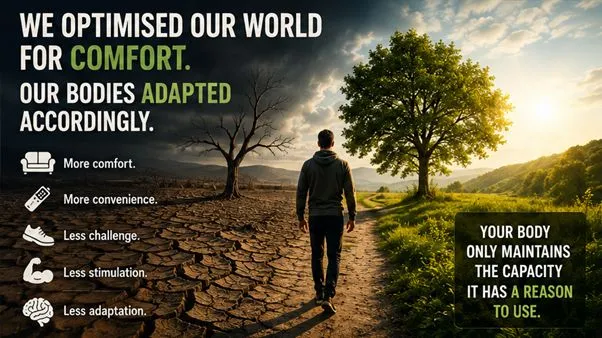
So we have continuously optimised our environment for greater comfort.
We live in temperature-controlled bubbles. Right now, it’s winter here in Sydney. It’s a rude shock after the blistering heat of Italy.
But it’s really not that bad. I go from my heated house, to the cozy comfort of the heated seat in my car, into my heated office… my actual exposure to the chilly environment is limited to a mere few seconds per day.
And it’s not just temperature.
We wear sunglasses when it’s bright out.
We take the escalator instead of the stairs.
Instead of hunting or gathering for our calories, we can have them delivered to our door with the click of a button.
No more walking back from the stream carrying heavy buckets of water… that flows straight from the tap.
And who bothers to even get up and change the channel on the TV anymore? Virtually everything in my house has a remote control. In fact, my TV doesn’t even have any buttons on it!
We wear soft, supportive, comfortable shoes to cushion our delicate feet. And we walk on flat, featureless surfaces with every little bump marked as a potential hazard.
It’s not just how we use (or don’t use) our bodies that’s changed… it’s how we use our brains too.
We use GPS instead of paper maps and memory.
We use calculators instead of doing mental arithmetic.
We type instead of handwriting.
And an electronic gizmo in our pocket runs almost every aspect of our lives… our calendar, to-do lists, remembering our friends’ phone numbers, our entertainment… increasingly with AI, even our very thinking itself!
Every one of these things seems like a logical and desirable thing on its own. But when you add them all together, the health implications become catastrophic.
Biology has a problem with comfort: Your body only maintains capacities it has a reason to use.
I’m sure you get my point, but let me share two quick illustrations as examples. Both are things I see regularly in clinic.
The first is what our newfound, uber-comfortable world is doing to our jaw and facial structure. It starts with something you would never suspect as a potential health timebomb…
Baby food.
If you walk down the baby food aisle of any supermarket today, you will notice that all of it comes in squeezy packets. There’s plenty of variety, and some of it sounds great… it’s gluten-free, sugar-free, organic…
But it’s all mush.
No chewing required. Or even possible.
The result is that babies spend far less time chewing than at any time in previous human history. And so, their jaw muscles simply don’t develop in the same way.
Which would be fine, except…
Bones grow in response to stress (we know it as Wolff’s Law.)
No chewing, no stress. No stress, no bone development.
So kids these days frequently display underdeveloped mandibles and narrowed palates. Both my kids had to wear an expander to widen their palate… even though we had some awareness of these issues. Although we gave them plenty of veggies and natural foods to chew on, I guess it’s still minimal compared to their hunter gatherer ancestors.
This doesn’t just create dental problems.
It creates airway problems. Sleep-disordered breathing. Mouth breathing. Snoring. Sleep apnoea.
All these conditions are on the rise. And there is overwhelming evidence linking them to a whole host of serious health problems including delayed development, concentration problems and ADHD, lowered immunity, poor brain development and reduced performance on almost every measure you can think of.
And that’s just the beginning.
As the narrowed palate takes on more of a peaked shape, rather than a smooth arch, it pushes up into the nose and sinuses, creating septal deviation. It reduces nasal airflow and predisposes to chronic sinus issues. I’ve even seen evidence linking these structural changes to the development of astigmatism and visual problems.
These are serious, lifelong second and third-order health complications…
All from mushy food!
Chewing may be stressful… but it’s absolutely necessary for normal, healthy development!
Another example I’ve mentioned in the past is the trend towards ever-more-cushioned shoes. In the 1970’s it was noticed that runners were developing impact injuries such as shin splints. The obvious solution was to increase the amount of cushioning in the soles of running shoes.
So that’s exactly what shoe companies did.
Nobody did any research… after all, the answer was obvious. Until the 2000’s when researchers began to study the real mechanisms of injury in runners. One of their most counterintuitive findings was that sometimes more cushioning in shoes actually caused runners to heel strike harder (Kulmala et al. 2018)
The explanation appeared to be that by reducing the brain’s ability to sense the ground, it was no longer able to appropriately “tune” the muscles and fascia to absorb the impact forces.
Pounding the pavement may be stressful… but again it’s necessary for the brain and body to respond to their environment in a healthy way.
The bottom line is…
Eliminating too much stress is counterproductive and unhealthy.
If health truly equals ability to adapt, as we discussed last week…
Then we must have stresses to adapt to.
Otherwise, we just turn into blobs.
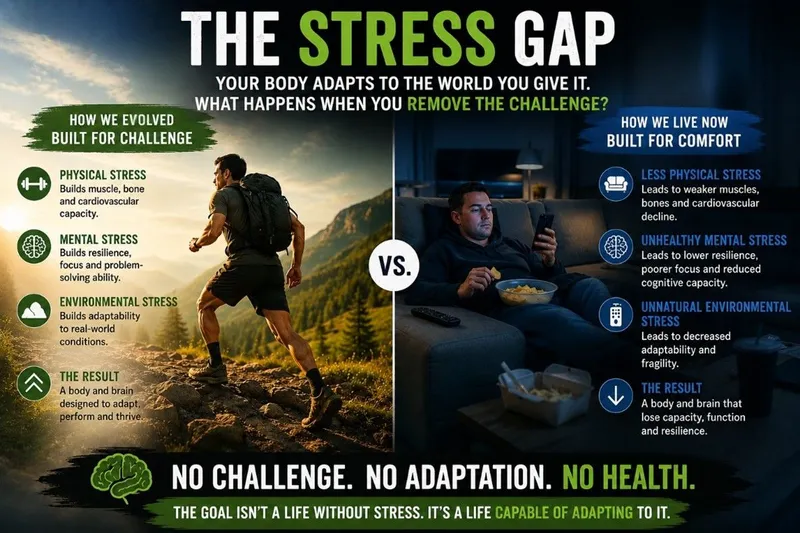
Now clearly, too much stress is a problem. No one’s denying that. It leads to injury, breakdown and burnout. My patient Jono had clearly crossed that line. He had a list of injuries a mile long!
Fortunately, he’s headed rapidly back in the right direction.
Last week we discussed the Goldilocks Principle– the idea that there is an ideal amount of stress that leads to maximum adaptability and optimal health outcomes.
Too little leads to atrophy. Too much leads to damage. But just right, is just right.
One other factor to consider…
It’s not just the amount of stress that matters. The type of stress is important too. Some stressors are destructive in any amount.
For example, there’s no optimal amount of mercury to have in your body. It’s been clearly determined that there’s no safe level. It’s just toxic.
Unfortunately, in today’s world we seem to be faced with increasing amounts of these kinds of toxic stressors. Many of these are unnatural. They’re things that our ancestors never experienced… things like plastics, refined heavy metals and forever chemicals.
But many stressors do follow the Goldilocks Principle. They are dose-dependent.
These are known as Hormetic Stressors.
And they’re increasingly being acknowledged as one of the keys to optimal health and performance in modern life. These are typically stressors that were a common part of life for many thousands of years… but we’ve largely engineered out of our daily lives. Things like…
- Heat.
- Cold.
- Physical activity.
- Sunlight.
- Breath holding.
- Immune system challenges.
- Fasting.
The term hormesis was coined in 1943 to describe the counterintuitive observation that a stressor can produce very different biological effects at low doses versus high doses.
Today the concept of hormesis has evolved into a well-established science, with hundreds of papers published since the 1990’s. It’s become one of the key principles of the biohacking movement and underpins many evidence-based health practices, including:
- strength training
- aerobic exercise
- fasting
- heat exposure (sauna)
- cold exposure
- cognitive challenge
- environmental enrichment
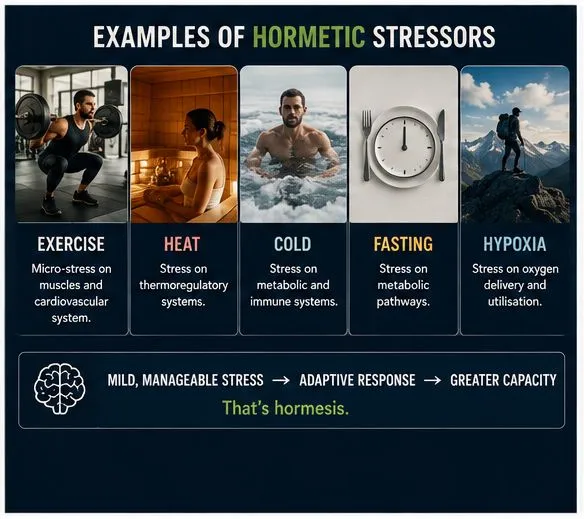
As someone who utilises many of these practices in my daily routines, I can tell you that they definitely count as stressors! Doing a cold plunge is tough! So is more than 30 minutes in the sauna, or pushing through a heavy workout.
Each of them is stressful enough to disrupt homeostasis. Mechanical tension, metabolic demand, oxidative signals and other cellular stresses tell the body:
Your current capacity wasn’t quite enough.
So during recovery, the body responds by remodelling itself to handle that challenge more effectively next time. Muscles grow. Cellular capacity expands. Weaker cells are killed off and replaced.
This is intelligent adaptation at work.
The body is taking in environmental information, rising to the current challenge, and preparing to deal with even more in the future.
Remember though… the body is efficient. It doesn’t waste energy. Your body only builds the capacity it believes it will need tomorrow.
And the only way it decides that is if you repeatedly expose it to stressors that slightly exceed its current capacity. A single workout or sauna has a negligible effect. But daily or weekly application… now you’re building a healthy, resilient, adaptable body.
Author Nassim Nicholas Taleb coined a term that beautifully describes this process:
Antifragile.
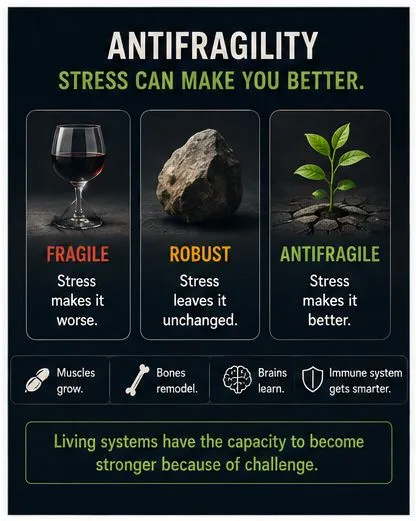
When something is fragile, stress damages it. When something is robust, it withstands stress. Something antifragile is different. Stress actually makes it better.
A wine glass is fragile.
A rock is robust.
A living human being has the capacity to be antifragile.
Muscles grow because they’re challenged. Bones remodel because they’re loaded. Brains learn because they’re forced to solve problems. Remove too many challenges and you don’t create stronger humans.
You create humans with less reason to become strong.
This brings me to another idea I’ve been thinking about…
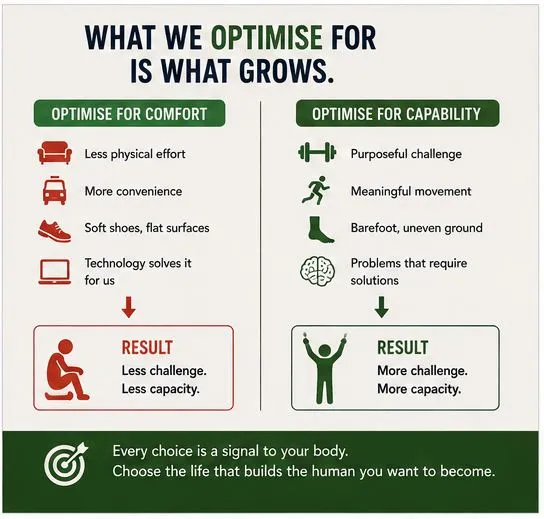
Whatever you optimise for tends to grow.
Optimise training for strength → strength grows.
Optimise education for problem solving → problem solving grows.
Optimise your environment for convenience → convenience grows.
Optimise life for comfort → comfort grows.
But comfort and capability aren’t the same thing. Sometimes they’re opposites. Every time technology solves a physical or neurological problem for us, we should at least ask…
What capacity no longer has a reason to develop?
When I look at the world my children are growing up in, that question frightens me a little. It’s why I send them to a Steiner school where there are no computers until high school. They don’t type… they handwrite. They play. They learn through story, colour and movement. Inputs our brains have learned to expect… to rely on… for thousands of generations.
Let’s bring it back to the feet… after all, this is The Foot-Brain Connection.
There’s no doubt that walking predominantly on flat, neurologically-deadening surfaces falls on the “too little” side of the Goldilocks curve. The same goes for wearing modern shoes.
They simply don’t provide enough sensory input, or mechanical challenge, to cause either the feet or the brain to adapt, grow and strengthen the way they did for millions of years before the modern era.
We’ve detailed many of the precise mechanisms of this process throughout many previous issues. Next week we’ll explore the actual neurological mechanism of either growth or destruction in the brain itself.
When it comes to traditional orthotics, I’ve seen them fall on either side of the Goldilocks Zone. On one hand, they massively reduce sensory input. They also reduce the physical workload of the foot, by holding it in a fixed position. This puts them squarely into the “Too little challenge” zone.
I’ve also seen them push on the feet in undesirable ways, which creates discomfort and irritation. This puts them in the “Too much challenge” category(for muscle testers, this often means they produce a generally hypertonic response when people stand on them.)
Better Balance Orthotics, on the other hand, fall directly into the Goldilocks Zone.
They increase the sensory stimulation to the plantar receptors, making up for some of the information we’ve lost through wearing shoes and living on flat surfaces.
On the mechanical side of things, their springiness and slight instability introduces a level of uncertainty and challenge into the system. Not enough to cause a problem, but just enough to make the brain pay attention– to give it a problem to solve.
No other type of orthotic I’ve ever tested has done that.
(And I’ve tested dozens.)
For some people, wearing barefoot shoes falls into the Goldilocks Zone. Their minimal support provides enough challenge to make the foot (and brain) work more.
For others, their feet may not be functional enough yet. For them the level of challenge is too great and the shoes can create discomfort or even symptoms. They need to develop more adaptability in their feet, brain and body before progressing to that style of shoe.
Wearing Better Balance Orthotics in regular shoes for a period of time can create that bridge.
I know this has been a long one, but there’s one last, critically important thing we need to cover today. It’s what makes hormetic stress more essential for health than ever before.
It’s not just that we’ve optimised our environment for comfort, to the point where we’re severely deficient in healthy, beneficial stressors.
It’s also that we are exposed to more toxic, harmful stressors than ever before.
Things like heavy metals. Artificial light. Air pollution. EMF pollution. Toxic chemicals. Mould. Crazy schedules. Social pressure. Excess social media exposure for children. Endless scrolling through short-form content. The list could go on for pages and pages.
All of these things impact our lives daily. And the reality is, they’re impossible to totally avoid.
But there is a way to increase your body’s ability to handle this load.
You guessed it… it’s measured exposure to hormetic stress.
Hormetic stress doesn’t just make you stronger.
It builds your functional reserve. It makes your entire system more resilient.
Researchers call this cross-stressor adaptation.
You don’t just become more resilient to the specific stressor you apply (eg. cold.) You become more resilient in general.
This doesn’t mean hormesis makes us bulletproof—or that other stressors become harmless. But it does suggest that we may be able to increase the reserve with which we meet an unpredictable world.
The formula looks like this:
Hormetic Stress = Greater Adaptability = Greater Capacity to Deal with Stress (Including Unnatural, Toxic Stressors.)
Every time you expose yourself to hormetic stressors you build your resilience.
Which raises a fascinating possibility.
Could Better Balance Orthotics be creating a form of low-level, repeated adaptive challenge for the nervous system?
Thousands of times per day, the plantar sensory system receives richer, more variable information.
Not enough to overwhelm it. But enough, perhaps, to keep giving it something to solve.
That’s a hypothesis I think is worth testing.
Cheers,

PS. Our brains are so bombarded with rapid stimuli and short-form content these days that many people’s ability to focus has been seriously impacted. To the point where reading long-form content (like books… or The Foot-Brain Connection) is actually considered a hormetic stress. So every time you make it through one of these newsletters, you’re actually building your brain!
Thank you for your time and focus… I never take it lightly. And you’re welcome for the stress 😉
PPS. One final piece of food for thought. Based on what you’ve read…would you consider the chiropractic adjustment a hormetic stress? Hit REPLY and let me know, I’d love to hear your thoughts.
References:
Running in highly cushioned shoes increases leg stiffness and amplifies impact loading- Kulmala et al. Scientific Reports Nov 2018https://pubmed.ncbi.nlm.nih.gov/30504822/