

Uneven ground does not merely exercise the feet. It trains the nervous system to solve problems.
Last week I wrote about how alive my feet have felt walking over the uneven streets of Italy.
That’s continued… we’ve explored the villages of Cinque Terre by boat and now we’re on the Amalfi Coast… still barely a flat surface in sight.

As we’ve continued to explore, I’ve realised that “more stimulation” is only part of what makes this environment so different.
The ground here doesn’t just stimulate your feet.
It constantly gives your nervous system problems to solve.
Every step is slightly different from the one before it.
One stone is raised. Another slopes sideways. The next is smooth, worn down by centuries of footsteps. Then there’s a gap, a crack or a sudden change in level.
It’s the complete opposite of the sensory poverty that our feet exist in most of the time.
But here’s the thing…
It’s not just about feet. The entire environment is novel. And our brains crave that.
It’s one of the major reasons why we feel so alive when we travel.
Before having children, Jodie and I travelled a lot. For our honeymoon we bought round-the-world tickets. For many of the countries we visited, we made little or no plans in advance. We just went with the flow…and had an amazing time.
I remember being in Egypt, in the back of a cab, on our way to the hotel we intended to stay at. As we were sitting stopped in traffic, suddenly this guy jumped into the back of the cab with us. He asked where we were going, and when we told him he said…
“Don’t go there, my cousin’s hotel is much better. You should go here instead.”
So we did. And it was incredible.
Our whole trip unfolded like that. A constant stream of novelty. New sights, sounds, smells and endless variables that our brains had to analyse and adapt to on the fly.
This is exactly what the human nervous system evolved for.
And most of us, in our comfortable, repetitive, predictable day-to-day lives are using a fraction of that neurological potential.
The problem is… it’s a use-it-or-lose-it system.
We’ve all seen how this plays out. As people age, their world shrinks.
Their comfort zone shrinks. Their capacity shrinks. Their worldview shrinks.
And it’s not just mental.
It’s physical too.
Their range of motion shrinks. Their flexibility shrinks. Muscle mass shrinks.
Because it’s all a reflection of the same thing…
A nervous system that is losing its adaptability and becoming locked into the same old patterns.
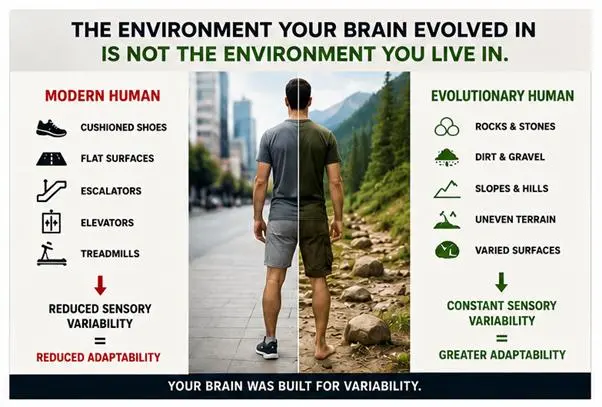
The neuroscience backs this up.
Novel, enriched and variable environments drive neuroplasticity, learning, adaptability and cognitive reserve.
In neuroscience, an “enriched environment” is one that contains:
- greater sensory stimulation
- more novelty
- more complexity
- more movement opportunities
- more problem solving
Decades of research have shown that enriched environments promote structural and functional changes throughout the nervous system. (Baroncelli et al., 2010)
It also suggests that richer, more stimulating environments help build a reserve that allows people to better cope with neurological challenges and age-related decline. (Gelfo F, et al. 2019)
Hippocampal research shows that environmental enrichment and spatial complexity consistently increases neurogenesis and hippocampal plasticity in animal models. (Khalil MH, et al. (2024).
The key word here is special complexity. The streets, alleyways and cobblestones of Italy provide a more spatially complex environment than anything I encounter in an average week at home.
It’s not just the surfaces we’re walking on… it’s literally everything. The streets are narrow and windy. The “footpath” is barely inches wide. The traffic is insane. There are cars, trucks, buses, motorbikes, mopeds and pedestrians swarming around each other in every direction possible.
On our drive from Naples to Sorrento we took a bus up over a mountain pass, through winding switchbacks and tight corners, in heavy traffic.
The views were simply incredible.

What was even more impressive was the bus driver!
That guy was able to handle spatial complexity!
He navigated that bus around impossibly tight corners and through the narrowest of streets, honking his horn as we went around blind corners to indicate that he was taking up the entire road, surrounded by other vehicles, barely slowing down…

All whilst texting on his phone!

The lady sitting across from me was holding on white-knuckled with both hands the whole way.
We’re travelling with my father-in-law and his Honduran partner, Waleska. Every time I’ve travelled to Honduras I’ve been amazed by the craziness of the driving there (we always joke about the “Honduran 3rd lane”…somehow it exists even when there’s only 1 lane!)
At the end of this journey, she said to me…
“People say we drive crazy in Honduras, but that was ten times crazier than anything else I’ve even seen!”
It truly was an astonishing display of what a fully-functioning hippocampus is actually capable of!
That guy’s brain is navigating more complexity, in a more wildly enriched environment, than I encounter in a typical month!
It’s not just the complexity of the environment that counts. Motor learning researchers have spent years examining the role of variability. It turns out that variability is part of the learning process itself.
Studies consistently show that variable practice improves learning, retention and adaptability compared with highly repetitive conditions. (Dahwale et. al 2018)
The number of variables this bus driver was juggling were significant. The angle of the sun (it was late in the day and it was coming directly at us through the front window), the way the light reflected off the ocean beside us, the swarm of vehicles around us…
There were constantly motorcyclists overtaking us around blind corners, and pedestrians squeezing through tiny gaps with only inches between them and the traffic, seemingly completely unfazed.
I’ll never complain about driving in Sydney again!
This same concept of variability driving adaptability has been understood by bodybuilders and gym junkies for years. It’s generally considered that free weights are superior to fixed machines as they introduce variable angles and require greater use of stabilising muscles.
This doesn’t mean weight machines don’t have their place- they can create greater safety and reduce chance of injury for less experienced lifters. However, over time they are training the muscles (and the brain) to manage force in one specific plane, which can potentially create greater vulnerability to injury over time.
In my own exercise routine, I have taken this one step further, moving to a system of resistance bands instead of free weights. This means my brain is dealing with not just variable angles of force, but also variable resistance. The more the band stretches, the greater the load.
For myself, I’m as interested in working out my brain as I am my body.
Traditional fitness focusses on capacity:
- How fast can you run?
- How heavy can you lift?
But real-world movement also depends on adaptability:
- How quickly can your nervous system detect change?
- Can it select an appropriate response?
- Can it recover from a small error?
- Can it maintain posture while attention is elsewhere?
- Can it change the strategy from one step to the next?
Fitness is the capacity to perform a task. Neurological fitness is the capacity to adapt when the task changes.
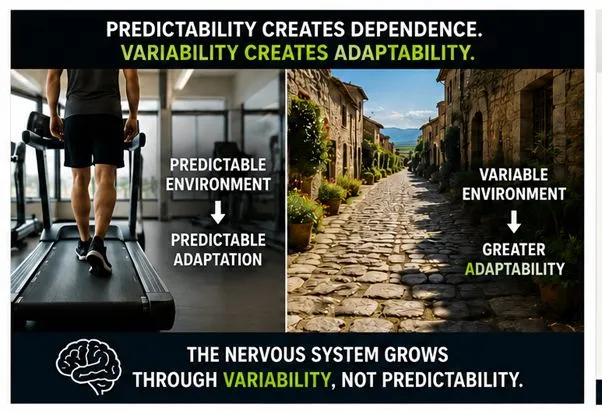
Bringing this back to feet, the Stimulation vs Support paradigm, and Better Balance Orthotics, I believe this is one reason why I have consistently observed superior results with BBO compared to any other support-based approach I have seen.
It’s not just the springiness of the orthotics that matters… it’s also the variability.
The unique way that we process the filler material makes it like stepping on a beanbag. It’s able to shift and change a little, meaning that you never take exactly the same step twice.
I believe this is one of the reasons that they still continue to provide meaningful stimulation even after more than a decade of wearing them- this is easily demonstrated with the Standing Hip Flexor Test or any of the other standard tests we teach.
I have never tested someone that didn’t continue to strengthen when standing on them, even after wearing them for years.
The brain simply does not tune them out the way it does with any other arch support or supportive device.
This is consistent with a newer body of research which suggests that motor variability is associated with learning and adaptation capacity. (López-Fernández et. al 2025)

People who demonstrate appropriate exploratory variability often show greater ability to adapt to new motor tasks.
This is fascinating because it flips the traditional model.
Most people assume greater consistency = greater health.
But biologically it’s just not that simple. Healthy systems often demonstrate controlled variability.
For example…
A heartbeat isn’t perfectly regular. In fact, HRV, which has been shown to be one of our best leading indicators of health, is about measuring the variation between our heartbeats.
Human gait isn’t perfectly identical from step to step. This is one reason why running outdoors often produces better outcomes than running on a treadmill.
Movement variability is often a feature of adaptability rather than a flaw.
So it makes sense that if we want to enhance movement patterns, we need a variable orthotic rather than a static support.
The level of variability doesn’t need to be dramatic. When we’re talking about HRV, we’re measuring tiny variations between heartbeats…
But those tiny variations make all the difference.
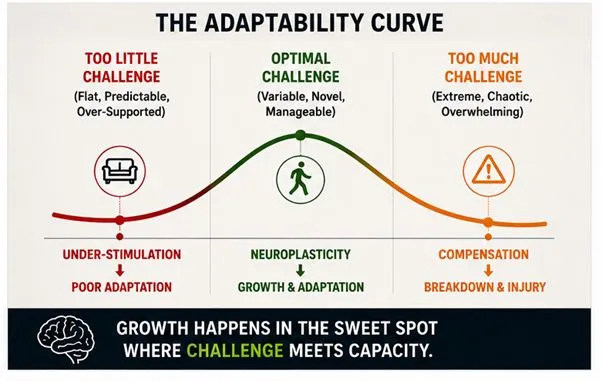
Too much variation and the system breaks down… think ectopic heartbeats, arrythmias and atrial fibrillation.
Not enough variation and the system stagnates and becomes rigid… unable to adapt to the challenges of an ever-changing environment.
But just the right amount…
That’s the perfect recipe for neurological stimulation, growth and adaptability.
Walking through Italy has reminded me that our ancestors didn’t live in a world of perfectly level floors, smooth footpaths and identical steps. Nor did they sit at the same desk every day, drive the same way to work every day or eat the same thing for breakfast every day.
Their nervous systems were constantly solving problems.
Every root.
Every rock.
Every uneven surface.
Every step was slightly different from the one before it.
We have engineered so much of the challenge, variability and novelty out of our modern lives that we are literally dumbing down our nervous systems.
My prescription for you this week… spice it up a little.
Drive a different route to work.
Brush your teeth with your other hand.
Try something you’ve never done before.
And of course, wear your Better Balance Orthotics.
Cheers,

Baroncelli L, Braschi C, Spolidoro M, Begenisic T, Sale A, Maffei L. (2010). Nurturing brain plasticity: impact of environmental enrichment. Cell Death & Differentiation, 17(7), 1092–1103.)
Milbocker KA, Smith IF, Klintsova AY. (2024). Maintaining a Dynamic Brain: Exercise, Learning, and Environmental Enrichment in Neuroplasticity. Brain Plasticity.
Gelfo F, et al. (2019). Does Experience Enhance Cognitive Flexibility? An Overview of the Evidence.
Frontiers in Behavioral Neuroscience.
Khalil MH, et al. (2024). Environmental enrichment: a systematic review on the effect of changing spatial complexity on neurogenesis and hippocampal plasticity. A Systematic Review.
Dahwale AK, et.al (2018). The Role of Variability in Motor Learning. Annu Rev Neurosci. 2017 May 10;40:479–498.
López-Fernández et. al (2025) Relationship between initial motor variability and learning and adaptive ability. A systematic review. Neuroscience 2025 Jan 565:301-311.