

Yesterday in clinic I saw three pulled hamstring injuries.
Three!
It’s not an uncommon injury… but it’s not that common! I might typically go months without seeing a single one. Whenever that kind of “coincidence” shows up in my life, I figure it’s the universe trying to get my attention. And I’ve learned it’s generally a good idea to listen.
So today we’re going to talk about hamstrings.
And by extension, the Superficial Back Line (SBL). It’s impossible to really understand hamstring function without considering their role as part of this essential structure. This is of particular importance to chiropractors, as the SBL completely encompasses the spine from top to bottom.
We’ve talked in detail about how the Deep Front Line (DFL) and the Lateral Line (LL) both insert into the plantar surface of the foot and play a role in lifting the arches [FBC#19]
But the SBL is the plantar surface of the foot.
This fascial line begins at the tips of the toes and runs through the plantar fascia, the achilles tendon, calves and hamstrings, into the sacrotuberous ligament, through the sacral fascia, up along the entire length of the spine, and then over the top of the head to ultimately insert on the supraorbital ridge.
On a fascial level, this literally is the foot-brain connection!
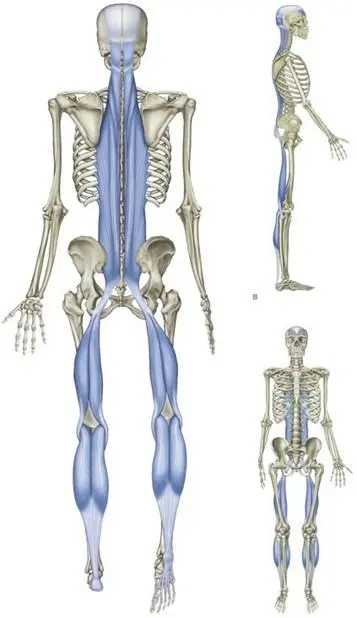
Remember, these fascial lines are the body’s force transfer mechanism. In the case of the SBL, this is how we transfer forward propulsive force from the ground when we are walking or running.
In the running world they refer to this mechanism as “the triple extension.”
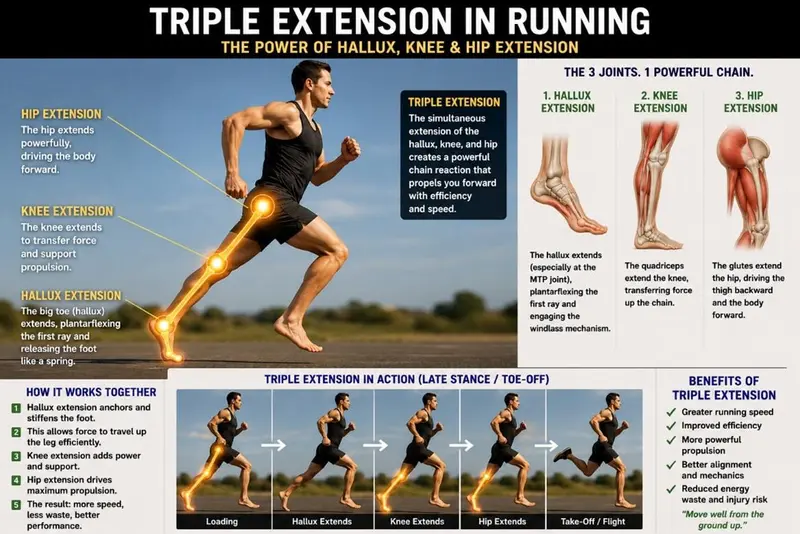
In order to propel ourselves forward, we first extend our hallux, then our knee, then our hip. The hamstrings are the bridge that transfers this force from the legs into the rest of the body.
They have a tricky role to play in this process, as they are both an extensor of the hip and a flexor of the knee.
This means that at the same time, as we move forward, they are accelerating the hip into extension (a concentric contraction) and decelerating the extension of the knee (an eccentric contraction.)
This requires some neurological finesse.
The brain can only accomplish this through precisely tuned feedback mechanisms. One fascinating fact that I recently learned…
Only 20% of muscle fibres span the entire length of some muscles. The other 80% insert into fascial elements along the length of the muscle (Wilke et. al 2019)
This is where the line between muscle and fascia begins to blur. It’s not as black and white as we learned in our training, or see in the anatomy books.
Fascia is not just a sheath around the muscle, or a compartment around a bunch of muscles.
It interpenetrates and interdigitates with every element of the muscle… sometimes not just encasing the muscle, but each individual muscle fibre.
And our fascial web contains 250 million nerve endings… 6-10 times more than muscle tissue. This includes not just mechanoreceptors and nociceptors, but also thermoreceptors, chemoreceptors and autonomic nerve endings involved in emotional regulation.
This is why it has been said that…
The brain listens to fascia and talks to muscles.
In the case of the 3 hamstring strains I saw yesterday, one was a sprinter, one was a softballer and one was a hockey player. Basically all 3 injuries were running injuries. They all occurred when the athlete required explosive power and acceleration.
All three of them were fit, healthy individuals. All three were warmed up… in all cases the injury occurred well into the game or training session.
In each case, there was no external force involved. They didn’t get tackled. They weren’t powerlifting a heavy weight.
So what went wrong?
None of these were force overload issues.
They occurred as a result of either force miscalculation or force mismanagement.
This is what causes the vast majority of hamstring strains.
I also saw a classic lumbar disc injury case yesterday. It was a young mum named Amy who shuffled very gingerly into my office. When I asked her what happened, she said…
“I just bent down to pick up a water bottle out of a school bag. Suddenly my lower back spasmed so badly I couldn’t get up. The next day it was so painful I couldn’t even get out of bed.”
My testing indicated a left L4 posterolateral disc injury.
This is the same mechanism of injury as the hamstring strains… it’s just a different tissue that failed. Again, there was no excessive force. The water bottle wasn’t heavy.
But the force was either mismanaged or miscalculated.
And that has everything to do with the function of the Superficial Back Line… and its beginnings on the feet.
You might remember in our recent issue on posture [FBC#21- Posture] we discussed how every motor neuron has up to 10,000 sensory inputs. It’s the total summation of all these inputs, across all the thousands of neurons innervating each muscle, that drive motor output.
Force Miscalculation – A Sensory Issue
When we experience a force miscalculation problem, it’s because the sum total of all those sensory inputs added up to an incorrect motor output.
These kinds of injuries, where there is no outside force involved, have been described as motor control errors. (Carlson C. (2009); McGill SM. (2007)
But remember, afferent precedes efferent. It’s really a sensory issue. In simple terms, the body created an inappropriate motor response based on bad information.
And when it comes to lumbar disc and hamstring injuries, one of the most common sources of bad information is the feet.
As we know, the plantar surface of the feet is one of the most receptor-dense areas of the body, second only to the head neck and jaw. (Corniani & Saal 2020)
The foot is not simply a mechanical structure; it is a highly sophisticated sensory organ designed to continuously inform the brain about our interaction with the ground. (Strzalkowski et al. 2018)
This brings us back to one of our central concepts… that modern shoes and featureless modern surfaces are effectively blindfolding the brain, severely dampening one of our most vital sensory inputs.
When we can’t accurately sense the ground, the entire force transmission mechanism of the SBL is thrown off… and hamstring strains and lumbar disc injuries are a common consequence.
This also sets up our other common cause of injury…
Force Mismanagement – A Motor Issue
Force mismanagement injuries occur when force is not appropriately absorbed or transmitted to the next link in the kinetic chain. This is where hamstring strains and lumbar disc injuries are two sides of the same coin.
Just the location of the weak link in the chain is different.
Again, the function of the SBL is critical here… and again it starts with the feet.
As we approach toe-off during the stance phase of gait, our hallux is extending and our foot is plantar flexing. Our weight is moving over the forefoot, which spreads our metatarsals and creates forefoot splay.
This stretches and tightens a thick band of fascia that runs transversely under our metatarsal heads, called the plantar plate.
This in turn tensions the plantar fascia, absorbing ground reactions forces and elastically storing them in the tissue. They are then transmitted up the kinetic chain through the achilles tendon, the calves and hamstrings and into the pelvis and spine.
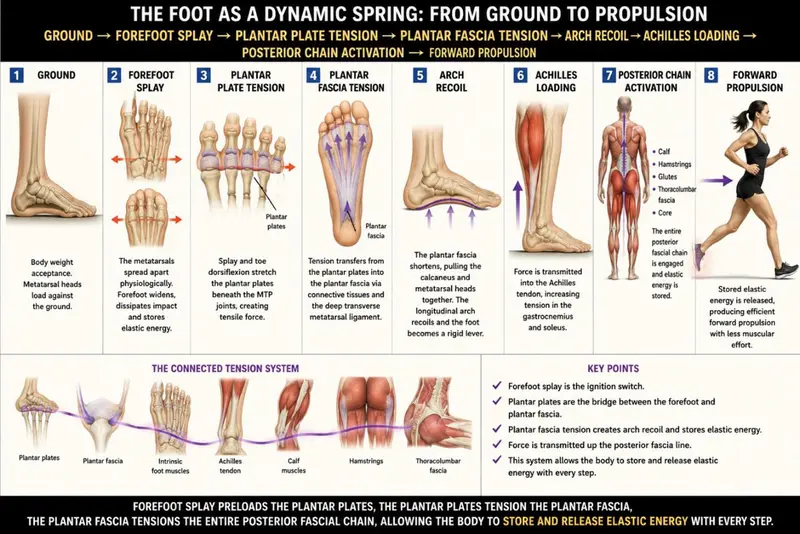
The whole thing begins with the splaying of the metatarsals. This acts like the “ignition switch” for the entire posterior chain.
I believe this is one of the strongest arguments for wearing barefoot shoes… or at least shoes with a wide toe box that allows for natural forefoot splay. When that doesn’t occur, the function of the entire SBL is compromised- and injury is a common result.
The reality is, hardly any modern shoes accommodate for this.

One obvious reason hamstring injuries are more common during sports is the greater amount of force involved. We know force = mass x acceleration. So sports involving rapid acceleration (like sprinting, softball or hockey) are more likely to create hamstring strains.
However, I think there’s another, widely overlooked reason.
In each of these sports players are usually wearing narrow, restrictive footwear. Which restricts their forefoot splay. So the posterior chain ignition switch never fires.
This could explain the many cases I’ve seen, especially watching soccer and rugby over the years, where a player jogs onto the field…
And pulls a hamstring before they ever get anywhere near the action!
In these cases, it’s not an acceleration issue.
It’s a force mismanagement issue.
When the plantar plate and plantar fascia are not appropriately tensioned, it introduces slack into the system. And tensegrity-based systems like the human fascial system rely on balanced tension to maintain their integrity and spread forces evenly [FBC#4 – Tensegrity]
Slack in a tensegrity system causes focal points of increased load… and this is where the injury usually occurs. Hamstrings and lumbar discs are common locations… but it could also result in calf strain or an injury anywhere throughout the spine.
How commonly do you think you’re seeing this in daily practice?
I had a personal experience of this last year. I was doing some heavy calf raises, when suddenly I felt a sharp twang in my mid thoracic area, just below my left scapula. Nothing too major, but enough to end my workout. I was pretty sore for a week or two.
What fascinated me was the location of the injury. My calves were doing all the work… but the focal stress point that blew out was in my thoracic spine.
That’s tensegrity, and the SBL in action.
It was force mismanagement… and in my case the weak link in the chain was in my thoracic spine.
As chiropractors, we’re working on the spine all day long… often without considering this wider interaction with the SBL and the way it transmits force from the feet to the head and back.
It means that the cause of a subluxation or muscle injury may not originate in the local area where the pain is. That spot is just the weak link in the fascial force-transmission chain.
It doesn’t mean you shouldn’t treat that area…
It just means it may also be worth considering the rest of the system. Particularly the top and bottom.
With my hamstring and lumbar disc patients, I’m typically addressing their cervical spine, lumbar spine, pelvis and feet. All of them are usually involved.
How To Check This In Your Practice
One way you could practically implement these ideas is by checking the reflex point I have found to be associated with the SBL. You can find it just lateral to the right PSIS.
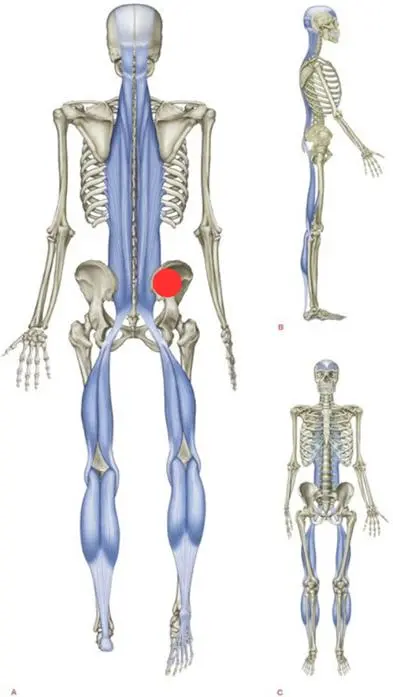
It’s usually quite palpable as a tight, tender spot. If you give it a firm rub, most patients will jump and be quite surprised by how sensitive it is. If you compare it to the same spot on the left there will be a noticeable difference.
I suspect if you were to check this on every patient tomorrow, you wouldn’t find a single one that isn’t significantly tender.
That’s how common SBL issues are.
If you give it a firm rub for 30-60 seconds after you’re done with your prone spinal adjusting it will help patients integrate and hold their corrections better.
This is also a perfect opportunity for a brief conversation with that patient about what that tenderness means.
“This is a reflex point for your Superficial Back Line, which is a fascial line that runs from the soles of your feet all the way up your spine and over the top of your head. The fact that it’s tender indicates that your feet may be a factor in your back/neck/spine/headaches.”
Tenderness of this reflex is a good indication that this patient would likely benefit from wearing Better Balance Orthotics.
This doesn’t have to interrupt your adjusting flow. The conversation can be as simple as…
“Next time I see you we’re going to do a quick test to see if your feet are affecting your spine.”
Or even…
“Let’s get you scheduled with Kaitlyn (our tech CA) for a quick test to see if your feet are affecting your spine.”
Of course, if it suits your practice style, it’s even better to get them assessed right away, while the sensitivity of the spot you just rubbed, and what it means, are fresh in their mind. I find it really helps patients understand the holistic, whole-body nature of the work we do.
Four individual cases.
One single mechanism of injury.
I guarantee you are seeing this every day in practice (multiple times per day.)
Hopefully this gives you a simple, implementable tool to start connecting some missing links. And a powerful treatment strategy to improve your outcomes.
I’d love to hear what you find… hit REPLY and let me know.
Cheers,

Carlson C. (2009). Axial back pain in the athlete: pathophysiology and approach to rehabilitation. Current Reviews in Musculoskeletal Medicine, 2(2), 88–93.
McGill SM. (2007). Low Back Disorders: Evidence-Based Prevention and Rehabilitation (2nd ed.). Human Kinetics.
Strzalkowski NDJ, Mildren RL, Bent LR. Cutaneous afferent innervation of the human foot sole: what can we learn from single-unit recordings? Journal of Neurophysiology. 2018;120(3):1233-1246.
Corniani G, Saal HP. Tactile innervation densities across the whole body. Journal of Neurophysiology. 2020;124(4):1229-1240.