

The minute someone walks into your office, you already know how their day is going. You can see it.
The same is true when your kids walk in the door from school. Good day or bad day? It’s visible and immediately recognisable.
Why?
Because our brains are wired to pick up visual clues. You don’t have to be a trained chiropractor to experience this… we all do it. Everyone has heard that body language can communicate more than our actual words.
So what is it that we’re actually picking up on?
It’s the Central Integrative State of the nervous system.
Let me put that more clearly…
Posture is neurology made visible.
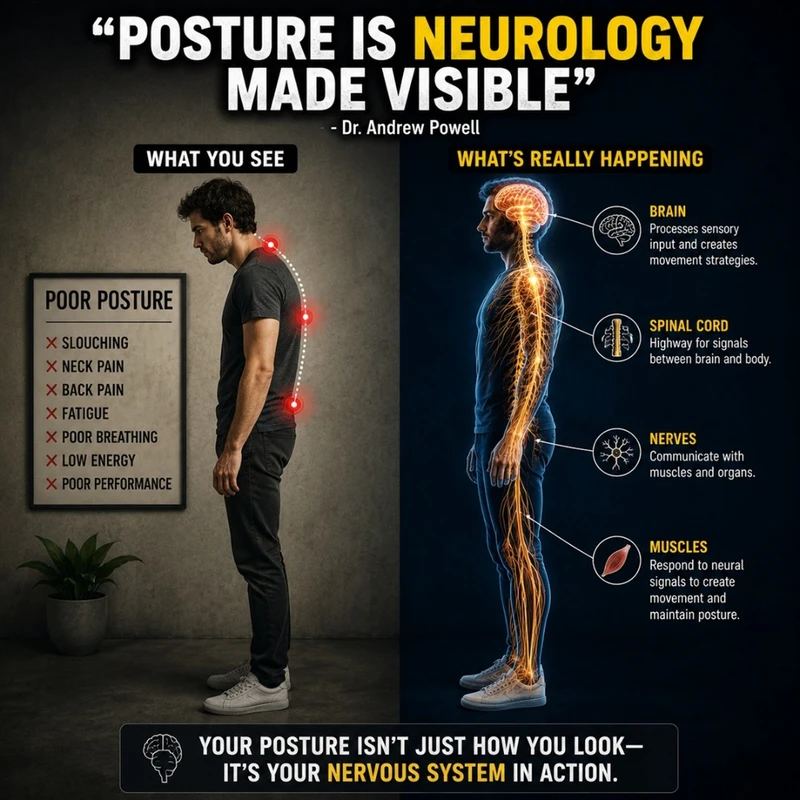
There are many tools we can use to measure the output of the nervous system…
- Muscle strength
- Range of motion
- Orthopaedic tests
- Standard neurological tests
- Muscle testing
- Palpation – tone, spasm and pain
But one of the simplest, clearest indicators may be quite literally staring us in the face.
And as a profession we’re missing key factors in the way we think about, analyse and attempt to improve posture.
We’re treating it as a motor problem.
A mechanics problem.
We’re attempting to treat the output.
Rather than focusing on the input.
What we’re really dealing with is a sensory issue.
A few weeks ago, we explored the BUOI paradigm… the idea that biomechanics flows from the ground up- Bottom Up, Outside In (if you missed it, you can catch up HERE )
Today I want to give you a different way to think about it… and a clinical tool you can apply to see immediate results.
As we previously discussed, our nervous system is a sensory-first system.
Every motor output flows from a sensory input.
That’s true… but it’s a massive oversimplification.
A more accurate description would be that every motor output flows from the total sum of sensory inputs delivered to the Central Nervous System (CNS) in that millisecond.
Here’s how it actually works:
Sensory inputs include our 5 special senses…. Vision, hearing, smell, taste and touch. But these collectively make up only a small portion of the total input flowing into our CNS at any given moment.
The vast majority of input comes from the sensory nerve endings in our muscles- our muscle spindle cells.
This input is then transmitted through the 86 billion neurons of the CNS (with each one of them connected to an average of 7000 other neurons.) The brain is a vast, almost infinitely complex processing centre that receives this incredible inflow of sensory data and produces a motor output in response.
In the words of Dr. Simon King, founder of Afferentology.com…
“The Afferent Input paradigm challenges the notion that the brain controls the body… Our every thought and action starts life as an incoming nerve signal. AFFERENT INPUT is the raw material that creates all brain and nervous system function.”
And the majority of that input is coming from our muscles.
Muscle spindles constantly fire into the spinal cord, activating reflex loops that control tone in our agonist/antagonist muscle pairs. This creates our resting tone, posture and movement potential. This input also fires up to the brain, which then modulates the output.
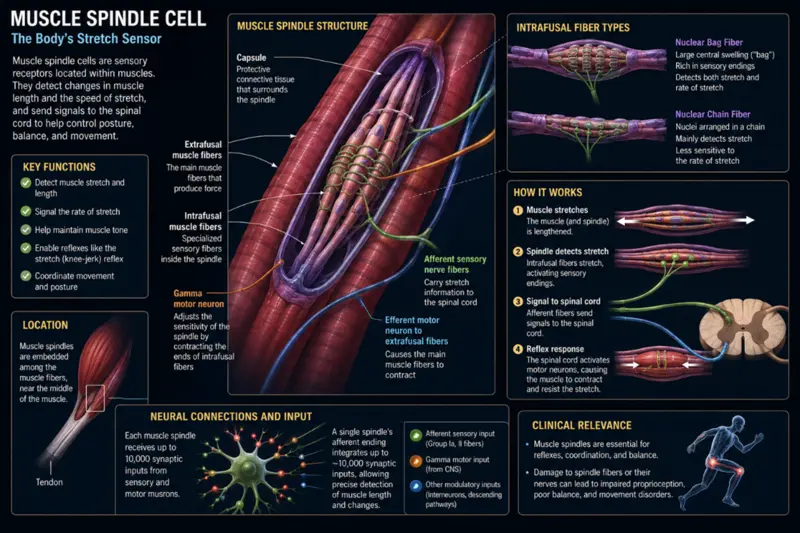
90% of our movement and tone is not conscious… it’s reflexive.
This is why trying to improve posture through conscious efforts, like reminding someone to “stand up straight” are never effective…
As soon as we stop paying attention, our unconscious, reflexive state takes over again. This is also why body language gives us away (we’ll get more into how that works and the research around it next week.)
This flood of sensory data from our muscle spindles is part of a 2-way conversation.
Our motor neurons talk back- the sum total of output arising from all that input.
Here’s where it gets mindbogglingly complex.
At rest, each motor neuron is firing to the muscle fibre it innervates 50x per second.
At full contraction, such as during a heavy deadlift, that can ramp up to 500x per second.
A single motor neuron supplies one or more muscle fibres, so it takes thousands of motor neurons acting together to bring a muscle to full contraction.
But what’s really fascinating about motor neurons is not their output…
It’s their input.
Each motor neuron receives up to 10,000 inputs- messages from other nerves.
These messages bring input from other muscles, skin, tendons, ligaments, bones and the brain.
The motor nerve will not fire (send a message telling the muscle to contract) until it accumulates enough inputs. A motor nerve needs to reach about 70mV to fire… and each input supplies only about 0.5 to 1 millivolt, so no single input can create an output.
And as if that wasn’t complex enough…
Not all inputs are facilitatory. Some are inhibitory.
So, it’s not until the cumulative total of all inputs- both facilitatory and inhibitory, reaches 70mV that the nerve will fire to the muscle.
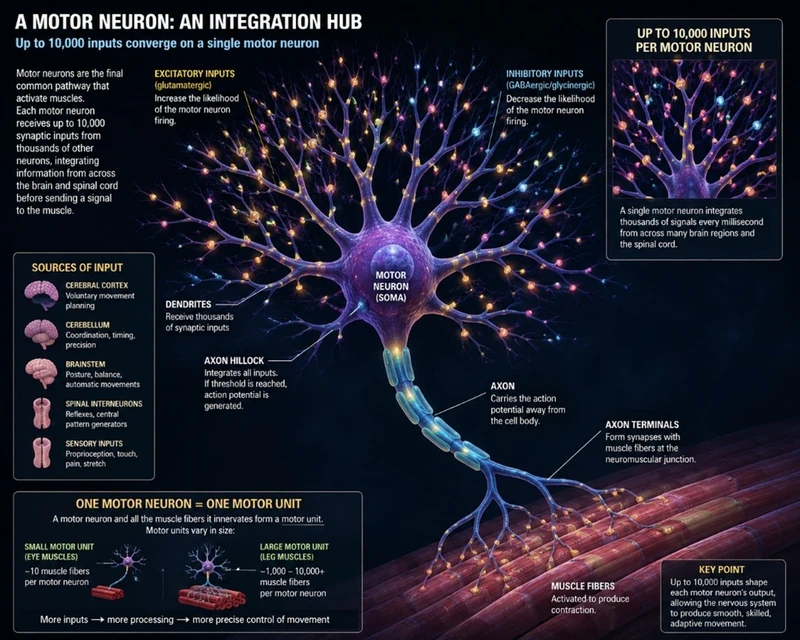
And this is happening 50x per second even when the muscle is at rest. Across millions of neurons.
It’s staggeringly complex. No wonder we can’t consciously maintain our posture. It’s logistically impossible.
And this massively skewed ratio- 10,000 sensory inputs for each single motor neuron…
Tells us just how important incoming sensory information is to our nervous system. The fact that every motor neuron receives such a mass of inputs for every output gives some clue as to the complexity of the task of controlled movement.
As Dr. King puts it…
“Muscles are the beginning and the end of the nervous system. We are an outside-in organism- we have to adapt to our environment… the whole reason we have proprioception is to control movement.”
Here’s the next key part:
Not all muscles are created equal when it comes to sensory input. Some are spindle-dense. Some are relatively spindle-light. It depends on the amount of fine precision control the brain requires of that muscle.
The most spindle-dense area of the body outside the head and upper neck is the plantar surface of the feet.
Of course, that makes sense… how can we stand upright, walk, balance or run if we can’t feel the ground?
When we look at it in this context, the Stimulation vs Support paradigm doesn’t just make sense… it becomes unavoidably logical.
We know the modern environment is dramatically reducing input to our feet through neurologically-deadening shoes and flat surfaces… effectively blindfolding our brain.
We know that traditional orthotics and arch supports further reduce the incoming signal.
We know that each motor neuron has up to 10,000 inputs, and will only fire once it receives a sufficient total of stimulatory rather than inhibitory inputs.
So when we blind the input from our feet, we directly reduce the motor output flowing to our muscles.
No wonder almost everybody has weak, dysfunctional feet!
And slumped, inefficient, dysfunctional posture as a result.
(We looked deeply into how foot function creates posture, particularly Forward Head Posture in [FBC#7])
This is not speculation. It’s textbook physiology.
Yet it’s going largely unaddressed.
This is the glaring hole in how most physical medicine (including most chiropractors) is attempting to address posture.
Adjustments are great.
Exercises are great.
Better ergonomics can help.
But all of them are missing out on addressing this most fundamental input- the ground we walk and stand on every day.
This is why they can create short-term benefits, but often fail to create consistent, lasting change. The patient is literally, actively working against these interventions every single time they stand or take a step.
And those postural changes have consequences. Probably more than most of us realise. I’ve been digging through the research on this, and next week I plan to share a bunch of it with you.
But for today I wanted to give you something practical to implement.
Something that’s fast, effective and your patients can feel (and see) immediately.
I call it the 5 Minute Foot Reset.
It’s a clinical protocol that immediately changes the way the body relates to the ground… and the way it reacts to gravity as a result.
I’m currently refining it to make sure it includes only the most reproducible and reliable techniques.
The truth is, it’s easy to create a 25-minute protocol… much more challenging to consistently produce the same results in 5 minutes!
The end result will be a simple, focused 1-page card that you can refer to daily in practice.
If you’re interested in that, please just send an email with ‘PROTOCOL’ in the subject line and I’ll send it through as soon as it’s ready.
What this gives you is a fast, simple tool that creates an immediate “wow” experience for your patients. They will feel the difference as soon as they stand up off your adjusting table.
You will see it.
They will feel it as they walk out of your office.
Their friends and family will see it too.
But here’s the thing…
What this is addresses is the motor output. It’s a series of quick corrections for the dysfunctional, repetitively strained musculoskeletal elements that dictate that patient’s motor response to the ground.
But remember the ratio…
10,000 sensory inputs per single motor neuron.
This won’t fix that.
Because it’s not a problem with their feet.
It’s a problem with their environment.
There’s no adjustment you can do that fixes that issue on a lasting basis.
That’s where Better Balance Orthotics come in. They are a Sensory Therapy that enhances Motor Outcomes.
If your patient is not regularly wearing them, you will find yourself having to repeat the corrections. And watching their postural problems return (usually not as bad, but if you give it long enough…)
That’s it for this week. Enjoy playing around resetting your patients’ feet and watching their surprise when they step off the table. If you really want to wow them, take a quick before and after photo and show it to them.
With or without the photo, this naturally opens up the conversation about how their brain is constantly setting up their posture based on the input from their feet.They will get it because they can feel it.
One last thing. I’m creating this as a resource for our current docs, but also an outreach for the majority of our profession who don’t even know the Stimulation vs Support paradigm exists.
There are so many great docs out there who are missing this key piece of the clinical puzzle, and it’s sabotaging their results. They deserve better and so do their patients.
I’ll be providing a link where they can download the clinical reference card and subscribe to The Foot-Brain Connection. If you could find the time to pass this on to 2-3 docs who need it, I’d deeply appreciate it. Thank you.
Remember, just send an email with ‘PROTOCOL’ in the subject line for access.