

There’s an old saying in computer programming circles…
Garbage in, garbage out.
It means that if the inputs into a system are incorrect, there is precisely zero chanceof it generating the correct output.
Last week we explored the twin concepts of ADIO and BUOI…
Above Down, Inside Out and Below Up, Outside In.
We covered how healing flows from top down through the nervous system, but environmental information flows bottom up from the feet to the brain.
(If you missed it, I’d recommend you start here before today’s discussion: [FBC#18 – ADIO]
This is a perfect example of a “garbage in, garbage out” situation.
If one of your primary sensory organs (your foot), is encased in a squishy cushion (a shoe) and used almost exclusively on featureless, neurologically-deadening surfaces…
There is precisely zero chance of the system producing the correct outputs…
In this case, those outputs being posture, gait, movement patterns, muscle activation sequences, joint position, spinal function and overall efficiency and function…
Basically everything we want to optimise for the health of our patients!
Today we’re going to build on last week’s conversation and cover one of the key physical mechanisms that completes the cycle between ADIO and BUOI.
This fell into place for me watching an Anatomy Trains webinar while I was in Puerto Rico. It was a 4-hour deep dive into the function of the hallux (it’s amazing what you can get done when your kids are on the other side of the world!)
Jodie thought it was hilarious that I could spend an entire 4 hours, on holiday, learning about the big toe. I guess it’s an example of my “Why” of Mastery showing up… I do love to go deep.
(If you’re not sure what I’m talking about, check out [FBC#13 Why.os] … it’ll be well worth your time.)
This filled in some final pieces in the BUOI theory and how it links up to the ADIO concept.
This is the actual physical mechanism at play. We’re going to get a little technical here, and tie together several of the concepts we’ve previously covered in The Foot-Brain Connection, including foot anatomy, arch mechanics, myofascial meridians, tensegrity, force dynamics and neurological feedback loops.
Here we go…
One of the new things I came across in the webinar was an interesting method of dividing the foot into 2 functionally distinct parts:
· The Heel Foot
· And the Toe Foot
This is not simply describing the front and back of the foot. Rather, it’s a medial/lateral division of the foot into 2 functional units with opposing roles to play. Although I’d never seen the foot broken down this way before, it makes sense- it’s a conceptualisation of how we actually use our foot, rather than just a description of the static anatomy.
The Heel Foot consists of the calcaneus, the cuboid, and the 4th and 5thmetatarsals and toes. It contains the Lateral Arch, which is inherently stable and relatively rigid due to the triangular shape of the cuboid, which is wider on top than on the bottom.
This allows it to function like the capstone in an architectural arch (See [FBC#3- Arches] for a detailed explanation of arch mechanics)

The function of the Heel Foot is to receive force. It gives the foot adaptability and is involved in the early stance phase as the foot receives load when we heel strike. It is active in dorsiflexion.
The Toe Foot consists of the talus, navicular and first 3 metatarsals and toes. It includes the Medial Arch, which is inherently dynamic- its structure makes it highly moveable, flexible and able to transmit force.
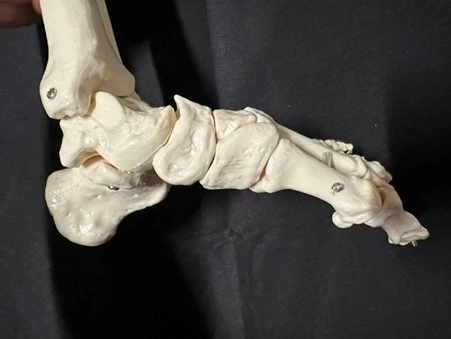
The function of the Toe Foot is dynamic. Its job is to organise how the foot ultimately takes the force absorbed through the Heel Foot and turns it into propulsion. It flattens during pronation as the force is transferred from the heel foot to the toe foot, then raises and stiffens with supination during the terminal phase of stance where it becomes a rigid lever. It is active during plantar flexion.
· The Heel Foot receives force
· The Toe Foot directs force
The Fascial Connection – the link between the foot and the rest of the body.
Both the Heel and Toe Foot are directly tied into one of the Anatomy Trains myofascial meridians. These are the pathways that force follows as it travels from the ground up into the body, and from the body back down into the ground.
This smooth transfer of force back and forth is what allows us to stand upright, walk, run and jump.
The Toe Foot (DFL)
The Toe Foot ties directly into the Deep Front Line (DFL) giving us the ability to create stability and propulsion.
Myofascially it transfers force up through the tibialis posterior, the deep posterior compartment, the adductors, the pelvic floor, the diaphragm and ultimately the deep neck, jaw and tongue. It is our body’s central stabilising system.

At the foot, it:
- Lifts and maintains the medial arch
- Creates a rigid lever for push-off
- Transfers force up through the core
When this system is weak it shows up as:
- Medial arch collapse
- Poor first ray function
- Weak toe-off (inefficient gait, shortened stride and limited hip extension)
- Pelvic floor and core weakness and instability
This is why foot Toe Foot dysfunction often results in:
- Lower back pain
- Pelvic instability
- Tight hip flexors, weak glutes and tight hamstrings
- Incontinence
- Breathing dysfunction
- Sexual dysfunction
- Poor digestion
- Medial knee issues
The Heel Foot (LL)
The Heel Foot ties into the Lateral Line (LL) giving us adaptability, balance and shock absorption.
Myofascially it transfers force up the chain through the peroneus longus & brevis, the IT band, the lateral hip stabilisers (primarily gluteus medius) and the obliques and intercostals.

This gives us:
Ability to stand on one leg (single-leg stance) which is essential for walking
- Controls side-to-side balance
- Allows adaptation to uneven ground
If this system dysfunctions we experience:
- Poor balance
- Ankle instability
- Lateral hip overload
- ITB issues
- Hip bursitis
- Spinal degeneration through uncontrolled impact forces (Ground Reaction Forces)
- Lateral knee issues
The Hidden Connection:
These 2 fascial lines are functionally tied together through a fascial sling that runs under the foot, effectively connecting the tibialis posterior and the peroneus longus. It creates tension and lift, providing dynamic stability for our arches. I described this mechanism in detail in [FBC #15 – Foot Dissection]
In summary, our Heel Foot (Lateral Line)
→ Feels the ground (afferent input)
→ Adapts to the environment
→ Keeps us balanced
And our Toe Foot (Deep Front Line)
→ Creates stability
→ Drives propulsion (efferent output)
→ Transfers force through the body
To put it into a simple analogy that patients easily understand…
“The outside of your foot is like your suspension system…
The inside of your foot is like your engine…
And the muscles underneath act like cables in a suspension bridge—holding everything together.”
The beauty of Better Balance Orthotics is that they improve all 3 of these functions. Through stimulating and engaging the muscles, nerves and fascia in the feet they activate the suspension system, improve the efficiency of the engine and strengthen the cables holding it all together.
The more I research and learn on this topic, the more deeply I come to appreciate what an elegantly simple solution they provide to one of our most universalphysical modern stresses… the very ground we walk on.
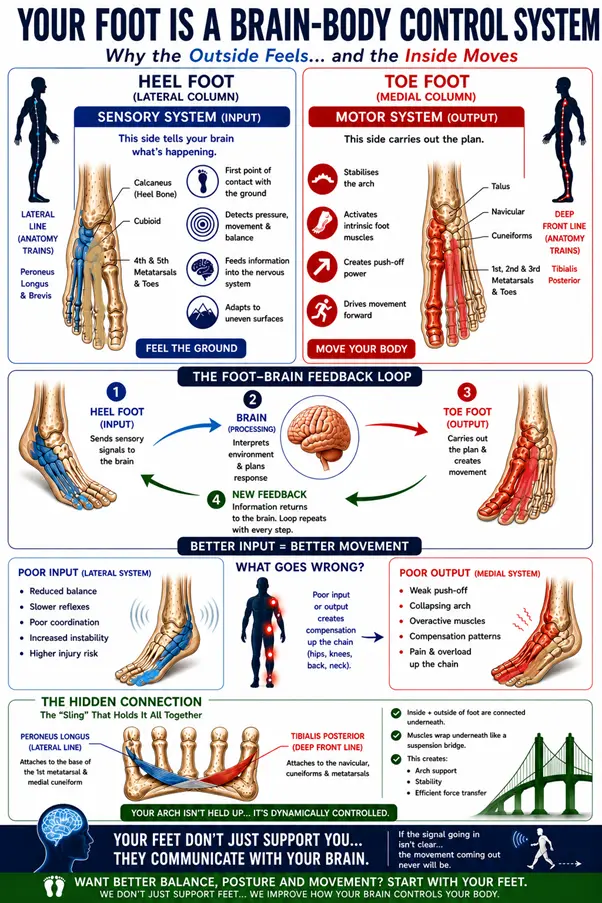
The Neurological Loop – where ADIO meets BUOI:
As we discussed last week, our foot is not just a mechanical structure—it’s a potent, highly innervated sensory organ that drives the brain.
When we map that onto today’s functional breakdown of the foot:
- Heel foot → sensory input (afferent – BUOI)
- Toe foot → motor output (efferent – ADIO)
The neurological role of the Heel Foot is to feed information to the brain.
This part of the foot is:
- First to contact the ground (heel strike → lateral loading)
- Rich in mechanoreceptors (Ruffini endings (stretch), Pacinian corpuscles (vibration) and Merkel discs (pressure)
- Constantly updating the brain about:
- Surface texture
- Pressure
- Speed of movement
- Directional change
As a result, the Heel Foot:
- Detects where you are in space
- Adjusts balance in real time
- Drives reflexes for postural control
When we wear shoes and walking on featureless surfaces, we deaden the input from this system. This produces slower reflexes, poor balance, less efficient movement and increased injury risk.
On the other hand, the neurological role of the Toe Foot is to execute the brain’s response. It takes the sensory input generated by the Heel Foot and converts it into force and movement.
It does this by:
- Stabilising the arch
- Activating intrinsic foot muscles
- Creating a rigid lever for propulsion
- Driving coordinated movement up the chain
Our brain is constantly shifting between these two systems throughout the stance phase of every step we take, coordinating pronation and supination, dorsiflexion and plantar flexion, heel strike to toe off, ADIO and BUOI. Information must flow both ways for the system to operate effectively.
The whole cycle looks like this:
- Heel foot
→ Feels the ground
→ Sends sensory data to brain
- Brain processes input
→ Cerebellum + cortex coordinate response
- Toe foot
→ Executes movement
→ Stabilises and propels
- New sensory feedback
→ Loop repeats continuously
It’s a closed-loop control system, occurring with every step we take:
Input → Processing → Output → Feedback → Repeat
If the input is poor, the brain is guessing and motor output is delayed or inaccurate, leading to instability and compensation.
If the output is poor, the brain may have good info, but it can’t execute effectively, leading to overload and inefficiency.
We need both components of the system operating efficiently if we want to experience healthy posture, balance, gait, movement and coordination.
This is why ADIO is expressed best when it’s counterbalanced with BUOI… it’s the yin and the yang of physical existence.
Nature spent millions of years fine-tuning this exquisitely balanced system… for an environment that most of us no longer live in on a daily basis. Some evolutionary biologists have suggested it was the evolution of our foot and bipedal gait that drove the expansion of our brain and our rise to become the dominant species on the planet.
Sadly, modern life has cut our brains of from that driving evolutionary force.
It’s why I believe Better Balance Orthotics are a perfect and vital complement to chiropractic care. If they’re not a regular part of your care plan, you’re missing a golden opportunity to create even more amazing results for your patients.
Cheers,
