
Wow, 23.5 hours on a plane, across 3 consecutive flights sucks!

Feels good to be home though.
The problem with flying into Sydney from the USA is that your flight lands at 7:30am… which is absolutely the wrong time to go to bed… even when that’s all you feel like doing!
So I hit the sauna and jumped straight into writing. Please forgive me if I’m a little less eloquent than usual this week… I think that long sitting on a plane turns everyone’s brain to mush!
It’s always worth it though. Puerto Rico was beautiful and the UAC meeting was excellent (as usual.)

Here’s the first insight I have to share…
You’re playing too small.
Thinking too small and playing too small.
That’s how I feel after every single UAC meeting.
Even when I go in thinking I’m not… I always come out knowing that I am.
I suspect the same might be true for you too.
I don’t mean that as a judgement… simply just an idea for your brain to chew on when you have a quiet moment. Where might it be true for you… and what would you love to do about it if you really gave yourself permission?
Anyway, with that being said…
I mentioned last week how I ran into Dr. Stephen Franson by the pool as I was writing to you. We ended up having quite a deep conversation and I’d like to share some ideas from it with you… as well as a new paradigm I think you’ll find useful.
(There’s a couple of practice gems here too.)
One of the things we discussed was how to scale chiropractic on a worldwide level, and what the blocks to massive growth were.
Something Steve said that really struck me, was he felt one of our key limitations is a lack of understanding of what our actual offering in the marketplace is.
He said that most chiropractors believed our product is the adjustment.
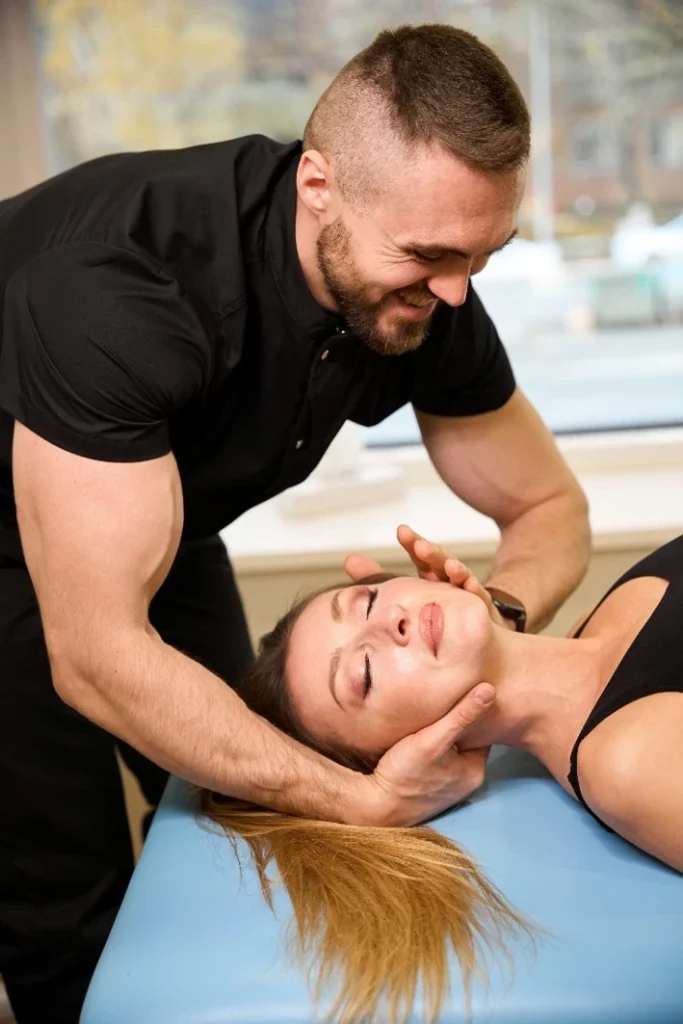
However, our real product isn’t the adjustment.
There are other professions manipulating the spine, such as manipulative physiotherapists.
But they aren’t creating the same life, and health transformations that we are.
(I know most of us would argue that what they are doing is manipulation, not adjusting… but that’s exactly the point. The question is… why are they moving the bone?)
The adjustment is how we deliver the product…
But it’s not the actual product itself.
According to Dr. Stephen, our real product is our philosophy.
It’s ADIO – the understanding that health happens from Above Down, Inside Out.
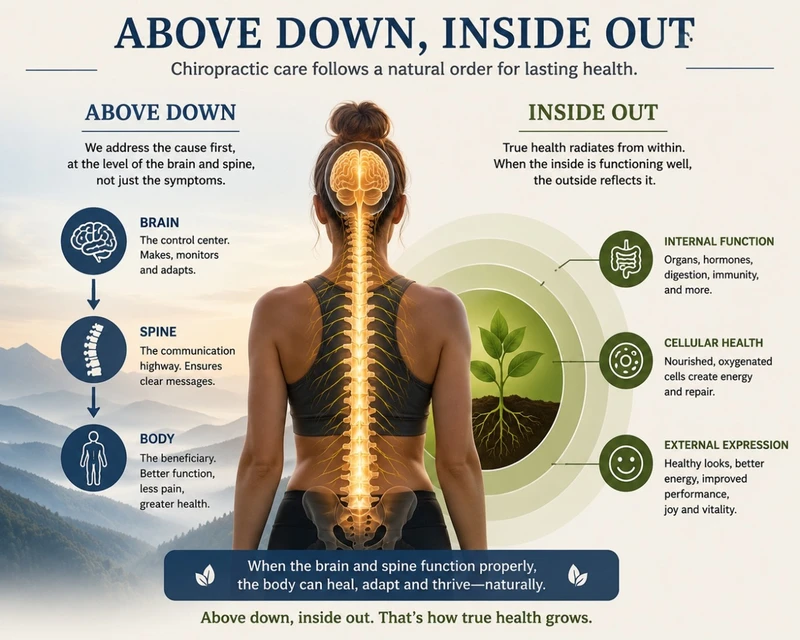
That resonated pretty deeply with me. It’s the first thing I teach my patients:
“Your body is designed to be healthy. It’s meant to work well and feel great. What interferes with that is stress. There are 3 main types of stress that we deal with- Structural, Chemical or Emotional.”
I also teach them it’s the fundamental difference between our approach and the standard western medical approach. Their philosophy is that the body is somehow broken and requires some kind of outside intervention to fix it… typically a drug of some kind.
Ours is that we need to identify and remove the interference to allow the body to heal itself.
That can seem like semantics when patients first hear it, partly because it’s so foreign… they’ve never actually heard it before.
But in reality, it’s everything.
This ADIO approach is fundamental to our chiropractic philosophy.
Dr. Steve reminded me that we should always…
“Keep the main thing, the main thing.”
What he means is that every additional modality, therapy or communication we introduce into our practice must align completely with our philosophy.
Otherwise, we are creating contradiction and confusion.
And there’s a saying in sales…
“Confusion never converts.”
Everything we add to our practice should be positioned as supporting or enhancing the adjustment.
As a means of removing interference from the nervous system and allowing ADIO healing to occur.
Better Balance Orthotics align beautifully here…
“These orthotics will help you get the most out of your adjustment and hold your adjustment better.”
They are always an amplifier and enhancer of the adjustment, never a replacement for it.
Dr. Steve believes this is the ideal way of communicating their value and importance to your patients. I’ve found the same thing to be true… when you take this approach, patients just “get it.”
The same is true for everything extra you do in your practice… shockwave, laser, massage, nutrition, pillows, dry needling, PEMF…
There are so many great therapies out there that complement what we do, but if they are presented as a collection of possible clinical options…
It can feel overwhelming or disjointed to the patient.
And remember, confusion never converts.
There is significant research to support this conclusion… many studies have shown that too many choices lead to less sales (and in chiropractic, a “sale” can be the difference between someone getting healthy… or not.)
I’ll include a few references at the end of this email if you’re interested in exploring this concept further… it’s actually pretty fascinating.
As Dr. Steve put it…
“If you can’t tie something back to the adjustment in a single sentence then it doesn’t belong in your practice.”
(By the way, this doesn’t limit your use of supporting modalities… it just places them in the right context. Steve told me he’s a black belt at this and gave me at least 10 examples to prove it.)
I’d suggest it’s highly worth your time doing an audit of the different offerings in your practice, including how they’re communicated… any that don’t fit this framework need to be repositioned, or eliminated altogether.
The amount of clarity, certainty and conviction this creates…
Both in your team and your patients…
Is truly palpable.
It’s like suddenly everyone is running in the same direction, towards the same goal. It lifts the whole practice.
So, if our real product is our philosophy, with ADIO being a critical component of that…
A new concept has recently been crystalising in my mind.
There is a perfect complement to ADIO.
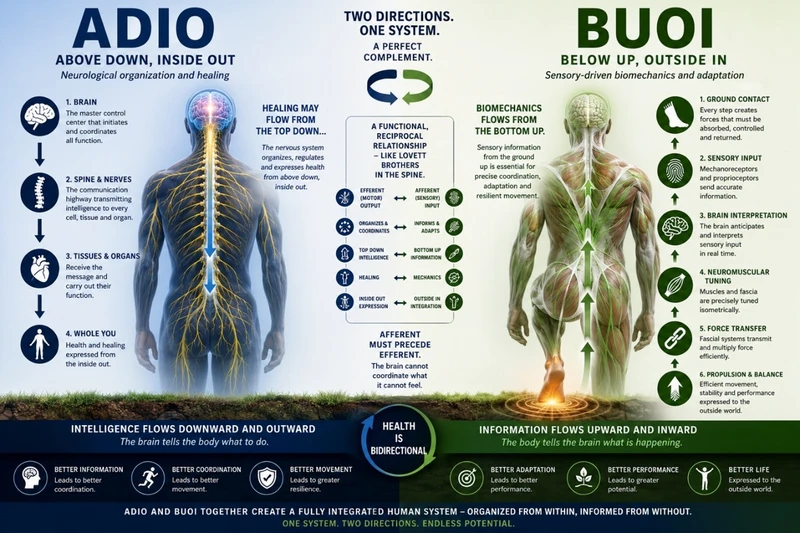
It’s a mirror image… like a Lovett Brother relationship in the spine. A functional, reciprocal relationship.
I call it BUOI.
Below Up, Outside In.
Hear me out…
I mentioned 2 weeks ago how so many of the experts I’ve talked to recently have come to the same conclusion…
That when we get the top and bottom of the system sorted, everything in between seems to fall into place.
This is a physical manifestation of that.
Healing may flow from the top down…
But biomechanics flows from the bottom up.
All forces in the body, whether internally generated or externally imposed…
Must ultimately be anchored into the ground.
Otherwise we simply fall over.
We’ve discussed the mechanisms of this at length, including the function of the myofascial meridians described in Anatomy Trains and the concept of tensegrity [FBC#4 Tensegrity] [FBC#11 DFL and LL]
This is the Bottom Up component. Every time our foot strikes the ground, the forces generated must be absorbed, multiplied and then returned to the ground for propulsion.
But this doesn’t happen in a vacuum. It requires precise tuning and coordination of muscles, fascia, bones and joints… all acting together in a perfect symphony.
And our brain requires sensory information to conduct that symphony.
Lots of it.
And if we want the right output… it has to be accurate.
That’s why our foot contains some of the greatest density of mechanoreceptors and proprioceptors in the body, and houses the smallest, finest nerves in the peripheral nervous system.
Our nervous system is a sensory first system.
Afferent must proceed efferent.
This is the Outside In component.
It’s a major reason why shoes and flat, featureless surfaces are so damaging… they massively reduce afferent input.
And without that, the efferent output never has a chance of being correct.
There’s solid research to back this up. It shows that when our foot strikes the ground, the Ground Reaction Forces (GRF) are absorbed into the body in less than 50 milliseconds.
But it takes 70 milliseconds for the brain to activate our muscles.
This means we can’t operate reactively… the brain must actually anticipate the GRF and pre-activate neuromuscular responses to meet the ground with each step.
It can only do that with constant, moment-to-moment sensory input.
Our brain then uses isometric contractions of the foot and leg muscles to create precise tension in the fascial compartments, dampening the impact forces.
This is known as Muscle Tuning Theory.
It is this calculated, anticipatory control of muscles, joints and fascia that allows us absorb force, elastically multiply it, and use it for efficient propulsion…
Rather than experience it as damaging impact forces throughout our body.
I’ve heard Dr. Franson say that every problem in the body is the result of either a toxicity, or a deficiency… or both.
The shoes-and-flat-surfaces issue falls into the category of both.
The deficiency is the lack of accurate afferent input…
And the toxicity is the aberrant foot mechanics and constant pounding of excessive, poorly managed ground reaction forces.
Unfortunately, most people are experiencing this double-whammy every day… including many of our patients from the moment they step off our treatment table!
This is why it’s so critical to incorporate the BUOI component into our healing philosophy.
It completes the loop:
- ADIO = intelligence → expression
- BUOI = environment → information
Or even more simply:
- ADIO: The brain tells the body what to do.
- BUOI: The body tells the brain what’s happening.
I remember years ago seeing Dr. John Demartini lecture for an entire day on the ancient wisdom:
“As Above, So Below”
He described in intricate detail how it plays out on every level of the cosmos, from stars and galaxies right down to cells and human psychology.
This is another example of that universal principle in action.
Next week we’ll explore an interesting biomechanical model I recently came across that ties the foot-brain connection into a coherent sensory and mechanical system… it’s the physical, functional link between ADIO and BUOI.
Have a great week.
Cheers,

PS. Have you checked out our Youtube channel? Sometimes it’s easier to show than to tell, so every issue of The Foot-Brain Connection is also an episode on Youtube. If you could take a minute to subscribe, like or share any of my videos it would really help the algorithm connect me with other chiropractors who need to learn these foundational concepts. You can find it here: https://www.youtube.com/@betterbalanceorthotics
Thank you 🙏 (Please ignore the weird, AI-generated me on the thumbnails that I just discovered… I promise the actual videos are all the real me!)
References:
Iyengar, S. S., & Lepper, M. R. (2000). When choice is demotivating: Can one desire too much of a good thing? Journal of Personality and Social Psychology, 79(6), 995–1006.
Chernev, A., Böckenholt, U., & Goodman, J. (2015). Choice overload: A conceptual review and meta-analysis. Journal of Consumer Psychology, 25(2), 333–358.
Scheibehenne, B., Greifeneder, R., & Todd, P. M. (2010). Can there ever be too many options? A meta-analytic review of choice overload. Journal of Consumer Research, 37(3), 409–425.
Schwartz, B. (2004). The Paradox of Choice: Why More Is Less. New York: Harper Perennial.