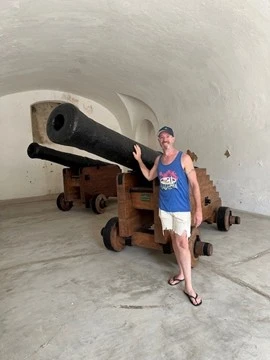
This week I’m writing to you from Puerto Rico, where I’m attending a meeting of my mastermind group, the UAC.
There’s something about being in the Caribbean that naturally brings pirates to mind… something to do with a certain movie perhaps? It’s not just the movie though- it’s a real part of the history here. Yesterday we explored Old San Juan, with its castle, fort and walls around the town, all built to defend the island from attack.

So I thought today we’d explore the analogy of running a Pirate Ship vs a Battleship and what it means for your practice. Implementing this framework has made my life easier, my team happier and my clinical results more consistent.
Thanks to Dr. Stephen Franson, founder of The Remarkable Practice, for the colourful analogy. He described their work coaching chiropractors as…
“We turn pirate ships into battleships.”
What that actually means is they help chiropractors install powerful, repeatable systems that take the stress and chaos out of clinical practice, produce better results and allow you to scale to whatever size you choose.
As chiropractors we’re naturally drawn towards the pirate ship model. It seems to be built into our collective DNA.
Chiropractors are typically free-thinking, contrarian and individualistic. We love to think outside the box and create novel solutions. Over the years I’ve been fascinated by how many different healing systems have been developed by chiropractors.
Some of them I’ve studied not even realising that’s where they originated, only to find out later that their developer was a chiro.
This novel thinking is one of our superpowers.
It’s also our kryptonite when it comes to running an effective business.
Pirate ships thrive on chaos, excitement and unpredictability. So do many chiropractic practices… mine was one of them for years!
Battleships, on the other hand, thrive on systems, routine and discipline. Which sounds terribly boring, even stifling to the free-spirited contrarian in me…
But the reality is, you will produce way bigger outcomes with a battleship than you ever could with a pirate ship.
And when it comes to improving the health of our patients, our community and our planet…
Bigger is actually better.
Last week we discussed the importance of the basics when it comes to creating health… sleep, diet, movement, healthy gait patterns.
This doesn’t just apply to your health… it also applies to your business.
When it comes to running a healthy practice, installing effective systems is an essential basic.
A coach of mine years ago described the word SYSTEM as…
Save
Your
Self
Time
Energy &
Money
When you put it like that, it sounds a bit sexier, hey?
One of the problems is that we were trained to be healers, not business owners. My university education included exactly 1 single business course… one hour per week, for one single semester.
That adds up to about 12 hours of business training in total over my entire 5 years of study!
No wonder I had no idea how to run a business!
Not only that, my practice was tiny to begin with. It was just me and a single CA, seeing a handful of patients per week. That meant we could get away with having minimal systems in place.
(It didn’t make it ideal… it just meant we could get away with it!)
That’s not the case anymore.
Over time it’s evolved into a team of six doctors and a CA team that runs like a well-oiled machine (for the most part) serving hundreds of patients per week.
That’s what has allowed me the freedom to be writing to you from Puerto Rico today, while my patients continue to be well cared for in my absence.

Before flying out here, we had a team meeting. In it I shared my plan to pull back from some of the day-to-day running of my practice to devote the time required by the ongoing growth of Better Balance Orthotics (thank you for being a part of that!)
To be honest, I was kind of nervous leading up to the conversation. I was worried they’d feel like I was abandoning them.
Turns out I needn’t have worried…
They were stoked.
Removing myself as a bottleneck and improving our systems actually makes their life easier. And it will allow the practice to create even better, more consistent outcomes… for even more patients.
In his excellent book, Atomic Habits, author James Clear describes how systems win out over willpower every time.
This was a huge take-away from the book for me.
For example, if you want to lose weight, planning your grocery shopping and removing snack foods from your house massively increases your chance of success.
If you want to build a consistent gym habit, laying out your gym shoes and workout clothes the night before works… you simply remove the friction, so that it becomes easier to take the desired action.
This kind of make-it-easy, remove-the-friction approach definitely applies when it comes to getting the most out of Better Balance Orthotics in your practice.
Having now worked with hundreds of practices, a very clear pattern has emerged.
Docs who embed BBO directly into their clinical system generate far better results than those who think of it as just another product or service.
In past issues we’ve talked at length about the health benefits of wearing Better Balance Orthotics… improved movement, balance, posture, breathing and digestion just to name a few.
Today I want to look at the business benefits.
To extend our pirate ship analogy, another great saying I learned from Dr. Franson is…
“You can’t fire a cannon from a rowboat.”
He explained that he sees Better Balance Orthotics as more than just an additional product to add to your business…
He sees it as a cannon… a ready-made, “bolt-on business” you can install within your existing practice. Add text to your email.


He’s right… I’ve seen this in action. Some docs help an occasional patient here or there with a pair of orthotics.
Others install a whole new arm to their practice.
One that takes their results to another level, increases referrals, and generates an additional stream of revenue they can use to further enhance their service.
This works best if you’ve built your practice as a battleship (or at least transformed your pirate ship into a battleship.) In his estimation, many practices in their current form are still more like pirate ships… or even rowboats. They are personality-driven and reactive rather than proactively system-driven.
This shows up in the form of inefficiencies, frustrations and stress for the practice owner and the team.
They are unable to make the most of a practice multiplier like Better Balance Orthotics and often create hit-or-miss results when it comes to implementing things that could genuinely help them and their patients.
So what does this look like in the real world?
The first step is to work out where BBO fits into your clinical philosophy.
If you view them as a “treatment for foot problems” then it makes sense to pull them off the shelf occasionally when a patient is experiencing foot issues.
When I first started with them, I saw them as a “treatment for scoliosis” and applied them when addressing that specific condition.
These days I consider them a Neurology-Based Rehab System that addresses a fundamental issue:
Humans are not designed to wear shoes and walk on flat, minimal-stimulation surfaces all day long.
With that understanding in place, it makes sense to present them to patients at the very beginning of their care. The data we’ve collected shows that wearing Better Balance Orthotics helps patients hold their adjustments and maximise the benefits of every other clinical intervention.
I want that in place for my patients right from day one.
That’s why we assess for them on the initial visit and present them as an integral part of our patients’ care plans.
Otherwise, they’re working against their adjustment the minute they step off the treatment table.
So, based on your clinical philosophy and understanding, where does it make sense to introduce your patients to BBO?
If this isn’t happening at a consistent time in your practice, you’re definitely missing opportunities to help your patients more and improve your results.
One of the key features of a system is that it’s consistent and repeatable. It doesn’t rely on you having to remember it… it just happens automatically as part of the process.
I had reminder how important that is this week.
A patient of mine, Lauren, complained about a pain in her foot and the lack of results she’d had trying to improve it with physiotherapy and podiatry. She’d been experiencing it for months… longer than time I’d been treating her.
I was shocked. It was the first time she’d mentioned it to me.
I asked if she wore our orthotics and she just looked at me blankly.
Talk about frustrating! I was kicking myself.
Here she was, experiencing a problem that was easily correctable with the techniques I’ve developed. Trying multiple other therapies that weren’t helping. Spending a bunch of money…
And I didn’t even know about it!
By the end of that treatment session the pain in her foot was reduced by 80% and I’d fitted her with a pair of Better Balance Orthotics to ensure it resolved fully and doesn’t recur.
So how did this situation happen?
Lauren was a long-term patient at a friend of mine’s clinic.
When she recently moved to Sydney, she started seeing one of my associates. When that doc went on maternity leave, Lauren came to see me.
We generally share care of the patients in my clinic, and because she’d been under regular care, I didn’t do a full reassessment when I first saw her… I just continued her current care plan.
She’d been dealing with the foot issue for so long that she didn’t even bother to mention it.
Had she walked into my practice as a new patient, this would have been picked up and dealt with on her initial visit.
Instead, she slipped through the cracks, and put up with an annoying problem unnecessarily for months.
I really feel like I let her down.
It’s a reminder that even when you have a system, it doesn’t always work perfectly 100% of the time.
But it’s a hell of a lot better than having no system at all. Instances like this are becoming much fewer and farther between in my practice.
Once you decide when to introduce BBO, and it’s happening consistently, your system should also include how you introduce it.
Your communication should be consistent with each patient, and across your entire team.
Are you positioning BBO as an optional add-on?
Or as an integral part of your system?
When I used to assess patients for BBO at my 12th visit progress exam, they often tended to perceive it as “one more thing” they had to do. Some even asked…
“If this is important, why didn’t you mention it until now?”
It’s a reasonable question.
We found that by shifting the assessment to our initial consultation, it made much more sense to patients. Of course, they want the best results from their care, so why not do everything possible to enhance that outcome?
In my clinic we do lots of objective testing on our initial assessment, including posture photos, thermal scans and vestibular testing. Assessing their feet and the impact on their neurology naturally fits here.
In fact, at my team meeting last week we discussed moving the BBO testing from the consult with the doc to the pre-testing that is completed by the CA team before the patient even sees the doc. This will streamline the process even further.
I’ve seen this work well in other practices… I’ll keep you posted on how it goes.
Your system should also include the physical aspects that make it easy and seamless to use.
Do you have a demo pair for testing patients in every consultation room? Is there a tape measure there so you can immediately measure them? Or do you have to go somewhere to find them.
Remember it’s all about removing friction and setting up your environment so it’s easy to succeed… minimal willpower or effort required.
If having an extra demo pair would enhance your system, let me know and I’ll get one sent right out to you.
A quick note on that testing…
I love the standing hip flexor test. It’s such a powerful, visceral demonstration to the patient about the impact of BBO on their neurology.
However, recently I’ve spoken to a couple of clinics who are doing great utilising BBO with their patients… but they prefer not to do that test. It just doesn’t fit as well with their system. Instead, they simply explain how important correct stimulation of the nervous system is.
The point is, there’s no right or wrong. There’s just what works best for you and your team.
Figure out what that looks like, then make it a repeatable aspect of your system.
The same goes for every step of the process.
Is it easy for your front desk? Is their communication aligned with what your docs are saying to the patient?
In my practice they take a photo of the prescription pad, send it through to info@betterbalanceorthotics.com, take a deposit, and share with the patient what to expect… including the benefits they’ve personally received from wearing BBO.
They also schedule a 6-week check-in to make sure the patient is getting the most from their new orthotics, as well as a 12 month follow-up to reassess them (and offer them a chance to grab another pair if they choose.)
Once you have your system in place, don’t just forget about it and assume it’s working. It’s worth checking in on periodically.
Does everyone on your team understand the system?
Are they using it consistently?
Is there any way they think it could be improved?
Sometimes they see things that you don’t, or get tripped up on things that you take for granted.
In almost every team I’ve worked with where they previously used the system well, but drifted away from it over time, this was the case. There was one stumbling point that made the system a little clunky or uncomfortable…
So over time they just stopped using it.
In most cases it wasn’t even a conscious decision… it just kind of happened without anyone even really noticing it.
What’s worse is, that sticking point was virtually always easily resolved once it was brought to awareness.
If this describes you or your team, please reach out- just reply to this email. I’ve helped many teams get their system back on track (or create it in the first place.) Chances are we’ve already solved your particular challenge many times over.
(If you don’t even know what the challenge is, that’s ok too… over time I’ve become an expert in systems diagnosis.)
One of the reasons this happens is that humans naturally tend to lose focus and drift over a 90-day period. I was first introduced to this idea in the book Traction, and then further reminded of it through Dr. Steve and the TRP systems he developed.

That’s why he suggests having a whole-team quarterly meeting, in addition to regular weekly meetings.
Implementing this absolutely revolutionised my practice.
The amount of clarity, focus, inspiration and renewed purpose in my team after every quarterly meeting is palpable.
Productivity goes way up.
Team happiness and satisfaction goes way up.
And patient numbers and results go way up.
It’s a win for everybody.
(If you’re thinking at this point… “Yeah, but Andrew, I hate running meetings…” you’re not alone. I also hated running meetings… so I avoided it for a long time.
And my business, my team and my patients suffered as a result.
Over the years there have been times when I’ve run my practice with constant meetings, and times when I’ve had none at all. Trust me… constant works better. I wouldn’t exactly say I’ve come to love them… but I’ve certainly come to highly value them!)
Obviously the focus of this email has been creating or refining your system for utilising Better Balance Orthotics to their full potential…
As a cannon.
A full bolt-on-business to enhance your existing practice and results.
But the truth is, what I’ve shared applies to every aspect of your practice.
If you just took one function in your practice and effectively systemized it each quarter…
In a year’s time your business would be virtually unrecognisable.
Like I mentioned earlier, if you need any support with this, please reach out. I’m here to help.
And if you know another doc who could also use that help, please share this newsletter with them. You’ll be helping them and their patients. To quote Dr. Franson one more time…
“We’re in the business of saving lives. When business is good… everyone wins!”
Thank you.
Have a great week.
Cheers,

PS. To appropriate a famous Aussie expression… That’s not a cannon… THIS is a cannon!
You definitely can’t fire this thing from a rowboat!