

A few years ago, I quit going to the gym.
It wasn’t that I didn’t enjoy it.
It was just… inefficient.
I switched to a daily resistance band workout I could do at home. Once I understood the science of variable resistance training, it just made sense. I was able to achieve the same results in 20 minutes that used to take me 60-90 minutes in the gym.
(If you’re interested to know more, check out the book Weight Lifting is a Waste of Time by Dr. John Jaquish.)
I bought Dr. Jaquish’s X3 workout system, which was a significant investment, especially with postage to Australia and our crappy dollar conversion… but worth every cent in time saved and improved results.

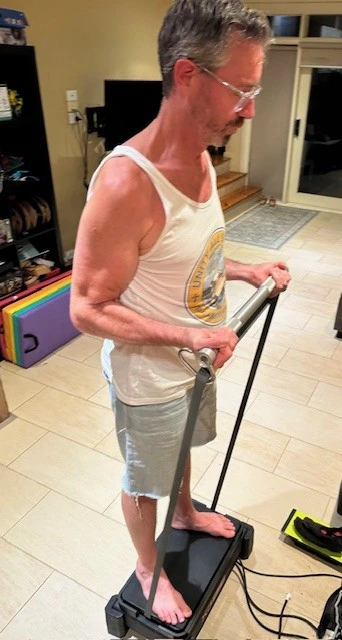
Then about a year ago he came up with the X3 Force bar, which is exactly the same bar… but with the capacity to measure force in real time.
By connecting it with an app I can see how much total force I’m producing with every rep, and each exercise overall.
Of course, that meant another significant investment… but again it was totally worth it.
Why?
Because what gets measured improves.
Each workout I can see when I’m approaching my previous max force… and squeeze out every last drop of effort to beat it.
Which drives continuous improvement and accelerates progress.
(Today we’re going to talk about why this matters in your practice… and how to develop and communicate total certainty about your results.)
This same fundamental dynamic applies across all domains of life… finances, business, health…
It’s why wearable devices are becoming one of the biggest industries on the planet… we live in a data-driven economy.
As Dr. Franson of the Remarkable Practice puts it…
“Being a great CEO is two parts data and one part gut… if you’re guessing, you’re stressing.”
That’s why I’m so excited by the purchase I made over the weekend at the Remarkable Practice Immersion in Brisbane.
I had a conversation with Dr. David Fletcher, founder and CEO of CLA, about their INSiGHT scanning technology. Their technology has been around for decades (although they’ve continued to improve it over that time) and is used in thousands of chiropractic clinics around the world… I’m sure you’ve come across it.

I’ve looked at it for many years, however, for one reason or another, it was never the right time.
Talking to David, I learned that he’s done quite a bit of work with Foot Levelers and The Orthotic Group in the past, using their technology to investigate the physiological impact of their orthotics.
He was impressed with our Stimulation vs Support model and the neurological implications of Better Balance Orthotics. He said to me…
“This is definitely the future… and it aligns perfectly with chiropractic.”
I couldn’t agree more.
I love finding new ways to validate the effects of our orthotics. In my clinic we use posture photos, vestibular plate technology, thermal images and of course, all of our chiropractic, orthopaedic and neurological testing to measure lasting changes.
Now we’ll have a whole new set of data to add to the growing body of evidence.
One piece I’m particularly excited about is their HRV (Heart Rate Variability) measurement. Research has consistently identified HRV as one of the best leading indicators of health.
This means it identifies problems before they occur, unlike most health measures which are based on lagging indicators… they measure what has already happened.
I have quite a bit of anecdotal evidence that wearing Better Balance Orthotics improves HRV… mainly from wearable devices such as Oura rings and wristbands that track heart rate.
For example, Dr. Caleb recently told me that when he started wearing Better Balance Orthotics, his sleep score consistently improved by 20 points. On the one day he wore different work boots without his orthotics the score dropped again… then went right back up the next day when he wore them again.
It’s cool to hear those kinds of stories… but now we’ll add a solid clinical data-set to back it up.
Because results matter.
They drive greater clinical certainty for you, and greater confidence and long-term outcomes for your patients.
One question I get asked is…
“How do you know that patients who wear Better Balance Orthotics hold their adjustments better?”
It’s a fair question.
And the answer is simple… Data.
Not opinion.
Not hope.
Real world results.
At the TRP Immersion over the weekend I had an opportunity to invite someone up onstage to demonstrate the immediate effects of our orthotics.
You can watch the 2 minute clip here:
I told the audience we were going to measure 3 specific variables:
· Range of Motion
· Pain/Muscle Spasm
· Muscle Activation
As you can see from the clip, all 3 measurements visibly improved…
His cervical and shoulder range of motion improved, his pain and spasm decreased and his hip flexors went from totally inhibited to firing normally.
This was not a “here’s one I prepared earlier…” type of demo. This was a genuinely random volunteer that I invited up from the audience.
The first time I did this in front of a live audience, to use a quaint Australian term… I was shitting bricks.
I had no idea if I was about to look like a fool.
I knew the orthotics worked clinically… but would it be clear and obvious enough for a live audience to see the immediate changes?
It could have been a disaster.
Fortunately, that’s not what happened. Nor has it ever in the many times since that I have done this live demonstration.
It works every time.
How can I be so sure?
Experience, and data.
We’ve now measured thousands of patients, across hundreds of clinics, on a range of both objective and subjective variables.
Patients who wear Better Balance Orthotics hold their adjustments better.
Period.
Their symptoms improve faster.
They move better.
They experience less fatigue when they’re on their feet.
Their objective findings change- x-rays, posture photos, thermal scans, vestibular scans, palpation findings, spinal listings, range of motion, cerebellar tests…
I know you’re already seeing these changes in your practice, even in patients who don’t wear our orthotics.
Chiropractic alone is amazing, and we know it works.
I’m telling you there’s more available.
When you add Better Balance Orthotics to your care plan, changes happen faster, and they last longer.
My very first day in practice, I walked in as the sole doctor in an empty practice. The previous doc had quit, so there was no one there to mentor me or show me the ropes.
I looked at his notes and was totally puzzled… there were a few listings on the top line, then whole pages of…
TAA
TAA
TAA
Etc…
I had no idea what it meant, so I had to call my boss and ask him to explain. Here’s what he said…
“TAA stands for Treatment As Above.”
I was completely floored.
This wasn’t a care plan… it was a single adjustment on repeat for months.
This was one of my biggest challenges when I was working in the student clinic at my university. I remember asking my clinic supervisor…
“I adjusted this patient’s L4, it was a great adjustment (at least, so I thought at the time), but then he came back next week and it was back again… what do I do?”
Of course, the answer was… “Adjust it again.”
Now, I obviously understand that not every problem resolves with one adjustment…
But if you have to continuously adjust the same segment…
You’re missing the deeper cause.
You’re adjusting a compensation pattern.
It’s one of the things I love about the AK paradigm… it gave me the tools to investigate the chemical and emotional side of the triad of health to uncover some of the causes I was previously missing.
This is not unique to AK…
D.D Palmer stated that the primary causes of subluxation were trauma, toxins and autosuggestion.
These are just different words for the same Structural/Chemical/Emotionalmodel.
As chiropractors we understand that our structure forms the foundation of our health.
Taking that one step further…
Our feet form the foundation of our structure.
They are literally the foundation of our foundation.
And in many practices, they are being largely ignored…
Or adjusted now and then…
But then left to operate in the same modern-shoes-and-flat-surface-environment that caused their breakdown in the first place.
Doesn’t it seem logical that patients who wear Better Balance Orthotics hold their adjustments better?
At the TRP Immersion Dr. Malcolm shared the example of Sisyphus (the Greek king who was sentenced to forever push a boulder uphill) as an analogy to describe the constant push of driving retention in practice.
It was a great metaphor that really struck home for me. His point was that you may never get to stop pushing, but by having the right systems in your practice you can at least reduce the steepness of the slope you are pushing the boulder up.
This doesn’t just apply to your business systems…
The same thing is true in clinical practice.
Adjusting patients without using Better Balance Orthotics to lock in and maintain those benefits is like doing this…

Versus when you prescribe our orthotics to help them maintain their adjustments and build on their progress faster it looks like this…

I know which I’d rather!
I remember the days when I first started practicing chiropractic… I had 5 years of theory and university training behind me… but virtually no real-world experience to build a basis for clinical certainty.
And it showed in my practice, my communication and my confidence.
My boss at the time told me there were 2 things I could rely on… objective data and the experience of those who’d come before me. He said…
“You can borrow my certainty… until you build your own.”
And build my own I did. Over the last 24 years of practice, I’ve arrived at a place of unshakeable certainty about the benefits of chiropractic.
You might not be at that place yet when it comes to Better Balance Orthotics.
That’s ok.
The data backs you up, and until your level of certainty becomes as bulletproof as mine is…
You’re welcome to borrow my certainty.
Have a great week.
Cheers,
