

I’ve just landed back in Sydney after an incredible week in Aspen at the Ski for Wally AK seminar. It was a time of connection, learning and healing (and of course, snowboarding.)

Every one of the speakers at the event was excellent. I’m constantly amazed at the level of genius within our profession…
And the level of heart that it’s matched with.
It’s a rare combination.
One fascinating thing was the way every speaker’s talk complimented and interconnected with every other presentation…
Despite the fact that none of us had any prior knowledge of what the others would be teaching.
My presentation on the “Cheat Codes for Balancing the Fascial System” linked up perfectly with the information from several other presenters, and today I’d like to share some of the insights that resulted.
Since becoming CEO of Better Balance Orthotics in 2020, I’ve been on a mission to uncover the mechanisms that create such consistent, profound changes in so many varied aspects of health…
Some of which, on the surface, seem to have nothing to do with feet.
This weekend filled in a few more gaps for me.
One area I’ve been studying in depth is the fascial system. We covered some of the concepts I’ve learned in Issue #4 – Tensegrity … (if you haven’t read that issue it’s a good primer for today’s discussion.)
The old paradigm was that fascia is simply unimportant connective tissue.
The newer, more accurate paradigm is summed up by this quote from Dr. Emily Splichal, author of Barefoot Strong and Sensory Sapiens…
“Fascia is an extension of your brain.”
The paper I presented last week was about some reflexes I have discovered that seem to operate in similar fashion to neurolymphatic reflexes (also known as Chapman’s reflexes.)
In Applied Kinesiology, each individual muscle has a neurolymphatic reflex that, when rubbed or treated in a variety of ways, can enhance the function of that muscle.
The difference with the reflexes I have developed is that they seem to influence entire musculofascial chains (as described in Tom Myers’ book Anatomy Trains) rather than just one muscle.
These musculofascial chains, or anatomy trains, describe how the body absorbs and transmits force in a coordinated way.
An example would be the Deep Front Line (DFL):
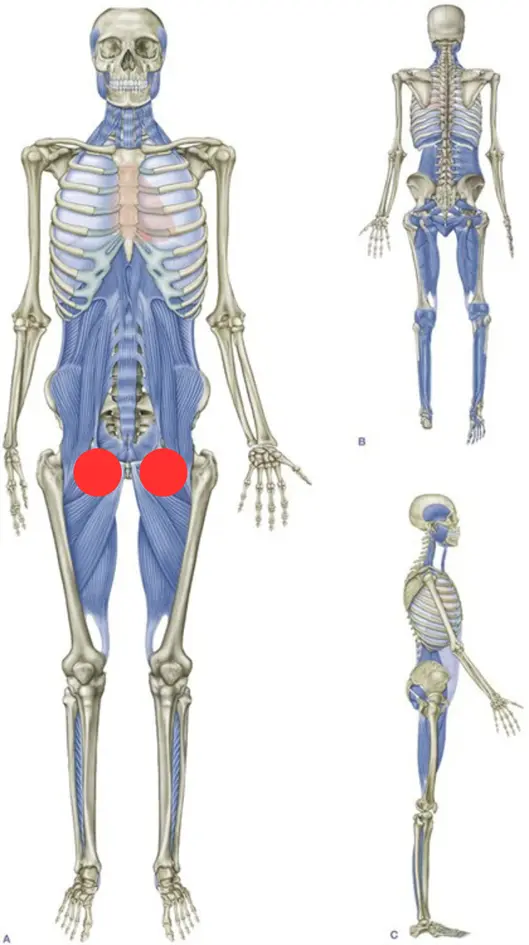
The Deep Frontal Line runs up from the feet and blends with the adductors, the pelvic floor, the psoas and illiacus muscles, the diaphragm, and then up through the ribcage into the neck and jaw muscles.
It is critical for maintaining the arches in our feet and all aspects of pelvic floor and core muscle function.
If you have patients with an unstable lower back, weak core activation or incontinence issues, try rubbing the reflexes marked on the picture above- they are on the front of the pubic bone, roughly an inch from the midline.
They are usually exquisitely tender.
If you rub them firmly for 1-2 minutes you will usually find your patient gets up off the table feeling much more solid, stable and grounded (not to mention, with less back pain.)
They will also maintain their adjustment better, especially if you prescribe the reflexes for homework- have the patient rub them for 2 minutes twice daily until they are no longer tender (this may take weeks or even months.)
If they are not wearing Better Balance Orthotics the reflexes may continue to be painful no matter how long they rub them for…
This is because the DFL begins with the arches on the feet, so every day they continue to wear shoes and walk on flat, unnatural surfaces they are working against your corrections.
Despite the critical importance of these musculofascial lines, I rarely hear them discussed… even though the book Anatomy Trains was first published in 2001.
I’ve heard the statistic that new information often takes 20 years to translate into common clinical practice… I guess unfortunately there’s some truth to that.
That’s why I was surprised during Dr. Marielle Alewaters’ excellent lecture on breathing, when she showed a slide of the entire DFL dissected out in one piece.
Dr. Marielle is an orthodontist and AK diplomate and her lecture focussed on the importance of nasal breathing across many different domains of health, including structural development, neurology, immune system function, concentration, learning and sleep.
What I hadn’t appreciated until I heard her present was that the DFL doesn’t just terminate in the neck and jaw muscles…
In fact, it continues all the way from the feet to the tongue.
Tongue posture is vitally important for maintaining nasal breathing, airway patency, facial structure and development (including teeth placement) and of course, speech and phonation.
What she was describing was a direct connection between foot function and our breath, our dentition and almost every aspect of our health and development.
(Her presentation was a compelling 4-hour deep dive into the fundamental importance of correct breathing and how it shapes us… if you’re interested, another resource I highly recommend on the topic is the book Breath: The New Science of a Lost Art by James Nestor.)
This points to a whole new mechanism by which Better Balance Orthotics impact health… one that I hadn’t previously considered.
Through their influence on stimulating the DFL, it seems plausible that they may directly impact breathing and even craniofacial development.
It also provides another possible explanation for the observation that children who wear them seem to concentrate and perform better at school…
I had thought this was just due to better neurological stimulation of the brain via the feet, but if your brain is more oxygenated through better breathing…
And you sleep better through better airway structure and function…
Of course you’re going to perform better at everything, whether on the sporting field or in the classroom.
This opens up some whole new lines of questioning and research for me-
Does our foot function drive breathing and airway function…
Or does our breathing and airway function drive proper foot function?
Like so many things in the body, I suspect the influence is bidirectional, with each influencing the other.
It also brings to mind the book Nutrition and Physical Degeneration by Dr. Weston A. Price.
For nearly 10 years in the 1930’s Dr. Price travelled the globe, including to some of the most remote places in the world, comparing the health of modern, westernised populations to that of indigenous populations.
He observed perfect dental arches, minimal tooth decay, high immunity to tuberculosis and overall excellent health in groups who ate their traditional, indigenous foods. He found when these people were introduced to modernized foods, such as white flour, white sugar, refined vegetable oils and canned goods, signs of degeneration quickly became quite evident.
Dental caries, deformed jaw structures, crooked teeth, arthritis and a low immunity to tuberculosis became rampant amongst them.
His book is a fascinating, well-documented study on the impact of processed food on many aspects of health.
However, Dr. Marielle’s lecture got me thinking…
What if it wasn’t just the food?
How many of those indigenous populations, along with modern food, also adopted modern shoes?
Of course, this is pure speculation…
But it’s an interesting possibility!
So many aspects of change in our health are multifactorial… could this be one more of them?
The other presenters at the Ski for Wally Seminar were equally insightful.
Dr. John Schmitt demonstrated his work on involving the entire kinematic chain in our adjusting, rather than focussing on a specific joint in isolation.
I’ve spoken before about the complete destruction of my L5/S1 disc, which I believe was largely down to the impact of my flat feet and poor gait for the first few decades of my life.
These days I would say it gives me less than 5% of the lower back pain that it used to… but it’s not gone entirely.
Dr. John performed a facet joint imbrication adjustment on my L5 that also involved specific positioning of my leg, rotation of my foot and lifting of my 4thmetatarsal… in other words, addressing the compensation pattern throughout the entire kinematic chain, rather than just moving my L5.
It felt different to any other adjustment I’ve ever received and I’m excited to see what the long-term effects are.
So far, they’ve been extremely positive.
Again, his work links into the idea of treating the body in terms of functional chains, rather than isolated joints. This much better reflects how the body actually functions.
It further reinforces my understanding of how stimulating the feet with proprioceptive orthotics produces such far-ranging changes throughout the body.
Another presentation, from Dr. Eric Peet, involved a discussion of Upper Motor Neuron Lesions and Pyramidal vs Extrapyramidal patterns of dysfunction. The neurology can get complex here, and it was clear that his presentation was just scratching the surface of what he has to offer…
However, the practical demonstration showed a unilateral pattern of spasm in the scalenes, masseter and temporalis (TS line for my AK docs) that was easily palpable. This provided a sensitive diagnostic indicator, that he was able to influence through several means, including nutritional intervention.
Another way he was able to immediately and significantly change the pattern was by changing the foot posture on that side.
Of course, that got me thinking again about our orthotics…
And sure enough, standing someone on them also significantly changed the pattern of palpable spasm.
Yet another direct line from the feet to the brain.
Every speaker at the event shared a ton of value… more than I can fit into a single issue, so I’ll save a few for next week.
This was more than just a learning experience though…
It was also profoundly healing.
With my Dad leaving the planet 24 hours before I was due to fly out for the event, it really looked like I wasn’t going to make it at all.
I truly believe he timed it to allow me to attend… thanks Dad, I love you.
So when I was in the airport, walking the gauntlet of the duty-free section, and I was offered the chance to create a custom-labelled bottle of quality Australian whisky to take with me…
I knew what I had to do.

To all those who sat up until 1:30am with me, sharing stories, memories and honouring the men who made us the people we are today…
Thank you.
I’m deeply grateful.
Cheers,
