
I hope you enjoyed your Australia Day long weekend (for my friends in the US it’s our equivalent of your 4th of July.)
We shared some family beach time in a beautiful coastal spot about 3 hours north of Sydney. We were joined by 3 other families, so we were 8 adults and 7 kids in total. We’re really blessed with the community we have at my boys’ school… it says something when you choose to spend your school holidays hanging out with the same people you see every day during the school term.

In last week’s Issue #3 of The Foot-Brain Connection we looked at arches and how they act as a distribution system for compressive forces.
Today we’re going to look at another Strain Distribution System… how the body deals with tensile forces.
As Tom Myers, author of Anatomy Trains puts it…
“Tension and compression are the yin and the yang of biomechanics.”
So, today we are exploring the concept of Tensegrity and the vital role it plays in our body mechanics, movement and overall health.
Tensegrity is a structural principle where isolated compression elements are held in place by a continuous network of tension elements, creating stability through balanced forces.
The term was coined by Buckminster Fuller in 1955, originally to describe man-made structures.

Since then, it has also been recognised as a key organising principle in the body.
Despite the concept having been around for decades, it was never part of my university education.
I was taught to conceptualise the body as a continuous compression structure, with each element stacked on top of the one below… like a house made of bricks, where each brick rests on the bricks below it.
In this view, the weight of the head rests on C7, the weight of the torso rests on L5, and the whole thing rests on the feet, legs and pelvis.
Our bones are our load-bearing elements, held together by our ligaments. Our muscles are the levers that move the bones and joints.
The role of fascia was never emphasized… it was just the stuff you dissected away to get to the important bits.
This is a view that has radically changed in the last 20 years, as we’ve understood more about fascia and its vital role in the body.
My ongoing search to elucidate the mechanisms behind Better Balance Orthotics… how they create the results we all see in our clinics on a daily basis… has led me to a deeply fascinating study of the fascial system.
Dr. Ed Butterworth, the original inventor of Better Balance Orthotics (although they weren’t called that at the time) believed that their primary mechanism of action in the body was through the fascia.
In this, and many other ways, he was well ahead of his time.
As a chiropractor, my first lens for understanding our orthotics’ impact is through the nervous system… after all, chiropractors are nervous system doctors (despite our frustratingly persistent reputation as “back crackers!”)
Hence the name The Foot-Brain Connection.
However, I’ve also come to understand that Dr. Ed was also correct. The orthotics have a huge influence on the whole body through our fascial system.
And it’s our fascial system that makes the human body a tensegrity-based system.
The Role of Fascia in the Body:
Our fascial web develops when we are only 15 days in utero, and it stays with us throughout our entire lives. It completely envelops our muscles, bones and organs, running from the top of our head to the tips of our toes.
It is made of one continuous sheet– if you were to remove all our muscles, bones and tissues you could unravel it out into a single sheet. This is part of what gives it some of its unique properties.
It forms the scaffolding for our nerves, arteries and veins.
It has been said that “The brain listens to fascia and talks to muscles.”
This is because the fascia contains about 250 million nerve endings. That’s 6-10 times more than muscle tissue. While muscles contain nerves for contraction and proprioception, fascia is packed with sensory receptors, including nociceptors and mechanoreceptors that detect pain, tension, and movement.
It also contains thermoreceptors, chemoreceptors and autonomic nerve endings involved in emotional regulation.
For this reason, it is considered one of the body’s largest sensory organs.
Fascia also contains sympathetic efferent nerves, which may explain the mechanism behind why stress often manifests in the body as areas of stiffness and tightness, particularly around the neck and shoulders.
Fascia doesn’t just wrap around our muscles, it is completely enmeshed with them. It surrounds every individual muscle fibre, bundle, and the entire muscle, often acting as the interface between the body and the nervous system.
Jack Thompson, creator of the course Fascia Strength and Power uses the metaphor of wearing a “Fascial Wetsuit” that stretches over the entire body.
He teaches that we can develop a level of fascial strength, elasticity and control that makes our movements much more fluid, efficient and powerful.
These concepts have been explored for centuries in the martial arts. Although I haven’t yet found research supporting his ideas, I can attest from my own personal experience that he seems to be onto something.
Jack teaches a series of movements and exercises designed to “Remove the Slack” from our fascial wetsuit and generate power from the elastic properties of our fascia rather than purely through muscular effort.
For a potent example of this concept, check out videos of Bruce Lee performing his famous 1-inch punch.

He drives stunning force from his back foot all the way out through his fist, which is a fascinating demonstration of how force is transferred through our fascial lines.
It’s also a great example of this “fascia strength” concept… there is no way muscles alone could generate this amount of force with such a small movement. It’s the potential energy stored in the fascia that multiplies the kinetic energy of the punch.
If you raise your arm above your head right now and just notice how it feels, we could assign that a rating or 100% muscular power.
From my own subjective experience of his techniques, it’s possible to do the same movement in such a way that it feels like it’s only 50-60% muscular power… it almost feels like the arm is raising itself.
Sounds bizarre, I know… but that’s genuinely how it feels.
He also teaches a concept he calls “Moving from Centre” where you initiate movement, for example an arm movement, from your core instead of your shoulder muscles.
Applying these concepts has helped immensely with my adjusting.
As chiropractors (if we had good teachers) we are somewhat trained to do this anyway…
And I think truly great adjustors do it instinctively…
But I’ve found when I consciously increase my focus on it, the results are highly significant.
I also notice my posture and movement efficiency improve, leading to noticeably less fatigue at the end of a full day of adjusting.
According to Jack, one of the greatest sources of fascial power in the body comes from our feet. He claims that most people have weak, dysfunctional feet (sound familiar??) and as this is the only thing anchoring us to the ground, it is impossible to “remove the slack from our fascial wetsuit” unless we develop what he refers to as “Springboard Feet.”
This concept of removing slack from the system is essential to how tensegrity structures operate.
Tensegrity in Clinical Practice:
In a tensegrity-based structure, the load bearing, compressive elements are not stacked on top of each other… in fact they are not even touching. They are held in place by a balanced web of tension.
As Tom Myers describes it when it comes to the body…
“Our bones are floating in sea of soft tissue that maintains their integrity.”
When you introduce slack into this kind of system, you undermine the integrity of the entire structure.
In clinic I use this model to demonstrate these concepts to my patients.
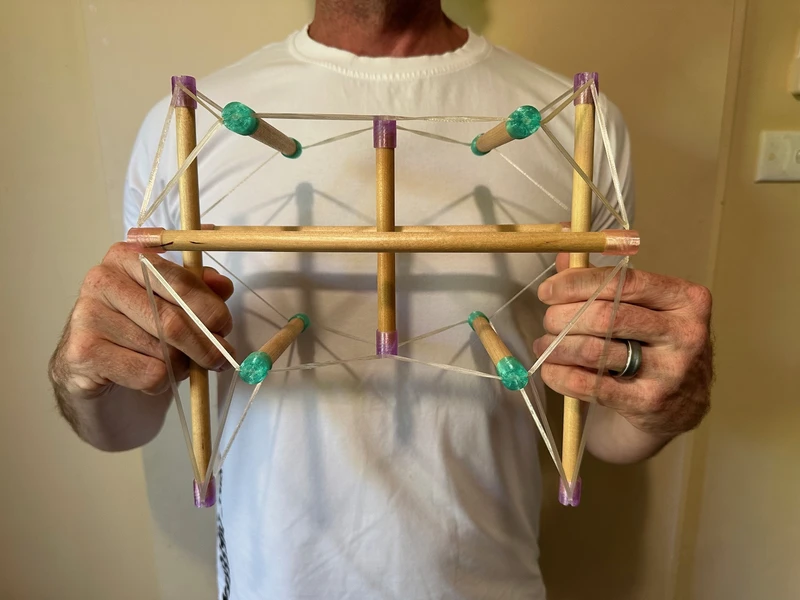
It’s a tensegrity-based model of the human pelvis. (I apologise these are not great pictures… it works better as a live conversation, but please bear with me.)
Notice that none of the wooden struts (representing bones) are touching each other. Instead, their position, relationships and relative movements are maintained by the web of tensile elements between them (representing our ligaments and fascia.)
To be clear, this model isn’t meant to be anatomically accurate…
Rather it’s a model of the forces at play in moving the pelvis. You can see how as I “walk” the legs, everything moves around the relatively stable central stick, which represents the sacrum.
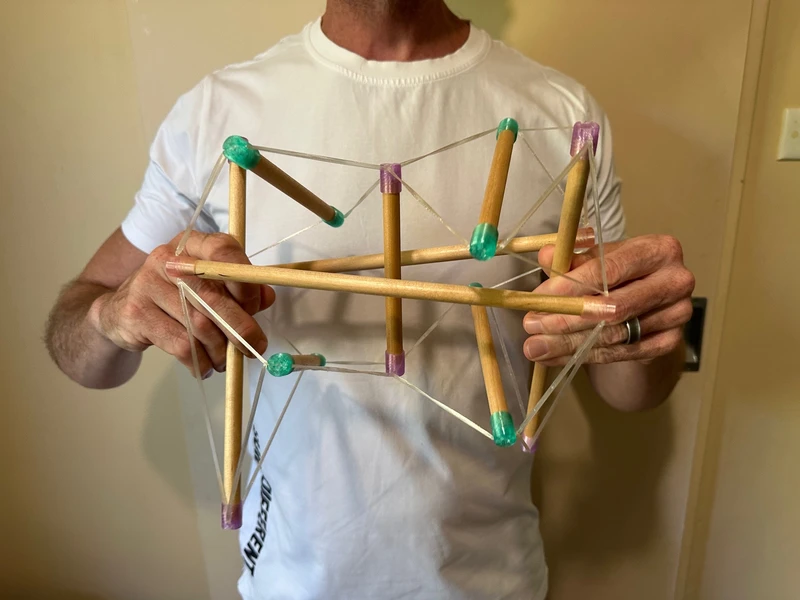
There are several interesting points we can demonstrate with this model.
One thing to note is that there is a large degree of flexibility and mobility in the system, yet the individual wires between the struts are actually quite inelastic.
The elastic properties of the model emerge from the entirety of the system, rather than the individual elements that comprise it.
This is also true of our fascia, which has a high degree of mobility and elasticity…
Even though the actual collagen it is made of is quite inelastic.
Another interesting property I’m attempting to demonstrate in this picture…
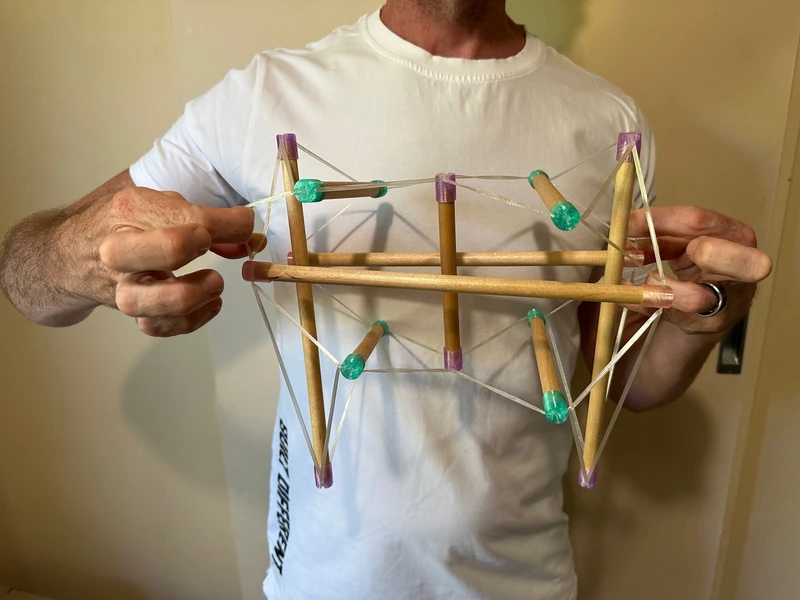
Is that when I pull on any one wire, the change in tension can be felt in every other wire throughout the model.
This is also true for the fascial system in our body…
And it has major clinical implications.
This is one reason why old ankle or knee injuries often set us up for future injuries in the spine or opposite shoulder down the track.
As we move through life, accumulating macro and micro injuries along the way, we are introducing more and more areas of slack and the resulting inappropriate tension into our fascial web.
This leaves us more vulnerable and less resilient over time.
Unless, of course, we do something to correct the slack in the system.
Regular chiropractic care is a great place to start… but unfortunately, it’s not always enough on its own.
When we look at the myofascial tracts described by Thomas Myers in his book Anatomy Trains, we can see that all of them except the arm lines begin on the feet.
This makes sense…
Really what these tracts describe are the pathways that force takes as it moves throughout the body…
And all force ultimately has to be anchored back into the ground… otherwise we fall over.
This makes our feet a particularly potent place for clinical intervention.
I’m sure you’ve experienced this…
Have you ever had a foot massage and felt tension melting from your neck, shoulders… in fact throughout your whole body?
This is an example of removing the slack in one part of the fascial web and simultaneously feeling the effects throughout the entire structure.
Notice that I said removing the slack…
Not removing the tension.
This is a critical distinction.
In a tensegrity structure, excessive tension is created when there is slack in the tensile elements that keep everything balanced. This allows force to focus and concentrate in specific locations, rather than being evenly distributed throughout the whole system.
This is why Jack Thompson tells us we need to remove the slack from our fascial wetsuit and create springboard feet.
It’s a highly counterintuitive way of thinking.
But it can be extremely clinically useful.
The Clinical Implications of Removing Slack (Weakness) Rather than Focusing on Tightness:
This was one of the brilliant, fundamental insights of Dr. George Goodheart that first got me interested in Applied Kinesiology over 25 years ago.
Rather than trying to fix tight muscles (which is what everyone else was doing by rubbing, stretching etc) Dr. Goodheart focused on fixing the weak antagonist muscle that was actually responsible for the tight muscle in the first place.
This is tensegrity-based thinking.
Even at that early stage of my career, when I was still in student clinic, I observed the effectiveness of this approach. I noticed that when I focused on releasing tightness, my patients often got temporary relief…
But the tightness often returned… usually frustratingly quickly.
Whereas if I fixed the weak muscle, which was the real cause of the issue, the patient often experienced lasting results.
Learning this was an “ah ha” moment for me…
One of those pivotal points that changes everything from that moment forward.
Understanding the principles of tensegrity and “slack” was another one of those moments.
It’s the same basic idea of “fix the weakness” to balance out the tightness…
Except this time the weakness is a dysfunctional ligament or fascial element, rather than a muscle.
So how can we apply this?
Traditional thinking says that once a ligament or fascia is over-stretched or damaged, there is no going back. This is one of the primary arguments I have seen for the use of traditional orthotics and supportive shoes.
But I simply haven’t found it to be true in practice.
There is way more to the body’s adaptive, healing capacity than many give it credit for.
One of the most effective tools I have found is Dr. Joe Shafer’s Ligament Interlink technique. When a ligament or joint capsule is dysfunctional it gives that joint a sloppy, spongy end feel. It’s very distinctive.
Patients can feel it too, especially if you take the time to point it out to them.
As soon as you apply the correction it immediately changes. The end feel of that joint normalises… and again, the patient can clearly feel it.
However, that’s not all that happens.
Tension throughout the body shifts and dissipates, sometimes in quite distant locations.
This is tensegrity in action.
Even if you’re not familiar with this particular clinical technique…
At the risk of sounding like a broken record…
One of the fastest, most efficient ways to activate this effect throughout the body is simply by standing and walking on Better Balance Orthotics daily.
By stimulating the muscles, nerves and fascia in the feet…
You don’t just wake up the brain and improve the foot mechanics…
You influence the entire fascial web… which changes everything.
Last week I had one of our new docs, Dr. Caleb Carlson, share with me that within a week of wearing Better Balance Orthotics he saw a consistent 20-point improvement in his sleep (as measured through his watch.)
He also saw a significant improvement in his blind spot mapping… his blind spots became symmetrical, whereas previously the left had consistently been larger than the right (this is an indication of better balance between his brain hemispheres.)
Not only that, when he wore his old (traditional) orthotics in his work boots for a day his sleep immediately dropped by 20 points… and went right back up again when he switched back to Better Balance Orthotics.
These are significant neurological changes…
That on the surface you would think have nothing to do with the feet.
Yet that was his experience.
I hear about these kinds of experiences every day… both from patients and from docs around the world.
We are only scratching the surface when it comes to understanding all the mechanisms at play.
There’s so much more we could dig into… but I realise this has been a long read, so I’ll save it for another day. If you’ve made it this far, thank you for sticking with me 🙏
Suffice to say, anything you do to improve your patients’ (or your own) fascial dynamics is having a profoundly beneficial effect on probably way more levelsthan we currently realise.
Until next week, have a great week.
Cheers,

PS. I’d love to know what you think of the new, format for these emails. Was there anything that particularly resonated or was valuable to you in today’s issue? Please SEND ME AN EMAIL and let me know 🙏