

Fifteen years ago, in 2011 I attended the International ICAK (International College of Applied Kinesiology) meeting in Bordeaux, France.
The meeting was awesome. I got to meet a bunch of the legends of AK (several of whom are sadly no longer with us), I learned a heap of cool techniques and concepts which I still use in practice to this day…
And I also got to tour through France and Italy and experience some of the architectural marvels and history that those countries are so rich in.
Australia has an incredible and ancient indigenous history…
But when it comes to impressive architecture…
The Opera House and the Harbour Bridge (as amazing as they are, especially covered in fireworks on NYE) are about all we have.
One theme was omnipresent… can you tell what it was from my holiday snaps?
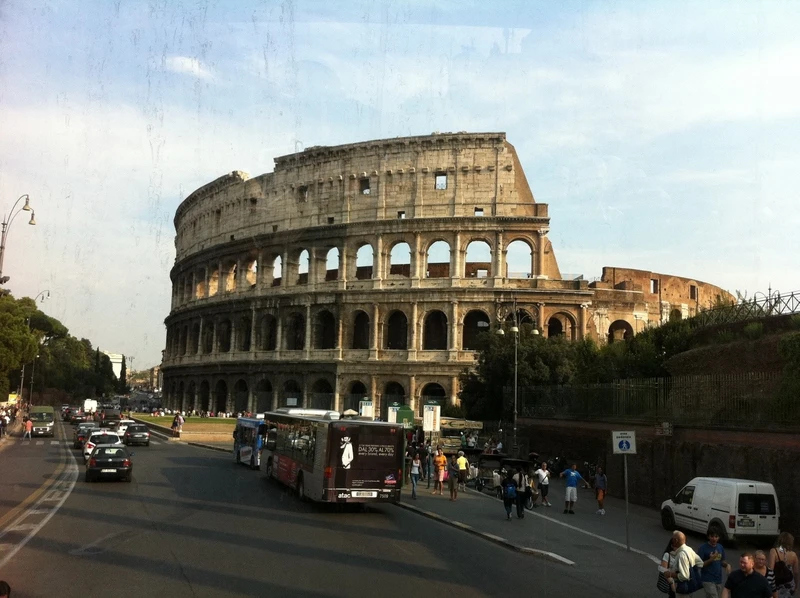
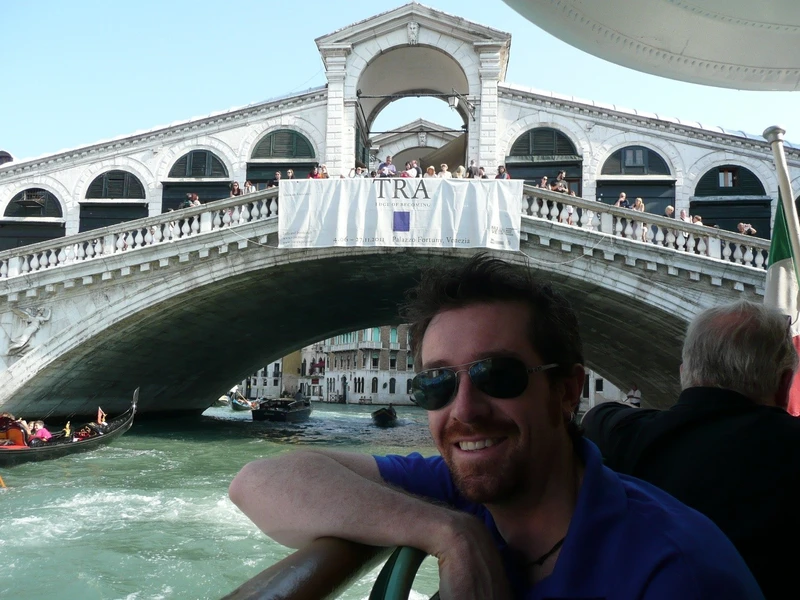


I’m pretty sure you guessed it… that theme was arches.
The earliest evidence of arch construction (made from mud bricks) was in Mesopotamia around 2000 BCE…
And they were minimally used by the ancient Egyptians…
But it was really the Romans who mastered their load-bearing properties and scaled their use as a core architectural strategy.
They were evident everywhere we went throughout France and Italy.
This was long before Better Balance Orthotics existed, so my interest in them was purely historical at that point.
(In fact, our orthotics did exist in an earlier version, created by Dr. Ed Butterworth, MD, as a scoliosis therapy, but this was long before I met him or eventually ended up buying his company after he passed… that’s a story for another day.)
These days I have a whole different perspective on arches…
One that has vital importance for your clinical practice, your patient outcomes, and your own health and physical performance.
So let’s dive into Issue #3 of the Foot Brain Connection, where we explore the concept of tensegrity, the importance of functional arches, and why arch supports (whether they are modern shoes, traditional orthotics or even orthopaedic footwear like Archies) will never create healthy balance, posture or neurology.
Before enrolling in Chiropractic, I was actually studying civil and environmental engineering at university.
Once I figured out that wasn’t my path and transferred to chiropractic, I was amazed at how similar the fundamentals of both disciplines were. In fact, 1st year chiropractic and 1st year engineering were basically the same course (with a couple of extra chiropractic philosophy courses thrown in.)
So today we’re going to talk physics.
Let’s start with the characteristics of architectural arches… you will clearly see how these concepts map to the function of the arches in our feet…
And why nature was way ahead of us (fossil evidence suggests a clearly developed longitudinal arch was present in early Homo species around 1.5–2 million years ago, coinciding with the development of endurance walking and running.)
The reason why arches were so ubiquitous in ancient Roman architecture, and the reason why so many from that time are still standing today is that an arch is a load distribution system.
It works by redirecting force, rather than resisting it.
When it comes to managing force in this way, curves are much more effective than straight lines.
This is the reason why we see so many curves and so few straight lines in human anatomy.
I’m sure that, like me, you have explained to many patients that the first sign of spinal degeneration is loss of the normal curves. Once they begin to straighten, we lose our “shock-absorbers” and our ability to manage force and gravity effectively.
Architectural arches are compression-based structures, so they are typically built from materials like stone, that are strong under compressive loads.
The equivalent of this in our body is our bones. These are our load-bearing elements.
Tom Myers, author of the book Anatomy Trains, refers to them as “Islands of compression floating in a sea of balanced tension.”
(We will explore this idea much more when we get into the concept of tensegrity.)
In my daily practice of Applied Kinesiology, we use different challenges to isolate which tissue is compromised. By putting a force into the body and then testing a muscle we can measure how the nervous system reacts to that force.
Dysfunctional ligaments weaken under stretch.
Dysfunctional cartilage weakens under compression.
And dysfunctional bone weakens to shock or a shearing force– give a short, sharp thump over a compromised area of bone and the nervous system will immediately display an inhibited muscle response.
(And yes, bones can be dysfunctional, usually after a knock or previous injury. You’d be surprised how common this is… if a patient has an issue and the cause doesn’t seem to lie in the muscles or joints, give this test a try – you might uncover a problem that you were previously missing.)
(Thanks to Dr. Joe Shafer who originally taught me these tissue challenge mechanisms… they are an incredibly useful diagnostic aid that I use in practice every day 🙏)
Anyway, back to arches…
When it comes to mechanical arches, the key to their load-bearing capabilities is the capstone.
This is a specially shaped stone that sits at the centre of the arch and unifies it into a single system, rather than just a stack of individual units.
The capstone:
- Converts vertical load (gravity) into lateral compressive forces across the entire arch. It doesn’t “hold” the arch up, it locks all the other stones into compression.
- Spreads the load symmetrically across the arch, preventing stress concentration and ensuring no single stone bears too much load.
- Is usually wedge-shaped so that gravity increases its stability– the more the system is loaded, the more stable it becomes.
The capstone doesn’t support the arch, it activates it.
The same is true when it comes to our feet.
In the human foot, the capstone is the midfoot- the talonavicular-cuneiform complex.
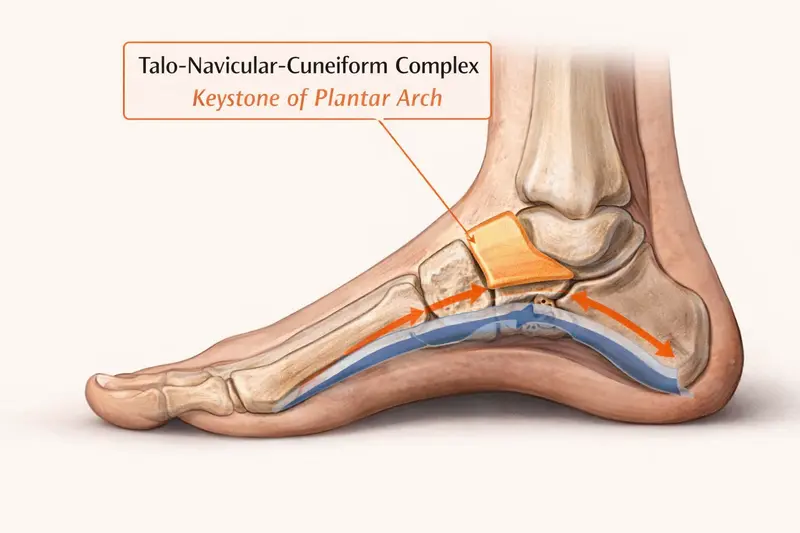
Those bones together form a wedge shape and operate much like the capstone in an architectural arch.
Where the human foot differs is that it’s designed to move, and to absorb and multiply Ground Reaction Forces, turning them into efficient propulsive force. (We covered this mechanism in detail in my previous newsletter: The real cause of every acute (and chronic) injury
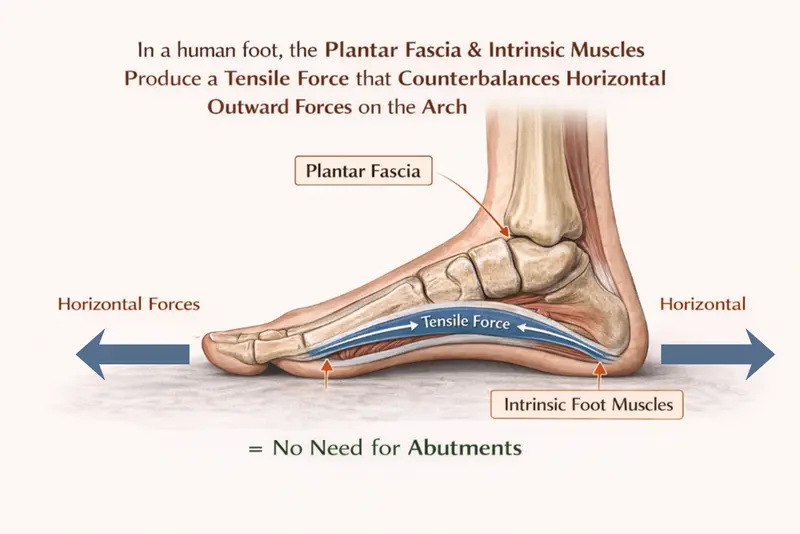
In an architectural arch the placement of the capstone converts downwards force (gravity) into both a vertical and a horizontal component- this is how it spreads force throughout the structure. Thick walls and strong abutments are required to “ground out” this force.
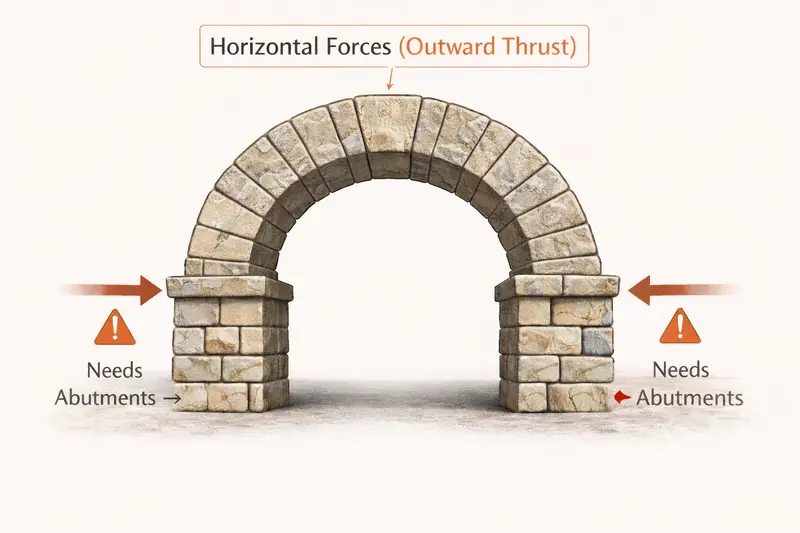
In the human foot we have an advantage that stone arches lack – the addition of tensile elements to absorb these forces. Our feet are not simply bony arches- they are also made up of muscles and fascia.
This is a critical difference.
By having these tensile structures (the intrinsic foot muscles and the plantar fascia) pulling inwards on either end of the arch we effectively counterbalance the horizontal forces, eliminating the need for solid, immovable abutments.
(Which is great news if we want to walk!)
As amazing as arches are for distributing force, they have one critical weakness… and this leads me to the key point of today’s issue of the Foot-Brain Connection…
The one force that a mechanical arch is unable to tolerate is an upwards (superior) force.
If you push upwards on the capstone, you undermine all of its properties– you pop it out and the whole arch collapses.
Fortunately, when it comes to architecture, this is unlikely to ever be a problem- gravity only goes in one direction!
When we consider feet however, the same is simply not true.
In fact, the whole “Support Paradigm” of modern shoes and traditional orthotics is based on the idea of placing something under the arch to support it.
Which pushes up into the foot…
Providing the exact upwards force that arches are mechanically unable to tolerate.
When we use supportive structures like arch supports or metatarsal domes, we are completely undermining the mechanical properties of the arches in the feet.
We are effectively replacing the arches with external support rather than activating them.
And we all know what happens when you externally support something in the body…
The body conserves energy by ceasing to do that thing for itself and becomes reliant on that support.
This is why regular orthotics and overly supportive shoes may provide short-term stabilisation, but at the cost of long-term function and mobility.
(Not to mention the neurological cost of dampening sensory input and reducing muscular and fascial activation.)
Once I got my physics and engineering brain wrapped around these concepts, I was simply no longer able, in good conscience, to prescribe traditional orthotics.
It’s why I have a $15,000 Gaitscanner sitting in my garage gathering dust… I wasn’t even able to bring myself to sell it!
There are some things in life, where once you see it, you can never unsee it.
This was one of those things for me.
And it doesn’t just apply to your patients who wear traditional orthotics.
It applies to basically everyone who wears modern, arch-supporting shoes.
(With the exception of barefoot shoes… these are personally the only shoes I wear and the only shoes I let my kids wear.)
With every step they take, and every minute on their feet, their shoes are providing an upwards force that is directly undermining the integrity of the arches in their feet…
And having a negative impact on their posture, their balance, their neurology and their overall health and performance.
Hopefully today I’ve given you something to think about as you head into clinic to serve your patients this week.
Have a great week.
Cheers,

PS. I was going to cover another key aspect of how the body manages force- the concept of Tensegrity. This is a strain distribution system that operates on every level, from muscles and fascia right down to cells, cytoskeleton and molecules. It’s a fascinating subject, and one that I’ve realised needs a whole issue (probably a whole book) to cover effectively, so I’ll save that one for next week.
To wrap up today, here’s a quick visual summary of what we’ve covered. I don’t use AI in my writing… I believe there’s value in human authenticity and connection. However, it is great for creating infographics like this…
