Lately I’ve been working on improving my balance. As you might imagine, over the last few years this has become somewhat of a hobby for me (some might even say obsession!)
Of course, I have a professional interest in this area…
Firstly, as a chiropractor dedicated to helping my patients…
And also as CEO of the world’s only Proprioceptive Orthotics Company, who spends a fair chunk of his time studying, researching and teaching other doctors about balance.
However, my interest goes beyond simply professional.
My personal passion is snowboarding.
For many years (before osteoarthritis and hernia surgery) it was rock climbing.
Balance matters for all the fun things we love to do in life.
I also have 2 active boys that are young enough to still want me to keep up with them… and I plan to be able to keep up with their kids in the future.
Balance, or the lack of it, is important throughout all stages of life, but it impacts us more and more as we age.
(I’m currently working with a 92-year-old who is recovering from hip surgery after a fall. If you ask her how important balance is, I know exactly what she’ll say. It’s sad to see how much her world has shrunk since that fall.)
It’s like so many other things that we take for granted… until they’re taken away.
I got to witness this first hand growing up.
When I was quite young my Mum was diagnosed with Meniere’s Disease. In its most severe form (which she had) it manifests as sudden, crippling vertigo attacks. One second she would be fine, then the next she would suddenly fall to the ground, feeling like the world was spinning around her, and be totally unable to function for the next 2 days.
These attacks were unpredictable and could occur at any time.
As you can imagine, she tried everything in her search for a cure, including drugs, surgery, special diets, health retreats… she even tried an experimental procedure where they drilled a hole in her head to “relieve the pressure” (which unfortunately did nothing to help – the disease has nothing to do with pressure.)
In the end the only thing that worked was taking up a regular yoga practice, which she continues to this day, more than 30 years later (and she hasn’t had a vertigo attack in years.)
So, in today’s issue of The Foot-Brain Connection, I thought we’d explore balance in more detail… how the brain creates our sense of balance, how it becomes dysfunctional, how we can improve it and why it matters for the patients you see every day (or even for your own family.)
I always thought my balance was pretty good.
As a rock-climbing instructor, I was never quite world-class… but I was pretty credible. For several years this was the central focus of my life.
As a snowboarder of over 30 years, I love nothing more than threading my way through the trees on Double Black runs or out in the Backcountry (or even my ultimate happy place…Heli-Boarding.)

Both of these activities require a finely tuned sense of balance.
But here’s the thing…
These are activities that you perform with your eyes open!
I was totally shocked when I discovered that in actual fact…
My balance was terrible.
Let me explain.
When we first took on Better Balance Orthotics, I knew they worked- I’d been using them both personally and in my clinic for years.
But we needed ways to prove it.
One of the first ways we explored was the use of a Vestibular Plate.
This is basically a scale you stand on… but it doesn’t just measure your weight, it also records your postural sway and how well you can maintain your centre of gravity under varying conditions.
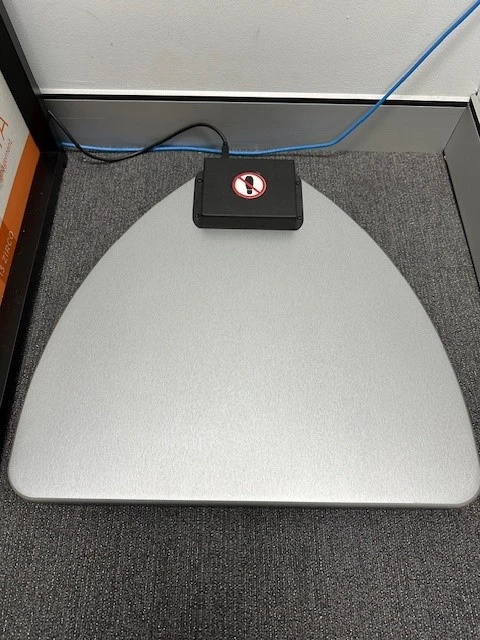
The first test is to simply stand on it with your eyes open- basically the way we usually operate in the world. This gives us a baseline reading of your normal, everyday balance.
Most people do pretty well on this initial test. If not, there’s a serious issue that needs to be addressed.
The next test is to close your eyes and continue to stand still.
Obviously, this removes vision from the equation.
If your balance is healthy this will increase your postural sway a little, but not too much.
For the final two tests we place a spongy cushion on the plate, creating an unstable surface. Test 3 is to stand on it with your eyes open.
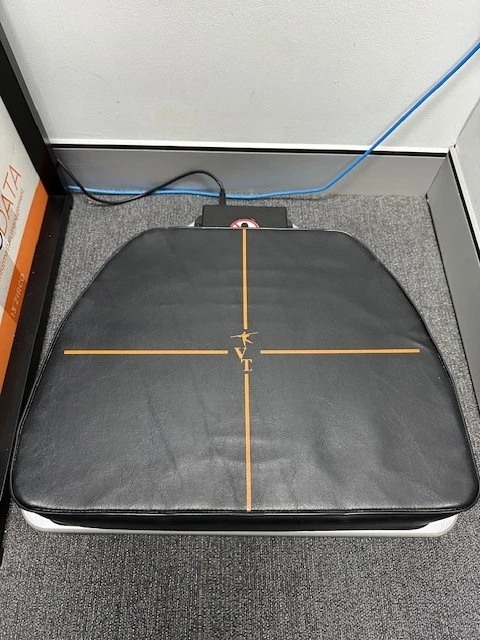
This greatly reduces your brain’s ability to sense the ground through proprioceptive feedback from your feet. If your visual and vestibular systems are ok, this shouldn’t bother you too much.
The fourth test involves standing on the cushion with your eyes closed.
This was the one that completely shocked me!
The first time I tried it, it was like I instantly became completely drunk. I don’t mean a little tipsy… I’m talking fall-down, can’t-walk-a-straight-line shitfaced.
I couldn’t believe it.
I scored perfectly on the first 3 tests… but terribly on the 4th.
(I was actually classified as “Moderately Reduced” but if that’s moderate, I’d hate to experience what the folks in the “Severely Reduced” category feel like when they do the test. My team are trained to be ready to catch them.)
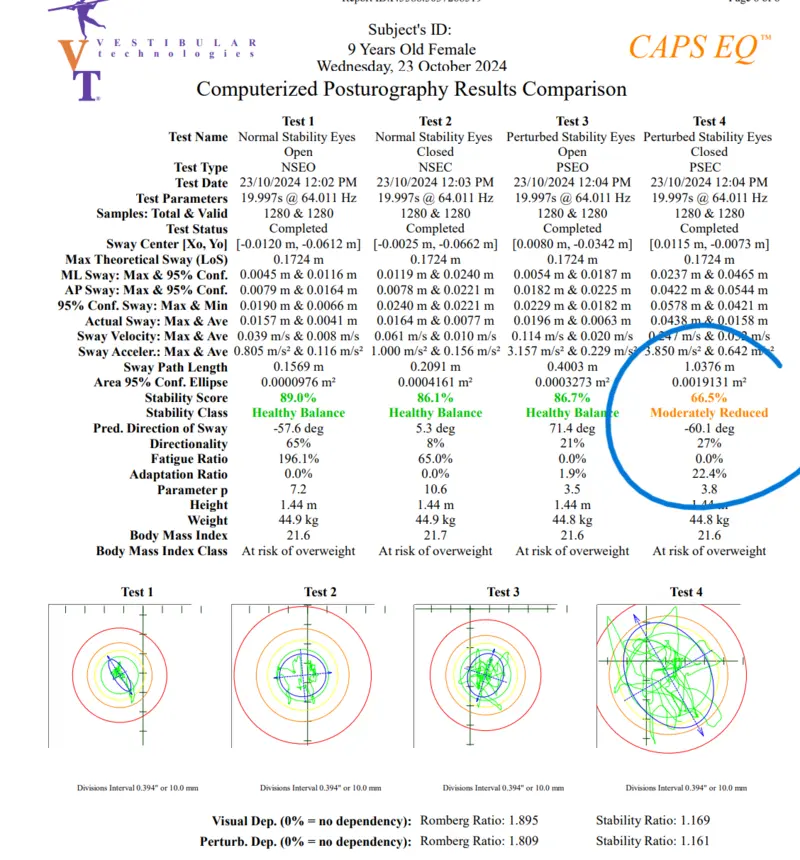
In fact, this is a pattern we see quite commonly in the clinic.
By taking out vision and proprioception from the feet, this test forces the brain to rely primarily on the vestibular system (the canals in our ears.)
Many people (myself included) are almost completely unable to do this.
These are significant balance (and brain) problems hidden in plain sight… because we never walk around with our eyes closed!
These are not only injuries, falls or accidents waiting to happen…
They are also nervous systems walking around under constant stress because they are not able to manage gravity effectively!
This means there is aberrant input continuously firing into the Sympathetic Nervous System, triggering a never-ending fight or flight response…
Without the person even realising why they feel so stressed, wound up or anxious.
I’ve seen theories suggesting this is a major contributor to many anxiety and mental health disorders.
Chances are you see these people in your clinic every day… but almost none of them come in saying they have balance issues (because they don’t even know they do.)
Let’s unpack what’s happening here.
Recently I had a conversation with Imran Khan Niazi, the director of the NZCC (New Zealand College of Chiropractic) Research Centre.
Imran is one of the leading chiropractic researchers in the world. He also has a particular interest in understanding balance. In fact, when we spoke, he’d just returned from China, where he’s currently involved in researching the effects of Knee Injury on Proprioception and Balance.
He explained balance like this…
Our brain uses 3 inputs to create our balance:
· Our Vestibular System
· Proprioception
· Our Visual System
For the sake of our analogy, let’s say the brain relies on each of these to create one third of our balance (this is not the exact proportion but it gives us the idea.)
The research is indicating that when we have an injury, or lose input to one of these systems for some reason, the brain shifts its attention more to the other systems to compensate.
(In Issue #1: Welcome to The Foot-Brain Connection last week we covered how we are all losing input to our proprioceptive system thanks to wearing shoes and walking on flat, neurologically-boring surfaces.)
This is more than just an attention shift- it is a long-term, structural, neuroplastic shift. The brain literally rewires itself to take neuronal real estate that was previously devoted to processing proprioceptive input and repurposes it for processing visual input instead.
In this way, many people become more and more reliant on their visual system over time for maintaining their balance.
And every injury (macro or micro) accelerates this process.
This is how people end up in the situation I found myself in… where everything looks good balance-wise… until you close your eyes.
Especially if you’re standing on an unstable surface.
(Like say, for example, a big cushy-soled shoe…)
When I think back, it makes sense.
The reason I took up snowboarding at age 18 was because I first tried skiing at age 17…
And completely destroyed my left knee.
After spending all day tumbling down the mountain (thanks to my complete lack of experience, skill, or common sense…)
I finally had a fall where my ski stuck into the snow, the binding didn’t release, and my body jack-knifed over it, causing my knee to bend 90 degrees sideways.
Needless to say, my medial ligament didn’t like that.
I spent the next day sitting in the carpark while my friends skied (I wasn’t even old enough to sit in the bar 😢)
And I spent the next several months on crutches.
I can’t believe I even considered going back the next year…
But I was totally hooked, even after that less-than-fun experience! I figured that if I snowboarded instead of skied, at least my knees couldn’t go in opposite directions…
And a lifelong love affair was born.
This was exactly the sort of injury Imran and his colleagues in China were studying- an insult to the knee that turned down the volume on proprioception and forced the brain to compensate by devoting more neurons and processing power to vision instead.
However, that’s not the only kind of injury that most of us experience.
In fact, it’s not even the most common kind.
Although as doctors we do see those kinds of injuries in our practices, I’m sure you would agree that by far the greater amount of daily damage we see are the repetitive strain, micro injuries that occur day-in and day-out for so many of our patients.
This is where most of the real, long-term damage is done.
And I believe it is where the long-term destruction of our balance occurs.
Day by day, with every repetitive micro trauma, our brain is forced to rely more and more on our vision to prop up our failing vestibular and proprioceptive systems.
Which makes us more and more vulnerable.
One place where these repetitive micro traumas pile up over time, yet go largely unnoticed, is in our feet.
They don’t often cause pain…
(Of course, there are exceptions, like plantar fasciitis, heel spurs and Morton’s neuromas…)
But they do become visible over time… and if you look at your patients’ feet you will see them every day.
For example…
Bunions are not just a structural deformity of the MTP joint.
They are a result of repetitive microtrauma to the plantar plate, the band of fascia that runs under the ball of our foot, which should maintain the integrity of our transverse arch.
Collapsed arches are not just a result of overpronation…
They are a result of repetitive microtrauma to the plantar fascia and intrinsic foot muscles that should maintain the integrity of our medial and lateral arches.
These are not just destabilising the mechanical efficiency of our feet, they are slowly and progressively turning down our brain’s ability to rely on proprioception from our feet…
And pushing us into a more heavily vision-reliant state to try to maintain our balance.
Which becomes an even greater problem when our visual acuity begins to decline, or when we are in low light conditions.
When both proprioception and the vestibular system are dysfunctional, any decrease in the visual system can be catastrophic.
I believe this is one major reason why falls become more common as we age.
So what can we do about it?
The simplest, yet single most powerful intervention I have found is using Better Balance Orthotics.
Putting them in your shoes immediately turns up the volume on the sensory feedback from the feet to the brain.
Although I don’t have direct research evidence of this (yet) I suspect, based on Imran’s explanation of his and other research, that this actually causes a rewiring in the brain, where more neurons are shifted back to processing proprioceptive input rather than being diverted to the visual system.
(By the way, one of the reasons I was talking with Imran was to discuss the possibility of the NZCC Research Department collaborating with us on researching Better Balance Orthotics… more on this exciting possibility to come in the future.)
Hopefully from the explanation above it’s clear that Better Balance Orthotics are not just about back pain, posture or sports performance (although they’re great for all those things.)
They’re really about something much more fundamental.
How well we relate to gravity, and to the ground we walk on.
Which is something that affects all of your patients.
My question for you today is…
How many of your patients don’t know about Better Balance Orthotics…
And are missing out on better outcomes as a result (even if they don’t have “feet” or “balance” problems?)
Cheers,

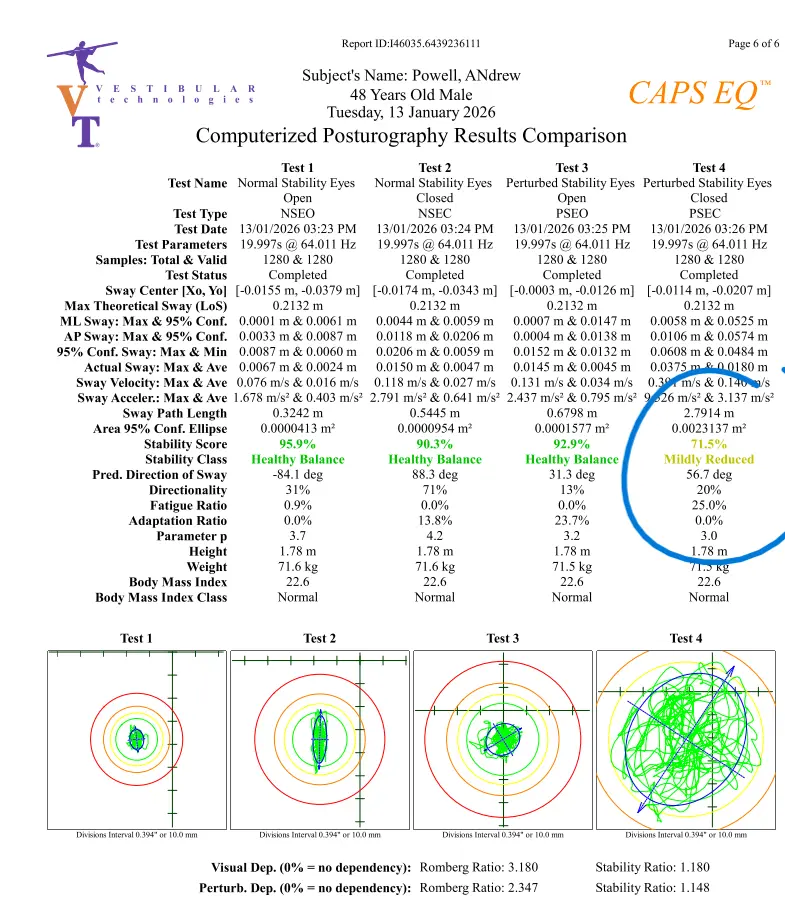
PS. As I mentioned in the beginning of today’s issue, I’ve been experimenting with improving my own balance. A friend and mentor of mine, Dr. Trevor Chetcuti, has been pioneering the use of stroboscopic glasses which selectively reduce visual input to train balance and other aspects of brain function… with some pretty impressive results. Here’s me on a single-foot wobble board, wearing glasses that reduce my visual input by 75%… this is part of my current daily routine.
Below that is my vestibular scan from today… as you can see, it’s not perfect yet but I have improved from “Moderately Reduced” balance on test 4 to “Mildly Reduced.” Like all of us, I’m a work in progress 😉
I’m considering putting together an Advanced Balance Training for Practitioners… if that’s something you’d be interested in please let me know and I’ll add you to my list to let you know when it’s ready. I’d also love to hear if you’d prefer an online training or a live workshop.