

“I don’t know what happened… my shoulder just started hurting really badly, and now I can’t lift it past here.”
That’s what my patient Rachel said when she came in to see me in clinic a few weeks ago. Usually it’s her knee that gives her trouble, so this was something totally out of the blue.
It was a classic frozen shoulder presentation- she couldn’t flex or abduct her shoulder more than 30 degrees. But the aetiology was all wrong… that doesn’t usually happen overnight.
As I started to examine her shoulder, I noticed a band aid on her arm. “What’s this about?” I asked her.
She said “I went for a skin check the other day and the doctor said that was a bad spot, so he burned it off. He really went to town on it- burned a big hole in my arm!”
(This is one of the fun parts of living in Australia… regular skin checks and frequent mutilation!)
I couldn’t help but notice that this lesion was directly overlying the large intestine acupuncture meridian… which then runs up through the shoulder and neck to terminate by the nose. This is one reason we sometimes see clinically that gut problems are a hidden, underlying driver of shoulder dysfunction.
Sure enough, when I had her touch the spot that was burned, then try to move her shoulder, her range of motion improved considerably. This was a clear indication that the wound on her arm had something to do with the restriction (and pain) in her shoulder.
What was presenting as an obvious shoulder problem… actually had very little to do with her shoulder! It was really an aberrant sensory input that was completely screwing up her motor output- in this case her ability to move her shoulder.
As we have discussed many times in this newsletter, our nervous system is really a sensory first system [FBC #21]. Every motor output actually begins with a sensory input. We are built to respond to our environment.
NEW TO THE FOOT-BRAIN CONNECTION?
The core idea is simple:
Your brain creates movement and posture based on the sensory information it receives.
The feet are one of our richest sources of sensory information from the environment.
Change the input → change the output.
That’s the idea we explore here every week.
Start here:
→ Sensory First: Why input changes output [#21]
→ Stimulation vs Support
→ Health = Adaptability [#30]
Fortunately, we were able to settle down the disturbed input from Rachel’s skin injury… with the result that she walked out pain-free and with full range of motion restored in her shoulder.
It got me thinking… had she waited a few weeks to see me, by which time her skin would have healed and she probably would have forgotten all about her skin-check experience… what other explanations might we have gone looking for to explain her sudden shoulder problem?
It was yet another reminder of what a massive influence sensory input has on our motor outputs.
I’ve been observing this all weekend at the National Nutrition Standard conference that I attended in Fort Lauderdale.
It was a great event- well organised, excellent presenters and an engaged, hungry-to-learn crowd of doctors. For many of them, it was their first experience of the foot-brain connection and what an immediate impact changing sensory input to the feet can have on the output of the nervous system.
Like many of my patients, their first response was often to laugh, or to ask incredulously…
“What just happened? How is that even possible?”
This was after I stood them on Better Balance Orthotics for the first time and retested their hip flexors, which only seconds before had been disappointingly non-responsive.
The answer was the same as I give my patients…
“Your brain is always setting up your posture based on the input it’s getting from your feet. Bad input equals bad balance, bad posture and bad neurology.”
And who typically has bad input from their feet?
Basically everyone who regularly wears modern shoes and walks on predominantly flat, neurologically-boring surfaces.
Chances are, that includes you… and all of your patients.
(Unless, of course, you’re wearing your Better Balance Orthotics 😉)
Sometimes the issue isn’t negative input, such as my patient Rachel experienced from having a hole burnt in her arm. Sometimes it’s just a lack of input… we’re not receiving the normal, expected input that our nervous systems came to rely on over thousands of years of receiving constant sensory feedback from our feet as they contacted the widely variable surfaces that we used to walk on all day.
This can be a much more insidious problem.
It doesn’t always cause immediate pain and dysfunction, like what happened with Rachel’s shoulder. But the long-term effects can be just as damaging. We see it every day in my clinic. Predictable postural distortions. Forward head posture. Reduced hip range of motion. Joint degeneration from uncontrolled impact forces every time our foot strikes the ground. Damaged knees. Degraded balance. Falls. Fatigue and inefficient gait, leading to reduced exercise and a more sedentary lifestyle.
I could go on, but I’m sure you get the picture. It’s not about the specific symptom. It’s about the pattern. This is something that applies to all of us.
One huge, and I believe, vastly under-recognized area where this shows up is pelvic floor function. This was the topic of my National Nutrition Standard presentation- the Foot-Pelvic Floor Connection.
Rachel’s shoulder and the pelvic floor might seem totally unrelated, but neurologically they demonstrate the same principle: motor output depends on the quality of the sensory information available to the brain.

There’s strong research evidence that demonstrates the link between foot function and a healthy pelvic floor. Which makes sense… what’s the point of having a stable pelvic floor if it’s not anchored to the ground?
In particular, this study used both EMG and fMRI to demonstrate that activation of Flexor Hallucis Longus (a big toe muscle) cause synergistic activation of levator ani (a pelvic floor muscle.)
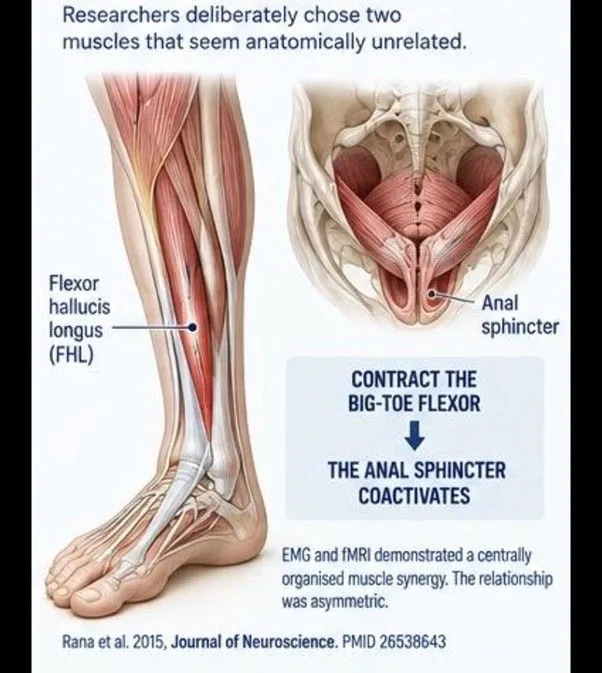
Other studies I discussed showed that changes in ankle position created changes in pelvic floor muscle activation:

Again, this makes sense… when your foot strikes the ground your pelvic floor must be prepared to absorb that force without leakage. In fact, the pelvic floor is intrinsically linked to both gait and breathing.
Some key takeaways from my presentation were:
- Pelvic floor problems are shockingly common (I bet there are many in your practice right now, both male and female, who experience this, but haven’t mentioned it to you either due to embarrassment or simply not realising you can help.)

- Rather than simply being “weak” the pelvic floor is more often poorly coordinated – in part due to a lack of appropriate sensory input.
- There are highly effective treatment strategies that often produce immediate results.
- Problems tend to recur over time if plantar sensory input is not addressed(that’s where Better Balance Orthotics come in.)
Would you like access to the full Foot-Pelvic Floor presentation?
It includes the research, mechanisms and treatment strategies I find most effective. Reply PELVIC FLOOR and I’ll send it over.
That’s it from me this week, I’m packing to fly up to Washington DC. for the final stop on my Foot-Brain Connection Road Trip: The Remarkable Practice Immersion. If you’re going to be there I’d love to connect.
Cheers,

PS. New readers: one more thing you haven’t heard about yet. Best-selling author Ryan Levesque launched his new book, Return to Real yesterday. It’s excellent – I highly recommend it. Better Balance Orthotics is featured as a case study. I’ve convinced Ryan to teach his Category of One framework privately to our BBO doctors… something he usually charges his private clients $5K for. You definitely won’t want to miss it. I’ll share more details soon… keep an eye on your inbox.