

This morning I met with the founder of a tech company who’s built a wearable device specifically for tracking the effects of the chiropractic adjustment. In real time.
It’s the coolest thing I’ve seen in ages. Something that shows on-the-spot data, before, during and after an adjustment. It also tracks trends and baseline changes over time between visits.
This is going to be enormously helpful for individual patients to measure the effect of their chiropractic care and other lifestyle interventions to help them make better health decisions.
Having just launched our objective testing stack in my clinic, to an overwhelmingly larger response than we expected, it’s clear that patients want this kind of data.
This also provides a mechanism to collect a large amount of chiro-specific data in an almost frictionless way. It’s shaping up to potentially lead to the largest study of chiropractic and its effect on the nervous system ever.
(And potentially also the largest study of the effect of Better Balance Orthotics on the nervous system ever… I’ll keep you posted.)
The benefits seem obvious and unambiguous… however, during our conversation a familiar problem came up. The challenge of getting chiropractors to actually implement.
We can see the benefits. Love the product. But still somehow not quite find the time to fully integrate things into our daily practice systems.
And I get it… I’m as guilty as anyone.
Part of our new testing stack is the Thermpix device, a thermal camera that takes images clearly showing areas of inflammation or reduced nerve function. I actually owned the first device in Australia, after meeting the CEO at a UAC event in Beverley Hills last year.
I came home super excited about it… and then it sat on the floor next to my desk in the office for 18 months!
Almost every day I’d look at it and think… “I really should do something about that!”
But I didn’t. Until I started hearing about it from other docs… how much they loved it, how much their patients loved it, and what an impact it was having on their practice.
And of course… surprise, surprise. When we implemented it as part of our testing stack, patients love it, the results have been awesome and it’s really having an impact in our practice!
Unfortunately knowing we should do something, and actually getting around to doing it can be two different things!
That’s why I ran a special onboarding webinar this morning for all the new docs who signed on with us at Dr. Matt Loop’s Social Media Revenue Summit a couple of weeks ago. The theme was high-impact implementation.
All the clinical knowledge and understanding in the world doesn’t do much good unless we actually do something with it.
Although the webinar was designed specifically for our new docs, it dawned on me that many of our regular docs could also benefit from the system I was teaching. I also offered a pretty cool bonus, and I thought it’d only be fair to share it with our existing docs too.
The webinar ran for 21 minutes. You can watch the replay HERE.
If you don’t have time for watching video, or simply prefer to read, here are the highlights:
#1 Mistake when implementing:
The biggest mistake docs make when it comes to implementing BBO is simply not taking action right away. They buy a Starter Pack, wear their personal orthotics and love them. Maybe they fit their spouse or their kids, or maybe a team member or a few patients.
But for the most part their pack simply sits on the shelf collecting dust. When I run into them, they tell me how much they love their orthotics… but the time hasn’t quite been right to implement yet. Sometimes I’ve seen this cycle repeat over 3 or 4 years… same conversation.
Meanwhile their colleagues are telling me about how much their patients love them, what great results they’re getting, how much it’s impacted their bottom line and how smooth and simple the whole process has been
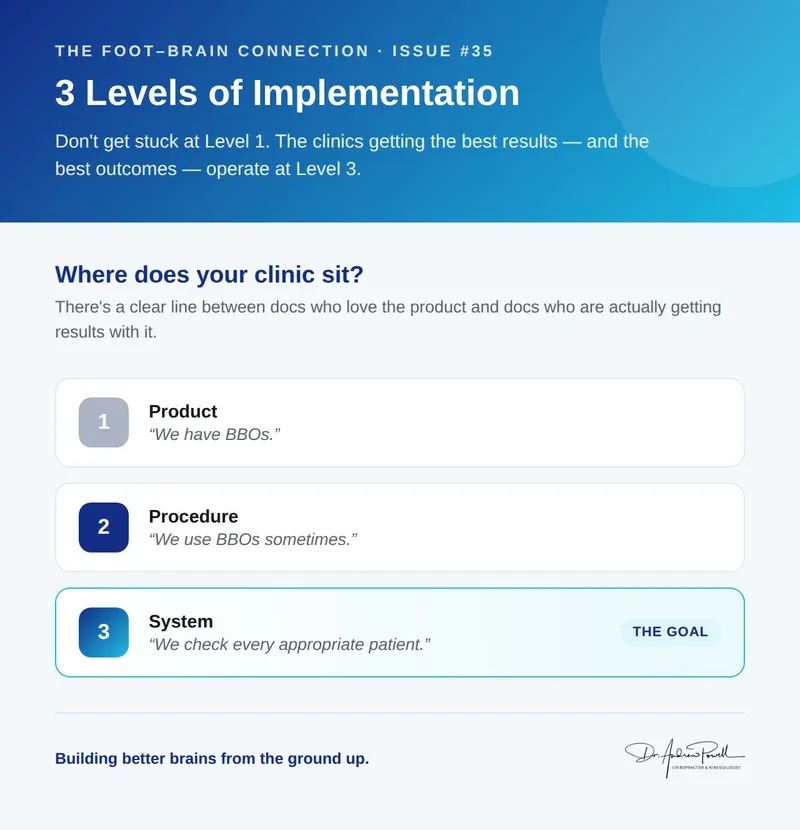
3 Levels of Implementation:
1/ Product – “We have BBOs.”
2/ Procedure – “We use BBOs sometimes.”
3/ System – “We check every appropriate patient.”
The docs I just described are at Level 1. I operated at Level 2 for years. The clinics I see really knocking it out of the park operate at Level 3. These are the clinics generating the best results, helping the most patients and generating a significant stream of extra revenue.
They don’t rely on anyone “remembering” to do anything… it’s simply part of the system. It’s just what they do.
The Biggest Block:
None of us got into chiropractic to become salesmen. One of the biggest barriers I see docs create for themselves is thinking “I don’t want to sell orthotics to every patient.”
I get it. Neither do I. That’s not what I’m asking you to do.
What I’m suggesting is that you regularly check patients. We’re clinicians. That’s what we do. We assess our patients’ level of function, determine appropriate interventions, and make clinical recommendations based on our findings.
We don’t pre-judge who needs a clinical intervention before we’ve tested them.
This is a completely different psychology. It feels much better for us… and our patients feel it too. Once a patient has undergone the assessment, felt the day-and-night difference in strength and function when they stood on the orthotics, they don’t need any convincing.
They already felt it.
All you need to do is briefly explain what happened, why it matters and how it’s going to help them.
That’s it. In my clinic it goes like this:
Patient steps onto the orthotics. Immediately feels the dramatic difference in strength and stability. Usually laughs and asks incredulously…
“That’s amazing… how is that even possible?”
To which the answer is…
“Your brain is always setting up your posture based on the input from your feet. Bad input equals bad balance, bad posture and bad neurology. Getting your feet right is going to help you hold your adjustments between visits and get the most out of every adjustment. Would you like me to fit you with a pair?”
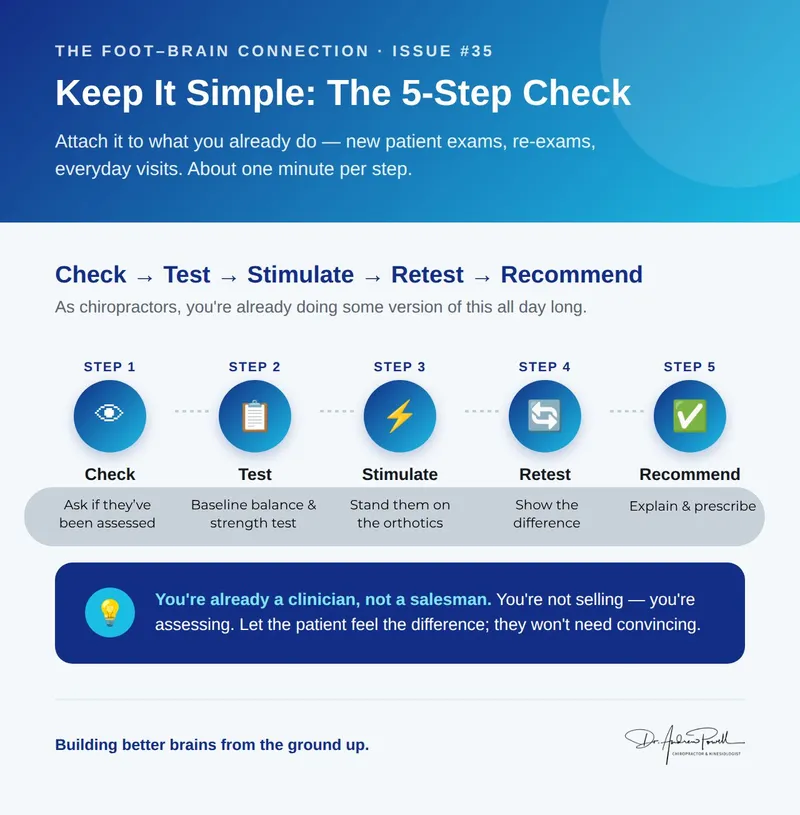
Keep it Simple:
There are 5 steps:
Check → Test → Stimulate → Retest → Recommend
As chiropractors we’re already doing some version of this all day long. What was happening before? We introduce an input. What changed? What does that tell us? And what do we recommend?
BBO should feel like a logical extension of the clinical reasoning you’re already using, not some tacked-on or out-of-left-field concept.
Attach BBO to systems that already happen in your clinic:
You already examine new patients. You already perform progress exams. And you already see existing patients every day in your practice.
Each one of these is an opportunity to check patients for BBO. Once you’ve had a little practice, it literally only takes a minute. One minute to test. One minute to explain. And one minute to measure and prescribe (or this can even be done by your team.)
With new patient exams and re exams this fits very naturally… you’re already testing the patient in various ways. But you don’t need to wait for these milestones to get started.
You probably have hundreds of existing patients who already know you, love you and trust your existing recommendations. Start checking them.
The conversation can be as simple as…
“We’ve recently introduced something new into the clinic. Have we ever checked how the sensory input coming into your feet may be affecting how your body is functioning?”
(…or “affecting your nervous system.” Or “your XYZ (symptom)”… use the language that makes sense for your office.)
Now you have a clinical reason to assess them.
The doc can ask this question, or it can even be asked by a CA when checking them in before their adjustment.
The important thing is just to create a trigger. When X happens, we check BBO.Because once there’s an established trigger in place, things no longer rely on someone’s memory. It’s simply part of the system.
Get your CAs on board:
They don’t need to understand all the mechanisms of plantar receptors or neuroplasticity. They just need to know the system. Have them ask if the patient has been checked… if not, flag it with the doctor for that visit.
The doc owns the clinical assessment and recommendation.
And then the team can take it from there. In my office the prescription goes out to the front desk with the patient. They take a photo and email it through to order (batching orders once a week means we cover the postage.) They take a deposit. And they share their own personal experience of the benefits they’ve received from wearing BBOs (if you haven’t fit your team already, you’re missing a real opportunity.)
The 5 Implementation Killers:
1/ “I don’t want to be salesy.”– Assess, don’t sell.
2/ “I don’t have time.” – Attach it to an existing workflow.
3/ “My associates won’t do it.” – Give them a protocol (and incentive.) Have me train them.
4/ “We have too many other things to focus on.” – This will always be the case. But this is low hanging fruit. It’s fast, easy to implement, profitable and awesome for your patients.
5/ “I need to learn more first.” – Start simple. Competence comes from repetition. Keep reading (or watching) this newsletter weekly. You’ll learn fast as you go. Nothing beats doing.
All of these are really just stories we tell ourselves, and there’s one thing that easily overcomes them all – taking action. Just like with my Thermpix, it’s always easier, faster and more rewarding than you thought.
The truth is, this is one of the simplest, most powerful systems you can implement that makes a real difference in the lives of your patients. You don’t need any expensive equipment, you don’t need extra staff, extra space or extra patients. You already have everything you need to make this a huge success.
And to make it even easier and more fun, here’s the Implementation Challenge and Special Bonus I shared on the webinar this morning…
If you check 20 patients in the next 2 weeks, and send me your results, I’ll send you a free pair of orthotics with your next order.
You can use them however you like… another pair for your other shoes, a pair for a family member or team member, a testing pair for your other treatment room, or even retail them for full price to a patient and pocket the profit- the choice is yours.
To be clear, this isn’t about having to sell 20 pairs of orthotics (remember we’re not salespeople!) It’s simply about preforming the clinical assessment.
I know that if you have the quick conversation 20 times, and physically perform the assessment 20 times, it’s going to get easier, faster and more comfortable. In fact, it’ll probably form the basis of your new clinical system. And that means you’re going to help a lot more people. So everyone wins.
All you need to do is send me a quick note that you checked 20 people, how many strengthened to your testing and how many orthotics you prescribed. That’s it. I realise this is based on an honesty system and it’d be easy to game the system, but I like to believe that if you’re a chiropractor on my list then you’re trustworthy.
And if you’re in the US and you’d like my personal help in your practice setting up your systems, training your team and fine-tuning your clinical application, let me know. I’m finalising the details of my upcoming Foot-Brain Connection Road Tripand the deadline is coming up fast… I’ll be taking off in just over a week.
See you soon.
Cheers,

PS. For those docs who requested more info on the Omega 3 testing and system we’re using in the clinic to reduce inflammation and improve brain health, I’m sorry I haven’t got back to you yet. I’ve seen your emails and it’s on my list to reach out as soon as possible. Thanks for your patience.