

You are always growing or dying. Life, and biology, never truly stand still.
Nowhere is this more true than when it comes to your brain.
I remember sitting in a Dr. Joe Dispenza workshop in Sydney in the early 2000’s. We were watching a video, filmed through an electron microscope, of a new synapse being formed in the brain in real time.
It was a slightly grainy, black and white image of one squiggly line (a dendrite) detaching itself from another squiggly line. Then inching uncertainly through open space, waving from side to side, like a dog sniffing out a scent, until it suddenly encountered and immediately fused with a new squiggly line.
Not exactly blockbuster visual effects.
Yet it was one of the most captivating things I’d ever seen.
Because it overturned decades of dogma and fixed scientific thinking, including everything I’d been taught about the brain during my university education.
What we’d just witnessed was the brain releasing an old connection, and wiring in a brand new one. And it happened in seconds.
Suddenly so much more was possible. It sparked a fascination in me with how the hardware between our ears actually works, and what it’s truly capable of. That fascination has persisted to this day,
Today we’re going to lean into the brain side of The Foot-Brain Connection (although we’ll touch on the foot side of the equation too.) Over the past several weeks we’ve been exploring concepts such as:
- Health = Adaptability
- Hormetic Stressors and the Goldilocks Principle- the idea that too much ortoo little stress is damaging.
- The need for Variable Stimulation to promote learning and adaptability
- The idea that the nervous system requires problems to solve
- The concept that what we optimise for grows
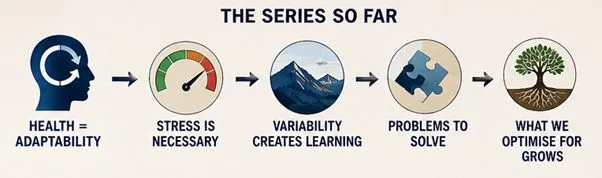
Today we’ll look at the actual neurological mechanisms that occur in the brain. What actually happens when you get all these inputs right… and equally importantly, what happens when we get them wrong?
This is where it all comes together. And the implications for your brain, your children’s development, and your patients’ health are simply too big to ignore.
For years the scientific understanding of the brain was that we are born with the maximum amount of neurons we will ever have… and it’s all downhill from there. Brains inevitably decline throughout life, accelerating as we age. It was considered a one-way street.
That thinking has been completely overturned. We now know that the adult brain can continually reorganise itself in response to experience. The mechanisms that have the biggest impact on your daily life and performance are synaptic plasticity and myelination.
- Synaptic Plasticity is the fact that neurons can rewire, pruning less-useful connections and wiring in new connections. This is the process that I witnessed at the Joe Dispenza event.
- Myelination is the laying down of new “insulation” around the nerves that we use regularly. This increases their speed and efficiency, making them easier for the brain to default to.
Both of these processes make the brain more effective and efficient at responding to its environment. But they’re a two-edged sword. They happen whether you like it or not.
YOUR BRAIN DOESN’T CARE WHAT YOU WANT. IT RESPONDS TO WHAT YOU DO.
The brain doesn’t judge whether an adaptation is ultimately healthier or better for you… it has no master plan for the person you’d like to become. It simply responds to the environmental cues you provide it with.
And that’s exactly the rub.
Use a circuit repeatedly and the nervous system becomes better at using it. Stop demanding a particular capacity, and over time you have less reason to maintain it.
Your biology is ruthlessly efficient.
Your brain doesn’t ask the question…. “What will make you the best, healthiest version of yourself 10 years from now?”
It asks… “What will best help me navigate my environment right now?”
And that makes your environment, and the specific demands you place on your brain, incredibly important.
Tomorrow’s brain is built by today’s environment.
This isn’t speculation… it’s well-established neuroscience.
If you’re as old as me, you remember a time before GPS navigation, before Apple or Google Maps. I remember driving around with a street directory on my knees, one eye on the map, one eye on the road, trying to navigate the complex, often winding and one-way streets of Sydney.
(Apparently we never got the memo that the USA and Canada did about building cities on logical grid patterns.)
Sydney grew organically, over the last 200 years, on a blueprint originally built for horses and foot traffic.
And you know what’s even older and more complicated to navigate than the streets of Sydney?
London.
Bigger, older and more populous… a perfect traffic nightmare. And before UBER came along, the experts in navigating this twisting maze were the London cabbies. Before getting their cab license, they were required to learn an extraordinary mental map of London… thousands of streets, landmarks and the routes connecting them. It was known as “The Knowledge.”
This made them perfect subjects for studying what that kind of learning did to the brain. So that’s exactly what researcher Eleanor Maguire did in 2000 with startling results.
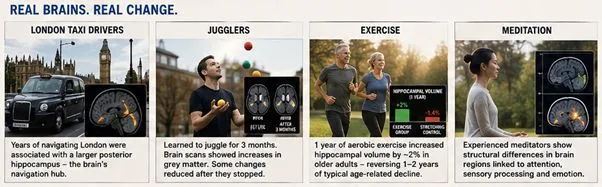
Experienced London taxi drivers showed structural differences in the hippocampus, particularly the posterior hippocampus, a region heavily involved in spatial navigation (Maguire et. al 2000.)
Subsequent longitudinal research following drivers as they went through taxi training strengthened the evidence that acquiring this extraordinary navigational expertise was associated with structural brain change (Woollett et al. 2011)
Driving around London didn’t just make cabbies better at navigating London… it physically adapted their brains.
This kind of Physical Performance = Structural Brain Changes research has now been replicated many times.
For example:
Juggling:
Adults who had never juggled before were taught to juggle. Within 3 months they showed increases in grey matter in regions involved in processing visual motion. Not only that, when they stopped practicing, some of those changes measurably diminished (Draganski et al. 2004)
Languages:
Bilingual people exhibit greater grey-matter density in the left inferior parietal cortex (Mechelli et al. date.) These structural differences were correlated to proficiency and age of acquisition.
(Turns out my Mum was right… she was a language teacher and is fluent in 5 languages… she always claimed her brain was better 😂)
Meditators:
Experienced meditators show structural differences in regions involved in attention, sensory processing and interoception (Lazar et al. 2005) They also show functional differences, with greater gamma-wave activity and overall brain coherence.
Exercise:
In 2011 Erickson conducted a randomised controlled trial of 120 older adults to measure the effects of aerobic exercise over a one year period. The results were clear- a 2% increase in hippocampal volume over that time. This may not sound like much, but it effectively reversed the 1-2 years of typical age-related volume loss that is considered normal in that age group.
Movement changed the structure of the brain.
EXPERIENCE BECOMES BIOLOGY
So how does that happen? How does experience get translated into physical neurology?
Clearly there are multiple mechanisms at work here, but one of the biggest players is BDNF- Brain-Derived Neurotrophic Factor.
BDNF is one of the key signalling molecules involved in helping the nervous system respond to activity. It supports neuronal survival and learning. It is involved in both Synaptic Plasticity and Myelination.
It has been described as “Miracle-Gro for neurons” due to its effect on multiple aspects of brain development, including ongoing repair and remodelling. In essence, it tells the nervous system…
“This circuit matters. Strengthen it.”
Although this is a simplification (and the brain is never truly simple) we could plausibly describe it as…
The Molecule of Adaptability.
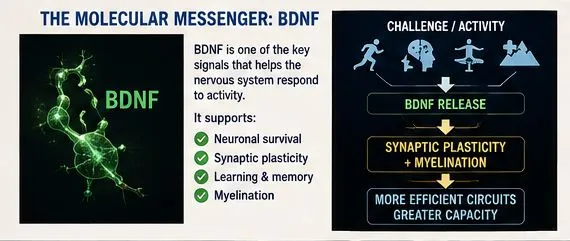
It is involved in both the formation and remodelling of myelin, as well as multiple aspects of neural plasticity.
Synaptic plasticity is the process I witnessed at Dr. Joe Dispenza’s workshop. The way he described it was that… “Neurons that fire together, wire together.”
This is the reason why we get better at things we practice, and worse at things that we neglect. The brain is a ruthless gardener, constantly pruning pathways that no longer serve us and strengthening ones that do.
This process is essential for development.
A child’s brain has more neurons than an adult’s… that’s why they are such incredible learners. They are able to soak up environmental information at an astounding rate. They don’t even have to try… it just happens.
But an adult brain is capable of deeper reasoning and navigating more specialised knowledge than a child’s. That’s a consequence of synaptic pruning. An adult brain has less total neurons… but more focused, relevant connections.
Although this process slows down as we age, in a healthy brain it should continue throughout life. And it requires BDNF.
Myelination also relies on BDNF. This is not about forming new connections… it’s about reinforcing those that are most relevant.
In other words, the ones we repeatedly use.
The more heavily myelinated a tract is, the faster and more efficient that pathway becomes. This represents the white-matter changes demonstrated in the studies above.
Imagine forging a new pathway through heavy snow. The first time you do it, it’s a painful, exhausting slog. But the next time it’s a little easier- you can follow in your previous footprints. By the tenth time it’s a well-worn pathway, and by the hundredth it’s become a super highway.
This is the basis of habit formation. It explains why new habits are so hard to maintain… and old habits are so hard to break.
Repetition doesn’t just change which neurons communicate… it changes the infrastructure the signals travel through.
BDNF is so central to these processes that I plan to devote our entire next newsletter to how you can build more of it… not just the science, but a practical blueprint. Keep an eye out for that one.
One of the most fascinating studies I’ve found on how this plays out in action, involved getting mice to run on a wheel (Xaio et al. 2016.) But there was a twist… the rungs of the wheel were irregularly spaced.
Every stride required the mice to continually detect, predict and adjust.
This meant the mice weren’t merely exercising… they were solving a complex movement problem.
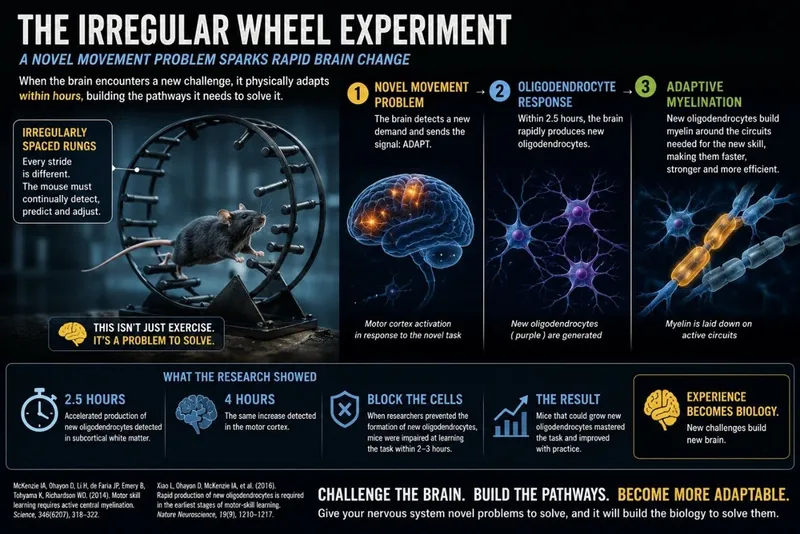
Researchers found rapid oligodendrocyte response during motor learning (these are the cells that produce myelin.) In fact, new oligodendrocyte production was detectable within 2.5 hours.
Not only that, when oligodendrocyte production was blocked it interfered with skill acquisition (McKenzie et al. 2014)
This is rapid, physical brain restructuring, in real time, in response to solving a complex motor problem.
Remember those cobblestones in Italy? [FBC#27]
Every step slightly different. Every surface giving the nervous system another problem to solve.
This was the mouse equivalent… and it clearly demonstrated why enrichedenvironments and variable inputs are so significant for healthy, adaptable neurology.
Here’s the flip-side though…
THE BRAIN THAT CHANGES ITSELF
Your brain doesn’t just wait for an enriched environment to stimulate it. This process doesn’t only occur when you’re on holidays in Italy.
Your brain is adapting right now. To the environment you’re in right now.
- The things you repeatedly do.
- The movements you repeatedly make.
- The thoughts you habitually think.
- The surfaces you regularly walk on.
- The problems you repeatedly solve.
And equally as importantly…
The problems you no longer have to solve.
We covered these last week- the stresses we have systematically engineered out of our modern, day-to-day existence.
- The stairs we don’t climb.
- The temperature shifts we don’t endure.
- The arithmetic we don’t calculate.
- The choices we don’t have to make.
- The complex, variable natural surfaces we don’t walk on… and don’t feel even when we do thanks to our cushy shoes.
In all these situations we don’t stop adapting… we just adapt to different inputs.
Which produces different results… remember, Garbage In, Garbage Out [FBC#19]
Your nervous system doesn’t necessarily adapt towards health… it adapts towards demand.
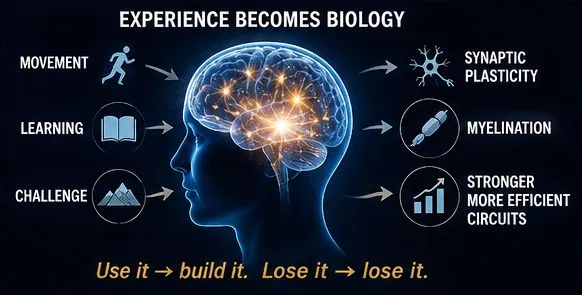
We’ve understood this for years. It’s reflected in the common wisdom: Use it or Lose it. Anyone who’s regularly exercised for a time, and then stopped, has experienced this firsthand. It’s a biological fact.
And it doesn’t just happen in the body. It happens in the brain. In the study on jugglers I mentioned earlier, their brains didn’t just change when they took up juggling. The study also reported that those brain changes began to reverse when they stopped.
We see the same thing when patients stop getting regularly adjusted. Often they’ll come back after a period of time and their nervous system capacity is demonstrably different.
This is why I find myself looking at my kids and asking…
“Am I giving them all they need to amplify BDNF production?”
And… “Am I providing an environment that points that BDNF in the right direction?”
Both are equally important.
Last year I attended a Dr. Joe Smith seminar where he introduced an idea I hadn’t heard clearly articulated before.
He said… “Sometimes giving supplements that enhance brain plasticity can actually make a patient worse because you are reinforcing a maladaptive circuit.”
In other words, you are locking in a short-term compensation mechanism that is actually harmful in the long term.
Making the brain more adaptable isn’t enough… we must also give it a reason to adapt in the direction we want.

To wrap this up, let’s bring it back to feet.
Every step is a sensory-motor event.
To produce an appropriate motor response, the brain has to integrate:
Plantar Pressure + Proprioception + Vision + Vestibular Input + Joint Position + Surface Variation
So walking is not merely transportation.
Walking is neurological training.
The question is…
Is it adaptive? Or maladaptive?
So far we’ve been talking well-established neuroscience. Now let’s extrapolate. This is purely speculation… but I think it’s plausible based on the evidence above.
We’ve seen how various inputs physically rewire the brain. Navigation. Juggling. Learning languages. Meditation. Running on an irregular wheel.
What happens when we apply this principle to our feet and Better Balance Orthotics?
I’ve spent years observing immediate changes in muscle function, posture and balance when we alter the sensory environment beneath someone’s feet.
What happens to the nervous system when we provide that altered sensory input repeatedly—thousands of steps per day, for years?
Does it affect BDNF?
Does it influence adaptive myelination?
Does it create measurable structural or functional brain changes?
Here’s another interesting thought… do patients with higher BDNF levels respond better to BBO (or to chiropractic adjustments?)
And equally… what happens to the brain when we vastly diminish the amount of sensory input travelling from our feet to our brain… inputs that we relied on for thousands of years. How does that impact BDNF?
We don’t know yet… but based on everything I’ve read and seen, I have a pretty strong suspicion.
Here’s what we can test today:
Change the sensory input beneath someone’s feet.
Test their muscle function. Their balance. Their posture.
Then put them on BBO and test again.
Don’t believe me. Test it.
Because long before we have an fMRI study showing us exactly what is happening inside the brain, we can measure what that nervous system is doing differently right now.

References: