

Everyone wants to be healthy. And we absolutely know it when we’re not.
But how do you know when you actually are?
Today I’m offering you a new answer to that question… one you probably haven’t considered before. One that may give you a whole new frame for understanding your own body and the outcomes you create for your patients.
I ask the question at the start of every patient orientation class…
“How do you define health?”
During that workshop we look at the chronic disease epidemic exploding throughout the developed world and ask the question…
“Why, if we’re spending more than ever on healthcare, is our population getting sicker?”
One answer is: We are applying the wrong definition of health.
And that has massive consequences.
For us as individuals. As doctors. As leaders in our own families. As educators within our communities. And for our entire global population.
For years I’ve explained to my patients the difference between the medical model and the chiropractic understanding of health. Today I want to take that one step further.
Before we get there, let’s take a quick look at the current state of play and some of the evolving thinking out there.
The most common answers I receive in my workshop describe health as some combination of:
- “Feeling good”
- “Having energy”
- And “Being able to do what you want”
Whilst all of these are important factors for producing quality of life, none of them really hold up as a valid definition of health.
For example, the person who drops dead of a heart attack on the sporting field was feeling good and energetically doing what they wanted… until the moment before they died.
Clearly they weren’t healthy.
The World Health Organisation (WHO) defines health as:
“Health is a state of complete physical, mental and social well-being and not merely the absence of disease or infirmity.”
This sounds good in theory, but there are a few issues. One is that virtually no one lives in a state of complete physical, mental and social well-being. So by this definition almost no one is actually healthy.
Another is that these are fairly vague terms. What exactly does it mean to be in a state of complete physical, mental and social well-being? This vagueness makes the definition almost impossible to measure and hard to apply in practice.
The other issue I see is that despite this definition, modern medicine seems to be largely practiced almost exclusively in direct opposition to this statement. It is generally the study of, and attempt to combat, disease.
This matters, because your definition frames everything that comes after it.
How you define a problem or a goal determines what questions you ask… which determines what answers you find.
One of my mentors, Dr. John Demartini says…
“The quality of your questions determines the quality of your life.”
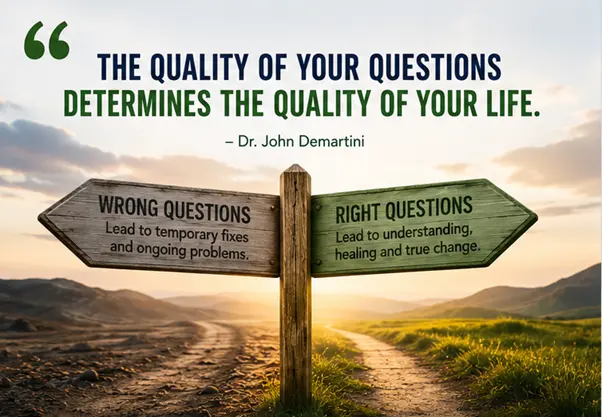
A couple of weeks ago in Issue [FBC#28] I added… “The quality of the problems you solve determines the quality of your life.”
I was reading an article the other day by Rian Doris, one of the world’s leading flow state researchers. In it he explained that one of the most common reasons people fail to get into flow is that they fail to clearly define the problem they are trying to solve.
Without this clarity of focus, the brain is unable to pull together the required content, context and resources to drop into flow.
The same applies when prompting AI- the quality of the output you receive is completely dependent on the clarity of the prompt you use.
So asking the right question matters… and it all starts with the right definition.

In my workshop, I explain it to attendees like this…
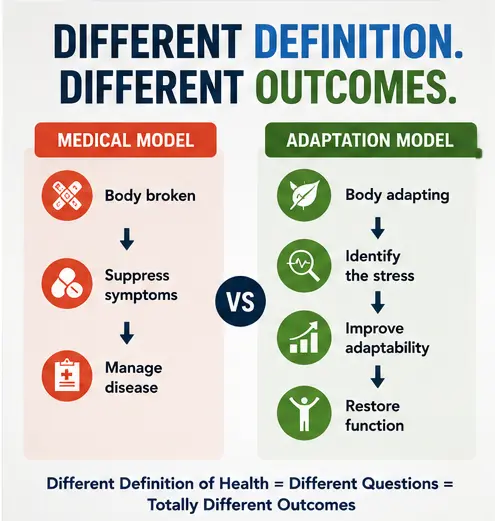
“The underlying assumption of the standard medical approach is that the body is broken, and we need to do something to fix it.
So for example, if your blood pressure is too high, the question that gets asked is… “How do we bring down your blood pressure?”
And the logical answer is “Take this blood pressure-reducing medication.”
Chiropractic takes a different approach, based on a different definition of health…
Health is the optimal expression of life, based on optimal nervous system function.
(This is my definition of health in chiropractic, rather than an official position… yours may be slightly different. But I bet we’re in the same ballpark.)
So I explain to my patients…
“In chiropractic the underlying assumption is that your body is designed to be healthy. What interferes with that is stress.
So if your blood pressure is high, the question is… “What stress is your body intelligently adapting to by raising your blood pressure?”
This is a very different question… so of course it produces a different answer.
The logical answer is… “Let’s find and remove the stress, so your body can function the way it was designed.”
Different Definition of Health = Different Questions = Totally Different Outcomes.
If you’re a chiropractor and you’ve been in practice for a while, none of this is news to you. But let’s go further.
As you know, I’ve recently been studying Afferentology. Within that system, Dr. Simon King proposes a new definition of health.
He suggests that:
Health = Strength
At first glance this may seem simplistic, but there’s a lot more to this idea than is apparent on the surface.
I heard something at the recent UAC event in Italy that’s really stuck with me. Dr. Ken Cooper said to me…
“We are always looking for the simplicity on the far side of complexity.”
That’s some Grade-A wisdom right there!
And Simon’s definition certainly falls into this category. It seems simple on the surface, but I’ve looked at the research and clinical experiences he’s based it on, and there’s a lot of depth there.
In Applied Kinesiology (AK) we use muscle testing as a tool to allow us to work either from weakness-to-strength or from strength-to-weakness. Both approaches provide valuable clinical information.
But Simon’s approach is to always focus on working from weakness to strength. He says “If my patient leaves stronger than when they came in, I know I’ve done my job.”
By the way, Simon’s work (and the research it draws on) clearly shows that strength is primarily a result of healthy nervous system function rather than an inherent property of muscle.
In AK we tend to think that a weak muscle indicates a problem (we even call it an “indicator muscle.”) We use that muscle weakness to determine the cause of the problem, and the most effective solution.
In Simon’s thinking, the weak muscle doesn’t indicate the problem…
The weak muscle is the problem.
It turns out there’s quite a bit of research to back this up.
In 2010 a systematic review and meta-analysis was published in the British Medical Journal titled: Objectively measured physical capability levels and mortality.
Its findings included:
- Weak grip strength was associated with approximately 67% higher mortality.
- Slow walking speed was associated with approximately 2.9 times the mortality risk.
- Slow chair-rise performance was associated with approximately 2 times the mortality risk.
These are some serious numbers!
Similar findings have appeared in many studies both before and since this one. For example:
García-Hermoso et al., 2018 — Archives of Physical Medicine and Rehabilitation: Muscular strength as a predictor of all-cause mortality in apparently healthy populations
This meta-analysis included:
- 38 studies
- Approximately 1.91 million participants
- 63,087 deaths
People with higher grip strength had approximately 31% lower all-cause mortality, compared with those with lower strength. The association was present in both sexes and somewhat stronger in women.
Of course, this doesn’t indicate that we should all start doing hand exercises if we want to live longer. (That would be another example of the wrong question leading to the wrong answer!)
However, it does represent the emerging consensus that strength generally is a powerful predictor of nervous system and overall health.
And this doesn’t just apply to physical conditions.
A major Swedish study published in the BMJ in 2012 found that teenage boys with low muscle strength have a 20% to 30% higher risk of dying from suicide later in life. The research tracked over 1.1 million Swedish male military conscripts aged 16 to 19 for 24 years.
The tests that they measured were knee extension, handgrip, and elbow flexion strength. Their key findings included:
- Suicide Risk: Teens with above-average muscle strength had a 20% to 30% lower risk of death by suicide.
- Weakest Teens: Those in the lowest strength category had the highest rate of suicide mortality (24.6 per 100,000 person-years versus 16.9 for the strongest).
- Impact: Low strength matched traditional risk factors like high BMI or high blood pressure for early death.
That last one really blew my mind… that low strength was as powerful as a mortality predictor as obesity or high blood pressure!
And these findings are not in question. I found dozens of studies reaching similar conclusions. Collectively these studies show strong links with cardiovascular disease, cancer and all-cause mortality. Their overarching message is…
Strength is not merely a marker of how much force a muscle can produce. It is a marker of the body’s total functional reserve— and functional reserve is strongly linked to survival.
In other words… Strength = Health
I like this as a measurable, quantifiable, clinically-improvable marker for health. However, my recent research and clinical thinking led me to go one step further.
For weeks I’ve been asking myself… if strength predicts health…
What produces strength (besides well-functioning neurology?)
The answer surprised me.
Because strength isn’t the foundation. It’s one expression of something deeper.
I believe that at the fundamental level…
Health = Adaptability
Think of two trees standing side by side in a storm. The stronger tree isn’t necessarily the one with the thickest trunk… or even the deepest roots.
It’s the one that can bend without breaking.
Biology works the same way.
As the research shows, strength matters enormously. But strength alone is not the whole of health. In fact, strength itself is an adaptation: the body responding to gravity, load and physical demand by becoming more capable.
Every aspect of a healthy body does this.
Your immune system adapts to threats.
Your bones adapt to load.
Your muscles adapt to resistance.
Your nervous system adapts to information, challenge and experience.
Your cardiovascular system adapts when demand increases.
Even healing itself is an adaptive response.
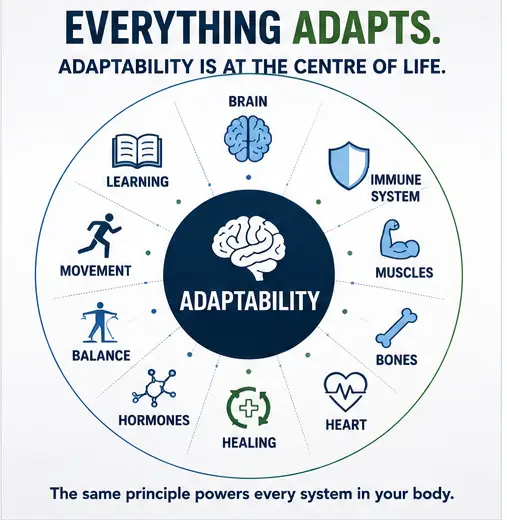
Health is not defined by any single one of these outcomes. It is the capacity that produces them all.
Health is the capacity to keep producing the right adaptation when conditions change.
This explains why two people can experience the same stress and have completely different outcomes. One person rises to the challenge… another falls in a heap.
The stress is not the whole story. What matters is the person’s capacity to adapt to it.
This is also the reason why we require a certain level of stress to thrive. Too little challenge and the body loses capacity. Too much and the system becomes overwhelmed.
But the right challenge, delivered at the right dose, gives the body a reason to become stronger, smarter and more resilient.
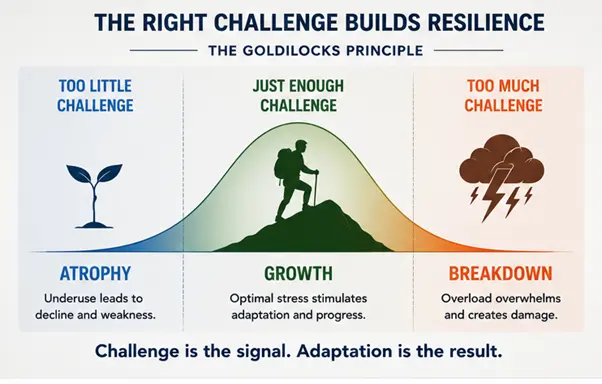
Over the past few weeks, I’ve shared my experiences walking over the cobbled streets of Italy and how that challenge impacted my whole body. We’ve discussed the importance of varied input (rather than simple repetition) for a healthy brain and nervous system.
This is why varied input matters.
It gives the nervous system something meaningful to solve. And solving problems is what the nervous system evolved to do, rather than atrophying due to boring, predictable, minimal-stimulation input.
At its core, it takes information from the environment, determines what that information means and produces the response most likely to keep you safe, capable and alive
That principle reaches far beyond muscles or movement. It is the central process behind learning, healing, resilience and evolution itself.
Darwin’s theory was never simply about survival of the strongest. It was survival of the fittest… those best able to adapt to the demands of their environment.
Over the next few weeks, we’ll explore what this definition changes.
Because if health really is adaptability, we need to rethink what weakens it, what strengthens it and how we measure it.
We’ll look at how different types of stress affect health, the actual neurological mechanisms that drive adaptability, how to optimise for maximum adaptability and the clinical framework that ties it all together into a practical, implementable system.
In a world changing at an unprecedented rate, with historic levels of stress, uncertainty and disruption occurring on almost every level, radical adaptability may be the most valuable attribute we could possibly develop.
The goal isn’t to create a life without challenge. The goal is to build human beings capable of adapting to it. Fortunately, we’re equipped with some powerful tools to do exactly that.
Cheers,

PS. Last week I offered some free 1-hour breakthrough calls (valued at $1000) to help you maximise the benefits of Better Balance Orthotics for your patients and your practice.
I still have 1 call available… if it has your name on it, send me an email with the subject line ADAPTABLE and let me know what you feel your biggest block or challenge is. We’ll break whatever is holding you or your team back and install the exact knowledge and mindset shifts needed to create dramatic results.