

I’ve adjusted more cervical disc lesions in the last week than I normally would in a month.
Over 100 of them.
And they’ve all been teaching me the same lesson.
If you’re a high-volume doc, that’s barely scratching the surface. But for an AK doc, that’s a lot of cervical discs in one week.
If you’ve been reading my newsletters for a while, you’ve been hearing these ideas…
That if you get the top and bottom of the system right…
Everything else tends to fall into place.
And that I’ve recently been studying Afferentology, a system founded by Dr. Simon King, which grew out of his many years as an AK diplomate.
Today I want to share what a profound impact that’s had on my clinical practice.
I’ve been in practice over 24 years now.
Over that time, I’ve learned a lot of things. And I’ve seen a lot of clinical trends come and go.
I remember a conversation about 10 years into practice where I caught up with my old college roommate.
I said to him…
“What I do now is nothing like what I did when we were in student clinic.”
He replied…
“That’s funny, because what I do now is exactly what I did in student clinic.”
There’s no right or wrong here… I know he’s helping lots of patients get well.
But doing the same old thing has never been my thing.
I’m always searching for the next thing that can improve the results I achieve with my patients. And every now and then I stumble across a new quantum leap.
Something that takes things to a whole other level that I never even knew existed before I discovered it.
Learning AK was like that for me.
Studying Integrative Neuro Immunology with Dr. Trent Banks and Dr. Trevor Chetcuti was another.
Learning Dr. Wally Schmitt’s Quintessential Applications Protocol was another.
The moment I really understood Better Balance Orthotics was in that category too.
The last few weeks I’ve added one more to the list… Afferentology (there’s no affiliate link here, Simon doesn’t even know I’m writing this email… I’m just sharing what I’ve found works.)
I first did Dr. Simon’s course about 10 years ago, and found it incredibly helpful… but at that point in my clinical journey, I wasn’t ready to fully grasp what he was offering.
I think now I am.
Simon uses a slightly different form of muscle testing that reveals a whole new layer of information through the nervous system.
It’s like putting on a pair of glasses that suddenly allows you to see in infrared and ultraviolet… it reveals a whole new layer of information that was always there… but you never previously had access to.
And the information revealed is fascinating.
There have been a number of take-aways, but my number one is this…
If you’re not fully sorting out your patients’ neck…
You’re missing a lot.
We know ADIO matters…
But this has brought it home to me at a whole other level.
I remember a few years ago hearing Dr. David Leaf saying that you can fix peripheral problems, but if you don’t sort them at the spinal level they’re just going to recur. He was right… but I think it goes even further.
I’ve seen so many lumbar problems this week that were really cervical problems masquerading as lumbar problems.
Spinal problems masquerading as peripheral problems.
Everything changes when you truly correct the neck.
(I’m sure you upper cervical guys are smacking your foreheads right now!)
I remember standing outside an Integrative Neuroimmunology seminar in Melbourne many years ago with Dr. Jeremy Thomas, waiting for an Uber to take us back to the airport. We’d just been through one of the most research-heavy, info-dense seminars we’d ever sat through (part of an 8-weekend program.)
The content was amazing. It completely changed my understanding of human health.
Both our minds were blown.
But it was a heavy lift. A huge amount to absorb.
He joked with me…
“What if the upper cervical guys were right… after all this, what if all we really need to do is get C1 right?”
We both knew he was (somewhat) joking… but now I really wonder how right he was.
Because my experience in the last few weeks has been that when you get the neck truly right…
Everything else in the body changes.
Massively.
Which makes sense- it’s the most proprioceptor-dense area of the entire body… even more so than the feet.
So you might be wondering…
Why is the “foot guy” talking to me about the neck?
It’s a fair question.
The answer is… this newsletter was never really about the foot. It’s about helping you become the best practitioner you can possibly be, and making the world a better place as a result. Improving feet was always just a high-leverage way of achieving that goal.
But here’s where it becomes relevant to the Foot-Brain Connection.
I’ve been observing this in clinic for weeks now (I’m 7 weeks into Dr. Simon’s 8-week course.) And I’ve observed that the neck problems his testing reveals are almost universal.
(Just like the fact that we wear shoes and walk on flat, unnatural surfaces… think there might be a connection?)
I’ve been reflecting deeply on why this is.
I think the biggest factor is that our cervical spine is uniquely vulnerable.
Our thoracic spine has a ribcage to protect it, and our lumbar spine is relatively short and grounded in the stable base of our pelvis.
But our cervical spine is just kinda hanging out there in space.
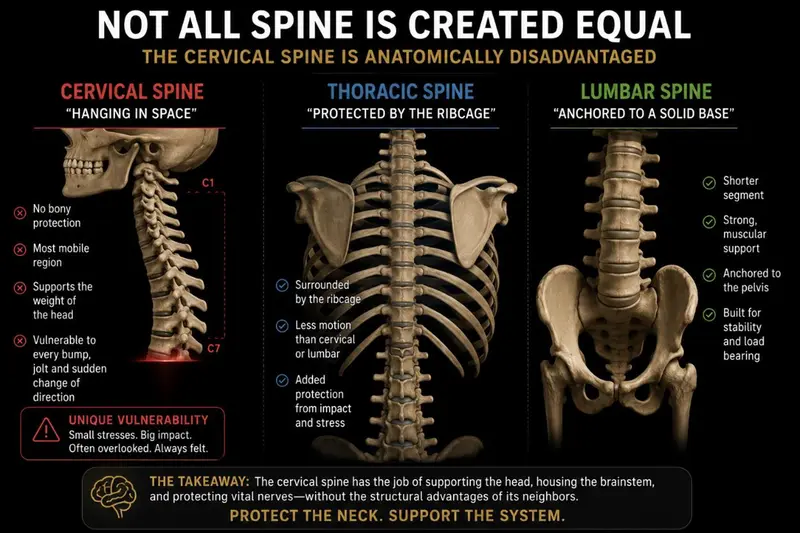
Vulnerable to every bump, jolt and sudden change of direction that we experience.
Every single one of us has experienced so many of these that we don’t even remember 99% of them.
Every time someone suddenly hit the brakes in the car.
Every time we tripped learning to walk (trust me, I have two kids, there were a lot of these!)
Every time we fell off our bike… or went go karting.
Every time we slept funny… or stepped wrong… or jumped around at a concert… or… you get the picture.
Our necks are anatomically disadvantaged… it’s the price we pay for being able to scan almost 360 degrees in our environment to detect potential threats.
That’s a huge evolutionary advantage… but it comes at a steep price. Ongoing, low grade, cumulative damage to our cervical spine. That’s why these neck issues are so common.
But it’s not the only factor.
One that I’m not going to delve into here, but we know matters, is our over-exposure to screens and head-forward activities.
We stare at screens all day. I’m sitting on a plane on my way to Italy for a UAC event right now. Everyone around me is staring at a screen. I’m staring at a keyboard.
We work at desks. We drive (at least for now… the robots are coming!) We hardly ever walk around staring at the sky (with our necks in extension.)
However, there’s a less widely-considered factor. And my research has led me to believe that it’s an even bigger factor than our screen time.
Because it existed even before screens became ubiquitous.
It shows up even in kids with tightly regulated screen time.
That factor is (you guessed it…)
Our feet.
I hate to sound like a broken record…
But it’s simply the truth.
As the arches in our feet dysfunction, it shifts our centre of gravity back onto our heels. This starts a chain-rection of compensation that begins with swaying our pelvis forward, and ends with chronic Forward Head Posture (FHP.)

And that FHP creates (or at least sets up the conditions to create) the anterior cervical lesions that ultimately cause the cervical disc lesions I’ve been adjusting all week.
Here’s the kicker though…
We know that if you keep adjusting the compensation pattern, without addressing the underlying cause….
You’ll be adjusting it again next week. Or next month. Or that patient will be going somewhere else looking for a lasting solution to their problem.
You can’t change their history of jolting their neck throughout their life.
But you can change what happens every time they stand, walk or run. And the implications for their neurology are huge.
I read a book a few years ago that had a massive impact on my life. The title of the book was “The One Thing.”
The central question that I took away from it was this…
“What’s the one thing I could do, such that if I did that everything else would become easier of unnecessary?”

This has been a powerful, guiding question for my life since reading that book. I promise you… if you ask yourself this question every day, your life will be different.
Exponentially better.
And when it comes it helping your patients, getting their neck right may be that one thing.
But there’s not just one thing.
Because as soon as you fix that one thing…
There’s a next thing. The cycle keeps repeating.
Getting that one thing right doesn’t mean everything is perfect. It just means that you’ve cleared out the biggest issue… and earned the right to move onto the next biggest issue…
Instead of just going around in circles, which is sadly where so many patients and practitioners get stuck.
When I had a conversation with Dr. Simon, he said his “one thing” hierarchy most commonly looked like this:
Get the neck right… then L4/5/S1… then the thoracolumbar and cervicothoracic junctions.
To which I added…
“My next thing is to get the feet right.”
In reply he mused…
“Yes that makes sense, you’re probably right.”
(Although in my clinical experience, getting the feet right comes before the TLJ or CTJ in terms of importance.)
So when it comes to getting your patients’ neck right… and everything that comes after that…
Better Balance Orthotics may be the next one thing.
I’m not suggesting they replace skilled, specific spinal corrections- those always come first (as long as you are adjusting primary issues, rather than layers of compensation patterns.)
But if you want those to hold, and not recur over time… you must take care of the one thing that keeps driving them to come back.
The neck may be the most important thing to correct…
But the feet may be the most important thing preventing that correction from holding.
Cheers,

PS. This newsletter has been almost like a confessional… a way for me to share my evolving clinical thinking with you week after week. This week is the latest instalment… my most up-to-date clinical thinking. In my mind it validates the ADIO paradigm of chiropractic… but also highlights the importance of the BUOI paradigm we have been exploring in these newsletters. ADIO corrects the command centre. BUOI improves the quality of information flowing into that command centre. The best results occur when both are working together. Let me know what you think… just send me an email at info@betterbalanceorthotics.com. I read every response.