

I really didn’t want to start Better Balance Orthotics.
I had neither the time, the money, nor the motivation.
In fact, when I got the call, I nearly turned it down cold. But sometimes life has a way of whispering to us that we need to do something… even when we don’t wantto.
This was one of those times.
But I’m getting ahead of myself.
When I was at university, in my final year of studying chiropractic, I met one of the most significant mentors in my life, Dr. Keith Keen.

He introduced me to Applied Kinesiology and had a huge impact on my thinking, my direction and my purpose in life. He was a total legend and without him I think the state of AK in Australia would be far different (and much worse.)
I remember Keith saying to me…
“If you’re ever going to use orthotics in your practice, the only ones you should use are Dr. Ed Butterworth’s.”
At that stage I was trying to get my head around learning chiropractic, learning AK, passing exams and entering practice. Orthotics weren’t even on my radar, despite my lifelong flat feet.
(If only I’d known then what I do now about the permanent damage I was doing… maybe I’d still have an L5 disc, functional hips and no metal wire holding in an abdominal hernia!)
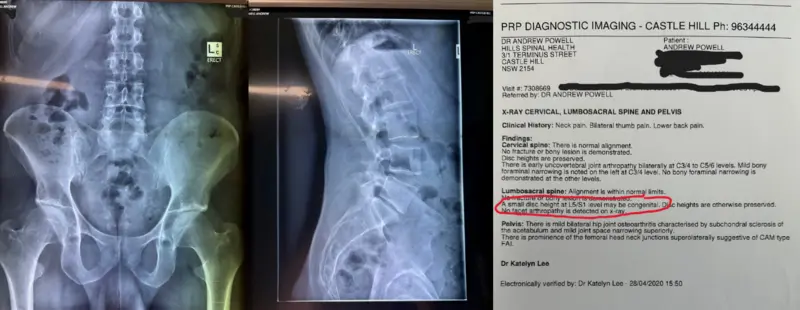
Over the next few years, as I settled into practice, the idea of orthotics came up again. I hadn’t forgotten what Keith told me… but I had no idea how to even find Dr. Ed Butterworth. So when a friend told me that a mate of his had started making orthotics, I thought I’d give them a go.
Back in those days we were using foam casting boxes to take a static mould of the feet. Although they never made any noticeable changes in my feet, I understood the theory that if we pushed the foot into subtalar neutral it should improve the alignment and function of the pelvis and spine.
At that time, I didn’t have any symptoms to alert me to the insidious degeneration that was occurring in my spine, my hips and my core. I was fit and healthy, in my mid 20s, and rock climbing almost every day.
I was always obsessed with creating better clinical outcomes, so over time I explored a few different orthotic companies. When I came across The Orthotic Group I was impressed with their scanning technology- rather than a foam box cast, or a static scan, they used a Gaitscanner- a sensor that the patient walked over, which recorded dynamic information about how their foot was working.
In theory this would produce a better orthotic.
It certainly produced pretty pictures, with big red spots showing where the force was poorly distributed in the feet, and how the centre of gravity was moving throughout the stance phase of gait.
So, I dutifully wore them and prescribed them to my patients. I even told them…
“These orthotics are only helping you while you’re standing on them, so you should wear them as often as possible.”
The theory all made sense…
But I wasn’t seeing the clinical results I wanted in practice.
Of course, that was hard to judge. Because I didn’t really have a way to objectively measure those results.
Some patients did experience less knee or back pain.
But I wasn’t measuring posture. I wasn’t measuring the vestibular system. I wasn’t taking thermal images. I wasn’t using photos to track visible changes in feet- arches, bunions, pronation. I wasn’t using functional neurological testing.
Just symptoms.
And over this time I was experiencing more frequent, more severe, and more prolonged episodes of lower back pain.
Still not enough to seriously get my attention. Initially just a couple of episodes a year.
But the progression was clear.
And all this time Dr. Keith’s words about orthotics were quietly ringing in the back of my mind.
So I decided it was time to track down Dr. Butterworth and find out more about his orthotics. The only way I could do that was to book as a patient in his clinic, which I did. I travelled over an hour to get there. It was probably the first time I’d seen a GP in over a decade.

I found Dr. Ed to be a charming and fascinating man. He was clearly passionate about the work he was doing helping patients with scoliosis through the unique orthotics he had developed. He showed me his collection of x-rays demonstrating clear improvements in scoliotic curves.
Most of these patients were not under chiropractic care. They had no other interventions apart from wearing his orthotics.
The results spoke for themselves.
He shared with me how his mission to help his own daughter, who suffered from severe scoliosis, had led him to investigate the discipline of Posturology. This was a small group of researchers and practitioners in France and Italy who were working on improving posture through targeted stimulation of the feet.
After his daughter’s failed Harrington Rod surgery, there was really nothing else the medical world had to offer her. This drove him to look further afield. At that time (in the late 1990s) it was basically unheard of for a medical doctor to be using muscle testing, let alone consorting with chiropractors and working on the spine via the feet.
He also told me his theory- that the primary mechanism of action of the orthotics was through influencing the fascia. Again, this was something I hadn’t heard anyone else talking about at that time.
He truly was a man ahead of his time.
I left his clinic impressed with his orthotics, and committed to trying them myself. I was also committed to implementing them in my clinic if the results stacked up.
They did.
To the point where my $15,000 Gaitscanner ended up gathering dust in my garage rather than being utilised in my clinic (it’s still there to this day.)
Which really says something.
Because they weren’t really easy, convenient, or sexy to use.
With the Gaitscanner, patients got to walk over an impressive-looking piece of technology, then received a multi-page colour report. On our end, we simply emailed it through to The Orthotic Group and received back a pair of orthotics, branded with our logo and ready to go.
With Ed’s orthotics there was no fancy tech or impressive report.
There was no professional-looking packaging.
The orthotics came blank and non-customised. They then had to be hand-filled by one of my team members. It was a messy, laborious, inefficient process.
My team really didn’t like filling them.
To be totally honest, it was a pain in the ass!
But they did have 2 things going for them.
And those 2 things outweighed every other consideration.
The first thing was results.
They worked.
They created both immediate and long term structural and neurological changes.
Symptoms improved… but it was much more than that. Posture improved. Balance improved. Bunions straightened. Arches lifted. Range of motion, pain, restriction, fatigue… all changed.
In my world nothing beats results.
I often tell my patients…
“Don’t judge the process… judge the results.”
The other thing they had going for them was alignment.
Philosophical alignment.
Paradigm alignment.
We were no longer propping up dysfunctional feet with a mechanical crutch.
We were optimising and rehabilitating the nervous system through a sensory input that created measurable, repeatable, long-term changes in structure and function.
At that time, I hadn’t yet coined the phrase “The Stimulation vs Support Paradigm…”
But I knew this approach was a much better fit for chiropractic… Philosophically, Ethically and Practically.
My gaitscanner never stood a chance!
However, not all these understandings crystalised immediately. It was a process that unfolded over years of observing results and tracking changes.
When I got the call from Dr. Ed, suggesting I buy his company, I was still largely using his orthotics for scoliosis. With a few knee, hip, plantar fasciitis and back pain patients thrown in.
At that time, I still thought we were treating various physical conditions, rather than addressing a universal environmental stress that humans never evolved to deal with (wearing shoes and walking on flat surfaces.)
Ed said to me…
“Andrew, I’m in my 80s and I’m ready to slow down. I know I have something here that will change the world… but I’ve just never had the time outside my medical practice to make it happen. I think you might be the person who can do that.”
(He knew that I’d previously run a coaching company called Chiro Practice Academy and had some idea about business and marketing.)
My first thought was…
“What makes you think I have any more time than you?”
The truth was, I didn’t.
I had a busy practice, young children and a full life.
But even then, I already knew that nothing else like this existed in the world, and that it would be a loss to the world if it disappeared.
And so Better Balance Orthotics was born.
It wasn’t an ideal transition.
The plan was for Ed to retire from medical practice and devote his time to sharing his orthotics with the world. Then one day I rang to speak to him. His wife answered the phone and said through her tears…
“He’s gone.”
Dr. Ed passed away before he ever got to see his vison come to fruition. I like to think he’s looking down and smiling when he sees what we’re doing with what he gave us.
For the first year we spent our time overhauling everything that was difficult or inconvenient about the business… which was basically everything.
We updated the branding. The packaging. The messaging. The physical testing and prescription process. The ordering process. The science.
The only thing we didn’t touch was the product.
It was already working amazingly.
To this day, with everything I’ve learned, I haven’t found a way to improve on Ed’s design.
(The other aspect we went all in on was understanding the research and the paradigm. I’ve spent years digging into the mechanisms behind why these orthotics produce the results they do. My mind has been repeatedly blown… their impact and importance is so much bigger than I ever imagined. The Foot-Brain Connection is a direct result of that journey.)
Our goal was to streamline every aspect of the process. To make it as frictionless as possible, both for docs and patients.
Ultimately, to get this unique technology on as many people’s feet as possible.
Because let’s face it… if you live in the modern world, life is better when you wear Better Balance Orthotics.
That meant making a whole bunch of changes.
It meant bringing the customising and hand-filling back in-house… and I mean literally in our house! No more messy, laborious customising orthotics your clinic. Now all the magic happens right here:

Every pair is hand-filled by one of our local employees.
They include neighbours, members of our local rugby team, local single Mums and teenagers from our local Steiner school… the people we trust to come and go in our house, whether we’re there or not.
It’s truly a community effort that goes into every pair of hand-customised orthotics that end up in your clinic!
Those little snips in the bottom of every pair… they’re not a defect, there where each pair is hand-customised. Even the filler material that goes into each pocket is hand-produced!
I share this with you for a couple of reasons.
One is to honour the people who have been instrumental in creating the results that you and I get to see in our clinics every day. We are building on their legacy… truly standing on the shoulders of giants.
The other is to share with you the value, care and genuine craftsmanship that goes into every single pair. You are not prescribing your patients some mass-produced, made-in-China, undifferentiated piece of crap.
You are prescribing a simple-but-powerful, life-changing piece of technology with a real, innovative human history and a production process that supports local families and communities. It creates great results… and you can also feel good about where it came from.
There’s so much more I could tell you about our unique production process… including the lady who has retooled her entire embroidery factory to produce Better Balance Orthotics with us… and who has agreed to take her first trip to Central America to train our team when we start production down there…
But that’s a story for another day.
For now, I just want to thank you for being part of our story.
Have a great week.
Cheers,
